

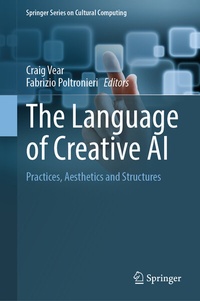
The Language of Creative AI
Description

This book builds on the discourse of AI and creativity and extends the notion of embedded and co-operative creativity with intelligent software. It does so through a human-centred approach in which AI is empowered to make the human experience more creative. It presents ways-of-thinking and doing by the creators themselves so as to add to the ongoing discussion of AI and creativity at a time when the field needs to expand its thinking. This will avoid over-academization of this emerging field, and help counter engrained prejudice and bias.
The Language of Creative AI
contains technical descriptions, theoretical frameworks, philosophical concepts and practice-based case studies. It is a compendium of thinking around creative AI for technologists, human-computer interaction researchers and artists who are wishing to explore the creative potential of AI.
More details
Other editions
Additional editions
Persons
Fabrizio Augusto Poltronieri is a computer artist, researcher, and curator interested in the relationships between Art, Digital Media, Design, and Technology. His expertise is in developing creative coding and its exchanges with philosophical questions. He is an Associate Professor in Creative Technologies at IOCT (Institute of Creative Technologies), De Montfort University. He holds a PhD in Semiotics from the Pontifical Catholic University of São Paulo (PUC/SP), Brazil. In 2011-2012, he was awarded a fellowship to develop a Postdoctoral research project on the early days of computer art at the Royal College of Art in London. One of the outcomes of this research was a major exhibition with four pioneer computer artists. This exhibition, entitled 'Primary Codes', took place in Rio de Janeiro, Brazil, in 2015. His second Postdoctoral research, at Leuphana Universität's Gamification Lab, in Lüneburg, Germany, was on how the universe of video games, the notions of gamification, and post-history affect the production of language mediated by digital apparatuses. He has been exhibiting his artworks around the globe. His work is part of important collections, such as the Victoria and Albert Museum in London. In 2021, Fabrizio was one of the artists representing the UK in the World Expo Dubai with an AI artwork.
