

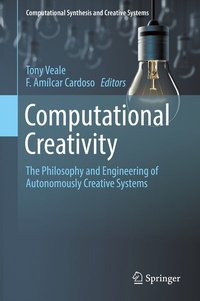
Computational Creativity
Description

Computational creativity is an emerging field of research within AI that focuses on the capacity of machines to both generate and evaluate novel outputs that would, if produced by a human, be considered creative. This book is intended to be a canonical text for this new discipline, through which researchers and students can absorb the philosophy of the field and learn its methods. After a comprehensive introduction to the idea of systematizing creativity the contributions address topics such as autonomous intentionality, conceptual blending, literature mining, computational design, models of novelty, evaluating progress in related research, computer-supported human creativity and human-supported computer creativity, common-sense knowledge, and models of social creativity.
Products of this research will have real consequences for the worlds of entertainment, culture, science, education, design, and art, in addition to artificial intelligence, and the book will be of value to practitioners and students in all these domains.
More details
Other editions
Additional editions
Persons
F. Amílcar Cardoso received his Ph.D. in Engineering Sciences and his habilitation in Informatics Engineering, both from the University of Coimbra, where he is a full professor and teaches Artificial Intelligence, Cognitive Modeling, Computational Creativity, Sound Design, and Computer Programming for Design. He did pioneering work on Computational Creativity in the 1990s as leader of the team that authored several creative systems (e.g., SICOM, NEvAr, MuzaCazUza), and he has since assumed an active role in the area, as cofounder of the series of Creative Systems Workshops in 2001-2006, of the Intl. Joint Workshop on Computational Creativity (2007-2008), of the Intl. Conf. on Computational Creativity in 2010, and of the Association for Computational Creativity in 2017. He has been involved in two EU projects on Computational Creativity: PROSECCO (Promoting the Scientific Exploration of Computational Creativity) and ConCreTe (Concept Creation Technology). He was the General Chair of the 7th Intl. Conf. on Computational Creativity, held in Paris, France, June 2016. In recent years, his research has mainly focused on computational models of Conceptual Blending. His current interests also include bioinspired approaches to visual and auditory expression, data sonification, and interactive environments for sound and image.
