

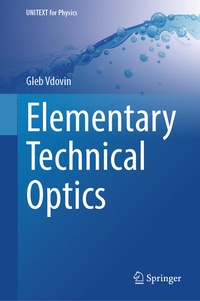
Elementary Technical Optics
Description

This book provides an accessible and comprehensive introduction to technical optics, suitable for matching the graduate-level curriculum of any related physics and engineering discipline. It addresses the varying foundational knowledge of physical optics among students by incorporating a brief overview of the fundamental principles most commonly applied in the design and implementation of optical systems, focusing on a concise set of core concepts.
This book assumes a basic understanding of physics and calculus. In some instances, formal rigor is relaxed to ensure simplicity and clarity, making the material accessible for engineering estimations without delving into unnecessary complexities. It introduces many basic concepts of technical optics, illustrated by practical problem solutions, providing real-world relevance.
Covering a broad range of topics, the content includes geometrical, wave, and quantum optics, spherical wavefronts, lens equations, and magnification. Additionally, it discusses invariants and imaging, optical systems, aberrations, coherence of light, polarized light applications, optical testing, radiometry, light sources, sensors, lasers, spectral systems, waveguides, wavefront correctors, and light propagation simulation.
A distinctive feature of this book is its description of a wide range of engineering systems using a compact, uniform set of basic concepts. Practical information is included throughout, making the book valuable for everyday practice in optical imaging and instrumentation, and ensuring it is an essential resource for students and professionals in the field of optical engineering.
More details
Other editions
Additional editions
Person
Dr. Gleb Vdovin has received his master's degree in Optical Engineering in 1986 from the Leningrad Institute of Fine Mechanics and Optics (USSR), and his Ph.D. from Delft University of Technology in the Netherlands, with thesis "Adaptive mirror micromachined in silicon," in 1996. He is the founder of OKO Technologies, company that develops and produces adaptive optical components and systems since 1997. In 1997, he received Rudolph Kingslake Medal and Prize form SPIE. Some work published by Dr. G. Vdovin received citation index of higher than 100.
Content
Faces of Optics.- Wavefronts, Rays, Imaging.- Invariants and Matrices.- Aberrations of Optical Systems.- Introduction to Optical Instruments.- Applications of Coherent Light.- Applications of Polarized Light.- Optical Testing.- Radiometry, Light Sources and Sensors.- Introduction to Lasers.- Introduction to Spectral Instruments.- Introduction to Optics of Waveguides.- Adaptive Optics.- Simulation of the Propagation of Light.
