

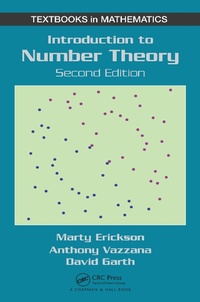
Introduction to Number Theory
2nd Edition
Published on 18. November 2015
426 pages
978-1-4987-1752-6 (ISBN)
Description

Introduction to Number Theory is a classroom-tested, student-friendly text that covers a diverse array of number theory topics, from the ancient Euclidean algorithm for finding the greatest common divisor of two integers to recent developments such as cryptography, the theory of elliptic curves, and the negative solution of Hilbert's tenth problem.
Reviews / Votes
Praise for the Previous Edition"The authors succeed in presenting the topics of number theory in a very easy and natural way, and the presence of interesting anecdotes, applications, and recent problems alongside the obvious mathematical rigor makes the book even more appealing. ... a valid and flexible textbook for any undergraduate number theory course."
-International Association for Cryptologic Research Book Reviews, May 2011
"... a welcome addition to the stable of elementary number theory works for all good undergraduate libraries."
-J. McCleary, Vassar College, Poughkeepsie, New York, USA, from CHOICE, Vol. 46, No. 1, August 2009
"... a reader-friendly text. ... provides all of the tools to achieve a solid foundation in number theory."
-L'Enseignement Mathematique, Vol. 54, No. 2, 2008
The theory of numbers is a core subject of mathematics. The authors have written a solid update to the first edition (CH, Aug'09, 46-6857) of this classic topic. There is no shortage of introductions to number theory, and this book does not offer significantly different information. Nonetheless, the authors manage to give the subject a fresh, new feel. The writing style is simple, clear, and easy to follow for standard readers. The book contains all the essential topics of a first-semester course and enough advanced topics to fill a second. In particular, it includes several modern aspects of number theory, which are often ignored in other texts, such as the use of factoring in computer security, searching for large prime numbers, and connections to other branches of mathematics. Each section contains supplementary homework exercises of various difficulties, a crucial ingredient of any good textbook. Finally, much emphasis is placed on calculating with computers, a staple of modern number theory. Overall, this title should be considered by any student or professor seeking an excellent text on the subject.
--A. Misseldine, Southern Utah University, Choice magazine 2016
More details
Series
Edition
2nd edition
Language
English
Place of publication
Philadelphia, PA
United States
Publishing group
Taylor & Francis Inc
Target group
College/higher education
Instructors and students in undergraduate number theory courses. It would also be useful to independent students of this topic.
Edition type
Revised edition
Product notice
Reflowable
Illustrations
23 s/w Abbildungen, 8 s/w Tabellen
23 b/w images and 8 tables
ISBN-13
978-1-4987-1752-6 (9781498717526)
Copyright in bibliographic data and cover images is held by Nielsen Book Services Limited or by the publishers or by their respective licensors: all rights reserved.
Schweitzer Classification
Other editions
Additional editions
Anthony Vazzana | David Garth
Introduction to Number Theory
Book
10/2024
2nd Edition
Chapman & Hall/CRC
€74.50
Shipment within 10-20 days
Anthony Vazzana | David Garth
Introduction to Number Theory
Book
12/2015
2nd Edition
Chapman & Hall/CRC
€157.00
Shipment within 15-20 days
Persons
Martin Erickson (1963-2013) received his Ph.D in mathematics in 1987 from the University of Michigan, Ann Arbor, USA, studying with Thomas Frederick Storer. He joined the faculty in the Mathematics Department of Truman State University, Kirksville, Missouri, USA, when he was twenty-four years old, and remained there for the rest of his life. Professor Erickson authored and coauthored several mathematics books, including the first edition of Introduction to Number Theory (CRC Press, 2007), Pearls of Discrete Mathematics (CRC Press, 2010), and A Student's Guide to the Study, Practice, and Tools of Modern Mathematics (CRC Press, 2010).
Anthony Vazzana received his Ph.D in mathematics in 1998 from the University of Michigan, Ann Arbor, USA. He joined the faculty in the Mathematics Department of Truman State University, Kirksville, Missouri, USA, in 1998. In 2000, he was awarded the Governor's Award for Excellence in Teaching and was selected as the Educator of the Year. In 2002, he was named the Missouri Professor of the Year by the Carnegie Foundation for the Advancement of Teaching and the Council for Advancement and Support of Education.
David Garth received his Ph.D in mathematics in 2000 from Kansas State University, Manhattan, USA. He joined the faculty in the Mathematics Department of Truman State University, Kirksville, Missouri, USA, in 2000. In 2005, he was awarded the Golden Apple Award from Truman State University's Theta Kappa chapter of the Order of Omega. His areas of research include analytic and algebraic number theory, especially Pisot numbers and their generalizations, and Diophantine approximation.
Anthony Vazzana received his Ph.D in mathematics in 1998 from the University of Michigan, Ann Arbor, USA. He joined the faculty in the Mathematics Department of Truman State University, Kirksville, Missouri, USA, in 1998. In 2000, he was awarded the Governor's Award for Excellence in Teaching and was selected as the Educator of the Year. In 2002, he was named the Missouri Professor of the Year by the Carnegie Foundation for the Advancement of Teaching and the Council for Advancement and Support of Education.
David Garth received his Ph.D in mathematics in 2000 from Kansas State University, Manhattan, USA. He joined the faculty in the Mathematics Department of Truman State University, Kirksville, Missouri, USA, in 2000. In 2005, he was awarded the Golden Apple Award from Truman State University's Theta Kappa chapter of the Order of Omega. His areas of research include analytic and algebraic number theory, especially Pisot numbers and their generalizations, and Diophantine approximation.
Content
Introduction. Divisibility. Greatest Common Divisor. Primes. Congruences. Special Congruences. Primitive Roots. Cryptography. Quadratic Residues. Applications of Quadratic Residues. Sums of Squares. Further Topics in Diophantine Equations. Continued Fractions. Continued Fraction Expansions of Quadratic Irrationals. Arithmetic Functions. Large Primes. Analytic Number Theory. Elliptic Curves.
