

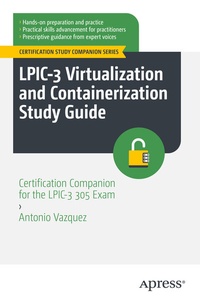
LPIC-3 Virtualization and Containerization Study Guide
Description

Get up to speed on the key topics required for the Linux Professional Institute's LPIC-3 305 exam, the third in the four-part LPIC-3 certification, which covers virtualization and containerization. The wider LPIC-3 certification helps developers and system administrators become experts in a given context of Linux and Open Source solutions.
This study companion is designed to sit alongside your studies and certification guides as you prepare for the exam and will take you through the three main areas of Full Virtualization, Container Virtualization as well as VM Deployment and Provisioning. We will undertake a deep dive of all the major topics, from the basics of virtualizations and containers to in-depth breakdown of virtualization solutions like KVN, Xen and Proxmox as well as popular containers like Docker, Kubernetes, Openstack, Terraform, Packer, Vagrant and others with key concepts covered on the exam called out and applied in each chapter of this book, giving you both practice and reinforcement, a far more effective learning tool than rote learning or similar approaches typically enlisted in exam preparation.
LPIC-3 Virtualization and Containerization Study Guid e will give you the guidance and support as you take the next exciting step in supercharging your Linux skills and knowledge to take the next step in your professional career.
You Will:
- Gain a clear picture about the different types of virtualization in use today.
- Understand how to work with virtualization solutions like KVM and Xen, and manage them using the libvirt API.
- Become aware of the use of fully enterprise-ready virtualization solutions like Proxmox.
- Learn the technologies that make Open Source virtualization, possible
This is for:
Developers and more seasoned Linux SysAdmins who are working towards the LPIC-3 certification. It would be expected that readers will meet the requirements of taking the exam which includes having passed the LPIC-2 certification. However, this guide will also be of use to Linux professionals who are not currently pursuing certification but wish to expand and refresh their Linux skills in relation to virtualization and containerization.
More details
Other editions
Additional editions
Person
Antonio Vazquez is a Senior Linux System Adminsitator with over 20 years of experience in the IT fieid. As an avid champion of FOSS, he has been using Linux for dacades, hold many professional certifications inlcuding the LPIC-3 certification as well as non Linux related topics including cloud and security.
Antonio is also a trainer who teaches students to get LPI certified, and also write books in his spare time.
Content
Chapter 1.Virtualization concepts and theory.- Chapter 2.QEMU.- Chapter 3.Xen..- Chapter 4.Libvirt Virtual Machine Management.- Chapter 5.Virtual Machine Disk Image Management.- Chapter 6.Proxmox, vSwitch and other tools.- Chapter 7.Container virtualization concepts.- Chapter 8.Linux Containers (LXC).- Chapter 9.Docker.- Chapter 10.Container orchestration platforms.- Chapter 11.Podman and other container related tools.- Chapter 12.Cloud management tools.- Chapter 13.Packer.- Chapter 14.Cloud-init.- Chapter 15.Vagrant.
