

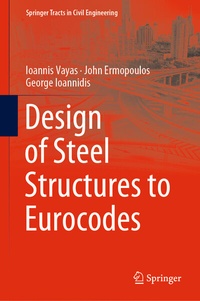
Design of Steel Structures to Eurocodes
Description

This textbook describes the rules for the design of steel and composite building structures according to Eurocodes, covering the structure as a whole, as well as the design of individual structural components and connections. It addresses the following topics: the basis of design in the Eurocodes framework; the loads applied to building structures; the load combinations for the various limit states of design and the main steel properties and steel fabrication methods; the models and methods of structural analysis in combination with the structural imperfections and the cross-section classification according to compactness; the cross-section resistances when subjected to axial and shear forces, bending or torsional moments and to combinations of the above; component design and more specifically the design of components sensitive to instability phenomena, such as flexural, torsional and lateral-torsional buckling (a section is devoted to composite beams); the design of connections andjoints executed by bolting or welding, including beam to column connections in frame structures; and alternative configurations to be considered during the conceptual design phase for various types of single or multi-storey buildings, and the design of crane supporting beams. In addition, the fabrication and erection procedures, as well as the related quality requirements and the quality control methods are extensively discussed (including the procedures for bolting, welding and surface protection). The book is supplemented by more than fifty numerical examples that explain in detail the appropriate procedures to deal with each particular problem in the design of steel structures in accordance with Eurocodes. The book is an ideal learning resource for students of structural engineering, as well as a valuable reference for practicing engineers who perform designs on basis of Eurocodes.
More details
Other editions
Additional editions
Persons
Ioannis Vayas is professor and director of the Institute of Steel Structures at the National Technical University of Athens, Greece. He has been involved in research, national and European codification, and consultancy on steel structures for over 40 years.
John Ermopoulos is professor emeritus and former director of the Institute of Steel Structures at the National Technical University of Athens, Greece. He is author of numerous publications in international journals and conferences. He has been involved in European research projects and in Technical Committees regarding steel. For many years he was consultant in various public and private technical projects.
George J. Ioannidis is professor emeritus of the National Technical University of Athens, Greece, where he was teaching the courses of steel structures for many years. He is the structural designer of numerous buildings and other civil engineering structures made from steel or reinforcedconcrete.
