

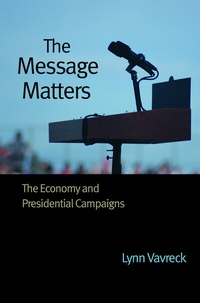
The Message Matters
The Economy and Presidential Campaigns
1st Edition
Published on 16. June 2015
232 pages
978-1-4008-3048-0 (ISBN)
Description

The economy is so powerful in determining the results of U.S. presidential elections that political scientists can predict winners and losers with amazing accuracy long before the campaigns start. But if it is true that "it's the economy, Stupid," why do incumbents in good economies sometimes lose? The reason, Lynn Vavreck argues, is that what matters is not just the state of the economy but how candidates react to it. By demonstrating more precisely than ever before how candidates and their campaigns affect the economic vote, The Message Matters provides a powerful new way of understanding past elections--and predicting future ones.
Vavreck examines the past sixty years of presidential elections and offers a new theory of campaigns that explains why electoral victory requires more than simply being the candidate favored by prevailing economic conditions. Using data from presidential elections since 1952, she reveals why, when, and how campaign messages make a difference--and when they can outweigh economic predictors of election outcomes.
The Message Matters does more than show why candidates favored by the economy must build their campaigns around economic messages. Vavreck's theory also explains why candidates disadvantaged by the economy must try to focus their elections on noneconomic issues that meet exacting criteria--and why this is so hard to do.
Vavreck examines the past sixty years of presidential elections and offers a new theory of campaigns that explains why electoral victory requires more than simply being the candidate favored by prevailing economic conditions. Using data from presidential elections since 1952, she reveals why, when, and how campaign messages make a difference--and when they can outweigh economic predictors of election outcomes.
The Message Matters does more than show why candidates favored by the economy must build their campaigns around economic messages. Vavreck's theory also explains why candidates disadvantaged by the economy must try to focus their elections on noneconomic issues that meet exacting criteria--and why this is so hard to do.
More details
Edition
Course Book
Language
English
Place of publication
Princeton, NJ
United States
Publishing group
De Gruyter
Target group
Professional and scholarly
Edition type
Digital original
Product notice
Reflowable
Illustrations
28 line illus. 39 tables.
File size
0,84 MB
ISBN-13
978-1-4008-3048-0 (9781400830480)
Schweitzer Classification
Other editions
Additional editions
Book
07/2009
Princeton University Press
€71.80
Article exhausted; check different version
Book
07/2009
Princeton University Press
€46.00
Shipment within 10-20 days
Person
Lynn Vavreck is associate professor of political science at the University of California, Los Angeles. She is coeditor of Campaign Reform: Insights and Evidence and coprincipal investigator of the Cooperative Campaign Analysis Project.
Content
List of Figures xi
List of Tables xiii
Acknowledgments xvii
Prologue xxi
CHAPTER ONE: Presidential Campaigns 1
Basic Questions 2
What's Coming 3
PART I
CHAPTER TWO: How and Why Campaigns Matter 9
The Challenge 10
Something's Happening in America 11
The Importance of the Economy 12
The Importance of the Media 14
A Theory of Campaign Effects 15
Integrating Literatures 16
Spatial Voting: The Past as Predictor of the Future 18
Retrospective Voting and Campaign Effects 22
Individual-Level Characteristics and Campaign Effects 23
CHAPTER THREE: Context Matters: A Campaign Typology 26
Theoretical Predictions 28
A Campaign Typology 31
Clarifying Campaigns 31
Insurgent Campaigns 32
When the Economy Is Mixed 33
Predicting Campaign Types, 1952-2000 35
PART II
CHAPTER FOUR: The Media Disconnect:Media and Candidate Messages 43
Candidates' Messages and How to Measure Them 46
Advertisements and Speeches 46
Newspaper Coverage 48
Coding the Ads, Speeches, and News Coverage 53
The Content of Modern Campaigns 57
The Media Disconnect 58
CHAPTER FIVE: The Message Matters: Candidate-Level Tests of the Theory 67
Clarifying Campaigns: Dominating Economic Discussion 69
Insurgent Campaigns: Issue Selection Matters 71
Stevenson 1952 and 1956: Second Time Same as the First 76
Goldwater 1964: Just Enough Power to Get the Job Done 78
Carter 1980 and Mondale 1984:War through Strength 80
Dukakis 1988: An Unfocused American Dream 82
Insurgent Candidates Making Wise Choices 83
Kennedy 1960: High Hopes 83
Nixon 1968: Freedom from Fear or Racial Appeal? 86
Carter 1976: Outside and Honest 90
Two More Tests of the Theory at the Candidate Level 105
A More Rigorous Test of Compliance 105
Explaining the Errors in Forecasting Models 107
PART III
CHAPTER SIX: The Message Matters:Microlevel Tests of the Theory 113
Clarifying Candidate Campaign Effects: Do Campaign Messages Shape Voters' Evaluations of Candidates? 115
High Fidelity? 116
Ads:Messages That Matter 120
Clarifying Candidate Campaign Effects: Do Campaign Messages Help Voters Learn about Candidates' Issue Positions? 123
Measuring Uncertainty 125
Reducing Uncertainty 128
Campaign Learning about the Economy 131
Insurgent-Candidate Campaign Effects: Changing the Debate by Increasing the Importance of Issues 134
The Most Important Problem in the Nation 137
Most Important Problem and Vote Choice 140
Insurgent Candidate Campaign Effects: Being Closer to Most Voters on the Insurgent Issue 144
The Difference in Distances 144
Differences in Distances and Vote Choice 151
The Message and Its Effects 155
CHAPTER SEVEN: Candidates Creating Context 159
Can Candidates Create the Context? 160
Creating Salience: Finding the Right Insurgent Issue 163
Appendix 167
References 191
Index 199
List of Tables xiii
Acknowledgments xvii
Prologue xxi
CHAPTER ONE: Presidential Campaigns 1
Basic Questions 2
What's Coming 3
PART I
CHAPTER TWO: How and Why Campaigns Matter 9
The Challenge 10
Something's Happening in America 11
The Importance of the Economy 12
The Importance of the Media 14
A Theory of Campaign Effects 15
Integrating Literatures 16
Spatial Voting: The Past as Predictor of the Future 18
Retrospective Voting and Campaign Effects 22
Individual-Level Characteristics and Campaign Effects 23
CHAPTER THREE: Context Matters: A Campaign Typology 26
Theoretical Predictions 28
A Campaign Typology 31
Clarifying Campaigns 31
Insurgent Campaigns 32
When the Economy Is Mixed 33
Predicting Campaign Types, 1952-2000 35
PART II
CHAPTER FOUR: The Media Disconnect:Media and Candidate Messages 43
Candidates' Messages and How to Measure Them 46
Advertisements and Speeches 46
Newspaper Coverage 48
Coding the Ads, Speeches, and News Coverage 53
The Content of Modern Campaigns 57
The Media Disconnect 58
CHAPTER FIVE: The Message Matters: Candidate-Level Tests of the Theory 67
Clarifying Campaigns: Dominating Economic Discussion 69
Insurgent Campaigns: Issue Selection Matters 71
Stevenson 1952 and 1956: Second Time Same as the First 76
Goldwater 1964: Just Enough Power to Get the Job Done 78
Carter 1980 and Mondale 1984:War through Strength 80
Dukakis 1988: An Unfocused American Dream 82
Insurgent Candidates Making Wise Choices 83
Kennedy 1960: High Hopes 83
Nixon 1968: Freedom from Fear or Racial Appeal? 86
Carter 1976: Outside and Honest 90
Two More Tests of the Theory at the Candidate Level 105
A More Rigorous Test of Compliance 105
Explaining the Errors in Forecasting Models 107
PART III
CHAPTER SIX: The Message Matters:Microlevel Tests of the Theory 113
Clarifying Candidate Campaign Effects: Do Campaign Messages Shape Voters' Evaluations of Candidates? 115
High Fidelity? 116
Ads:Messages That Matter 120
Clarifying Candidate Campaign Effects: Do Campaign Messages Help Voters Learn about Candidates' Issue Positions? 123
Measuring Uncertainty 125
Reducing Uncertainty 128
Campaign Learning about the Economy 131
Insurgent-Candidate Campaign Effects: Changing the Debate by Increasing the Importance of Issues 134
The Most Important Problem in the Nation 137
Most Important Problem and Vote Choice 140
Insurgent Candidate Campaign Effects: Being Closer to Most Voters on the Insurgent Issue 144
The Difference in Distances 144
Differences in Distances and Vote Choice 151
The Message and Its Effects 155
CHAPTER SEVEN: Candidates Creating Context 159
Can Candidates Create the Context? 160
Creating Salience: Finding the Right Insurgent Issue 163
Appendix 167
References 191
Index 199
