

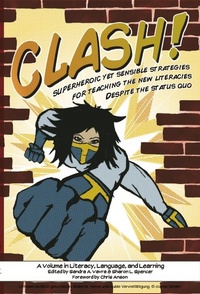
CLASH!
Superheroic Yet Sensible Strategies for Teaching the New Literacies Despite the Status Quo
1st Edition
Published on 1. September 2011
313 pages
978-1-61735-519-6 (ISBN)
Description

This book offers ideas that secondary teachers, university content faculty, and teacher educators can use to challenge traditional literacy practices and demonstrate creative, innovative ways of incorporating new literacies into the classroom, all within a strong theoretical framework. Teachers are trying to catch up to the new challenges of the twenty-first century. It is a superheroic feat that must be achieved if education is to stay relevant and viable. There is a lot of zip, bam, whap, and wow in the fast-paced, social networking, technological world, but not so much in the often laboriously slow-paced educational world. Where is the balance? How do teachers and students learn together, since one group has seasoned wisdom with limited technological know-how and the other uses all the cool new tools, but not in the service of learning? These are some important issues to consider in finding the balance in an unstable, fast-moving, ever-changing world.
This book is practical and useful to literacy teachers, teacher educators, and university faculty by bringing together the expertise of composition/rhetoric researchers and writers, literacy specialists, technology specialists, and teachers who are on the cutting edge of new literacies.
All prices
More details
Other editions
Additional editions

Sandra A. Vavra | Sharon L. Spencer
Clash!
Superheroic Yet Sensible Strategies for Teaching the New Literacies Despite the Status Quo
Book
08/2011
Information Age Publishing
€70.80
Article not available at the moment
Content
- Intro
- CLASH!
- Superheroic Yet Sensible Strategies for Teaching the New Literacies Despite the Status Quo
- A volume in
- Literacy, Language, and Learning
- Series Editor: Patricia Ruggiano Schmidt, Le Moyne College
- CONTENTS
- Part I: Batman Begins, Simply
- 1. The Cold, Hard Cash of Truth About Literacy in the Twenty-First Century
- 2. "And Now . A Word From Our Students": Creating Better Writers and Thinkers by Having Students Study, Write and Film TV Commercials
- 3. Superheroic Resourcefulness: Expanding Literacy and Engagement Through YouTube
- Part II: The Force is with Reluctant New Media Adopters
- 4. Popular Culture as a Sponsor of Literacy: Confronting the CLASH! BOOM! POW! in the Basic Writing Classroom
- 5. Making Messes and Meaning With Wikis and Blogs
- 6. "Are You Now or Have You Ever Been?" Teaching "Writerly" Confidence, Media Literacy, and Historical, Civic, and Cultural Awareness With This I Believe
- Part III: Bringing an X-Mentality to the Everyday Classroom
- 7. Teaching Poetry in a Freestyle World: A Pedagogy for the Unimpressed
- 8. Capitalizing on Digital Literacy: Visual Rhetoric, the Graphic Novel, and Academic Identity
- 9. Unraveling the Riddler: New Media, Technology, and Literacies in Exploring Heroes and Superheroes
- 10. Changing the World, One Zip Code at a Time
- 11. New Media as Instructional Supports in Inclusive Classrooms
- part iv: From Indiana Jones to Buzz Lightyear: Moving Literacy from the Temple of Memory to Infinity and Beyond
- 12. Taking Risks and (Re)defining Expertise: Facilitating the Move From Consumption to Production in the Use of Digital Media
- 13. Composing Digitally and Learning Languages: Using Linguistic Models of Competency to Teach Multimedia Assignments
- 14. Remembering: The Past and the Future
- 15. Grappling with the Infonauts: Archival Literacy and the Fight for Memory
- Literacy, Language, and Learning
- CLASH!
- Superheroic Yet Sensible Strategies for Teaching the New Literacies Despite the Status Quo
- edited by
- Sandra A. Vavra and Sharon L. Spencer North Carolina Central University
- Information Age Publishing, Inc.
- Charlotte, North Carolina www.infoagepub.com
- Foreword
- Chris M. Anson
- Reference
- PREFACE
- The Cold, Hard Cash of Truth about Literacy in the twenty-first Century
- By Sandra A. Vavra and Sharon L. Spencer
- "I'm about to write you a reality check. Or would you prefer the cold, hard cash of truth?"
- -Marvel Comics
- Despite decades of research and good-faith efforts by many expert professionals and states to address the literacy achievement gap, reports from credible bodies like the National Center for Education Statistics (National Center for Education Statisti...
- This will not be shocking news to most teachers and teacher educators in this country, from mere daily experience. In a chapter of the International Reading Association's fifth edition of Theoretical Models and Processes of Reading, the authors arg...
- A number of other countries that are in global competition with the U.S. seem keenly aware of the need to invest in the literacy of their human capital and are not hampered by partisanship or infighting. Ireland, for example, has launched national po...
- Thus, it is safe to say that the U.S. is neither superheroic nor on the cutting edge in its support of 21st century literacy initiatives when compared to other industrialized nations. As two researchers put it,
- Superheroes face facts about the spirit of their times. Here's some of the spirit of our times that should capture the attention of any teacher willing to be a warrior for literacy:
- So, we have met the enemy and it is US-the statUS quo. The good news is that-absent a coherent national commitment for achieving 21st century literacy-a number of states that are highly motivated because they have lost record numbers of old eco...
- "One must think like a hero to behave like a merely decent human being."
- -Marvel Comics
- At least one superhero administrator has emerged in the literature recently-Superintendent Kenneth Eastwood of the Enlarged City School District of Middletown, New York. His work in a district described as high poverty (65%), high minority (66% Bla...
- Therefore, despite the inevitable resistance to change and seeming impossibility of slowing down (let alone improving) years of poor performance on state accountability standards, Eastwood's heroic vision and stick-to-it-iveness succeeded in decrea...
- Superheroic results like these aren't accomplished by magic or wishing it were so, the stuff of fairytales. Superheroes operate in a harsher universe which requires daring and grand altruistic actions. Eastwood's new literacies initiatives are fo...
- "I hate broccoli, and yet, in a certain sense, I am broccoli,"
- -Marvel Comics
- Perhaps we can best start by being brutally honest with ourselves. Alvermann and colleagues (1998, 1999, 2002) explored literacy and technology at the dawn of the 21st century, concluding that school literacy is inevitably bound to the forms and avai...
- Next, would-be teacher superheroes need to know the obstacles they face. The problem is-there is no consensus on what literacy comprises. McLuhan (1962) originally used the term post-typographic to refer to the cultural shift in how information is ...
- All of them require the teacher to question the literate tradition, the very nature of learning/thinking, and the very nature of education. They invite teachers to consider that, since the twenty-first century began, those who graduate from high scho...
- The term critical literacy adds an important dimension to the definition of literacy. Critical theory researcher/practitioners like Comber and Simpson (2001) see literacy as a political act, one that can challenge or support the status quo, one that ...
- A colleague of ours, whose specialty is composition/rhetoric, describes her approach to motivating students to engage deeply in literacy practices in terms that come directly from a critical literacy mindset. For her, the best writing comes from some...
- In short, in the absence of an agreed-upon definition of literacy, we encourage teachers to throw themselves willingly into uncertainty, to fight the paralysis of worrying about breaking rules, to trust the hunches that come from experience, and to a...
- So, if you are willing to approach literacy instruction fearlessly, with new eyes, even in the absence of a sanctioned definition, then you are ready for superheroic task two: closing the gap between the traditional literacy instruction paradigm of s...
- At first blush, then, it would appear that schools are more than keeping pace with the technology revolution. But a second hard look at reality quickly contradicts that rosy outlook. We stated earlier in this piece that a recent study shows students ...
- The quote above might easily be mistaken for a contemporary, politically conservative assessment of the Internet, or at least of many of the applications it makes possible: Twitter, YouTube, blogs, wikis, computer gaming, virtual reality. The writer ...
- Plato's example is not a cautionary tale meant to encourage would-be literacy superheroes to uncritically accept new technologies any more than they should condemn them out-of-hand. Instead, his example should encourage educators to fully engage in...
- Similarly, literacy teachers need to face their own worldviews about the importance of technology to literacy learning and achievement. And they need to confront the myriad of rationalizations they create to justify their disdain, diffidence, and fea...
- With teachers this indifferent to creating new learning environments and the new media associated with it, teaching the new literacy might not become a curriculum priority for a long time to come, a delay no country can afford if it is to succeed in ...
- Remedies can come in many forms. Superintendents, like the aforementioned Eastwood in Middletown, New York, and principals need to summon some superheroic, Superman-like vision that sees to the heart of the literacy issue and to do some superheroic m...
- Ultimately, teachers need to become engaged with the new media, starting with the simple act of just spending time online every day. We like to think of it this way: The old adage "familiarity breeds contempt" does not apply here, but rather "f...
- The third, seemingly impossible task for would-be literacy superheroes is how to get their arms around the moving target that is the new literacies/new media. It is clear that current perspectives on literacy have moved well beyond the traditional de...
- Fast forward almost three decades and the new media/ literacy specialists are still speaking in near-hyperbolic terms: "TV (and, many believe, all mass media) is a powerful source of social learning that shapes attitudes, social and consumer behavi...
- It doesn't take superheroic powers of insight to see that the new media have profoundly influenced our students' lives and their literacy practices. The logical response from a committed teacher or superhero is obviously to step in and do somethi...
- Then again, it's one thing to decide to address the issue and another thing to capture what is essentially a moving target. Leu and Kinzer (2000
- Leu, 2000) have characterized the new literacy as deictic (pronounced dike-tic), a term linguists use ...
- Teacher/superheroes have a lot of work to do. As Lawless Mills, and Brown (2002) suggest, they have to teach their students important things like how to avoid being seduced away from important content by the unlimited freedom offered by the multiple ...
- How about this one?: Teachers have to show students how to sift through and critically analyze the strong ideological, political, religious, economic, and cultural stances embedded in the information available on the Internet, where anyone can publis...
- Superheroes are not philosophers. Unlike Plato, who reacted to the "new" literacy of writing with fear, disdain, and dread, superheroes can face the cold, hard cash of truth. Superheroic teachers unflinchingly face the fact that they can no longe...
- Teaching students to be literate is a transforming experience, for both student and teacher-the very essence of the superhero's quest. Even though we know that perfect success is not assured, we firmly believe that the willingness to CLASH with t...
- Editors' Note: There are many superheroes teaching in our schools and universities. The following chapters are their stories, their efforts to ward off the formidable foe of the status quo, their CLASH of wills in the service of doing the right thi...
- REFERENCES
- chapter 1
- Figure 2.1. Sample script. (Figure continues on next page.)
- Figure 2.1. Continued.
- "AND NOW . A WORD FROM OUR STUDENTS"
- Creating Better Writers and Thinkers By Having Students Study, Write, and Film TV Commercials
- Tom Scheft
- WHY STUDY COMMERCIALS?
- Let's take a typical victim: me. I hate to begin this way, but I'm willing to bet you're not so different. While we strive to help make our students savvy, discerning people, so many educators (e.g., me) are walking contradictions-preaching t...
- Story #1. Deep breath . I'm just going to say it:
- I have purchased three McRib sandwiches for myself on three separate occasions, and I don't like McRib sandwiches.
- I will never buy another McRib, ever. And while I enjoy most things McDonald's cooks up (and have happily spent vast sums at the golden arches over several decades), that company-through their televised McRib ads-seduced me to part with eight d...
- I was watching television when that first McRib ad burst onto the screen and boasted of a boneless rib. I was shocked. What? I thought. I love ribs. And they've removed the bones!? No way. Well . we have gone to the moon. We can transplant hearts...
- So I hustled down and bought a McRib. Long story short: By the third bite, I realized I didn't like the McRib. And although McRib advertisements inundated the airwaves for several months (no doubt enticing numerous fans and foes [like yours truly])...
- A year later, I was, again, just minding my own business watching TV and-there it was. "It's back!" proclaimed the announcer, as that boneless pork-delivery-system emerged from a vat of tantalizing sauce. The McRib had returned. Wait, I thoug...
- That subsequent purchase was the first four bucks I regretted, and I felt that anguish about two bites into the sandwich. I didn't beat myself up too badly. After all, I reasoned, I was another victim of the Hawthorne effect-a special response to...
- But sometime later, perhaps a year or two, it was back. And-oh the shame-they got me again
- I was McRobbed for the third and final time. I learned a very important lesson: Fool me once, shame on you. Fool me twice, shame on me. Fool me three time...
- Story #2: Several years ago I was moving into a new home, and I needed a washer and dryer. I knew exactly what I wanted. Can you picture them-sturdy, white, metallic cubes about three feet tall? Yeah, I'd get those.
- But then . I was watching TV . cut to a commercial . and there they were . two gleaming edifices standing side by side . shiny and RED . with a big, round eye in the center (no doubt an allusion to the Cyclops from Homer's Odyssey) . ...
- I was shocked. There I stood (sat, actually) . on the brink of blindly accepting and purchasing the conventional, while turning my back (metaphorically) on the future of our planet. The shame.
- The next thing I knew, I was standing with my new buddy, the appliance salesman for a large company-ready to order the big, gleaming, new, RED machines (a.k.a., saviors of the Earth). But, for some reason, I hesitated, and then decided to, what the...
- "Appear?" I said.
- "Well, they're fairly new," he said. "I haven't heard any consumer feedback on them yet. Have you checked the Internet?"
- "Ah, no."
- "I'd check it. Oh-and where's your laundry room?"
- "Where?" (And I hesitated, because I realized "in my house" was a logical answer, but probably not an appropriate answer.)
- "Do you live in a house, an apartment?" he asked.
- "Townhouse. The laundry room is on the second floor."
- "Oh," he said, pausing dramatically. "That might be a problem."
- "A problem?"
- "Yeah, these new machines spin at an extremely high velocity, and it's recommended that they be installed on concrete floors. Otherwise they can do some damage. You think your floors are made out of concrete?"
- Who knew? The ad never mentioned that. The first salesman-my buddy, eager to sell me the appliances-never mentioned that. And when I went to the web to do a little research, I found out there were dozens and dozens of folks who were extremely ups...
- WHAT WE WANT FOR OUR STUDENTS
- For learning to be effective, it should be-ideally-relevant, useful, and interesting. Certainly, exploring argumentative writing is relevant and useful, but interesting, like beauty, is in the eye of the beholder. We want to "hook" our studen...
- Imagine introducing your students to the following TV ads available from YouTube:
- Don't get me started! There are so many excellent commercials to choose from. Go to YouTube and look around.
- THE POWER OF THE TV ADVERTISEMENT
- These mini-movies promise us marvelous realities, tantalize us with escape from the ordinary, and suggest solutions to our myriad problems (from upset stomachs to unsightly blemishes to dingy clothes). Because of our love for television and our willi...
- It's no accident companies pay staggering sums to produce and air their commercials on television. They know commercials work. According to an article by Johnson (2009) on the Advertising Age website (http:// adage.com/superbowl09), a 30-second spo...
- Call me crazy, but I see absolutely no reason why I need a blanket with sleeves. And yet, according to a December 20, 2009 article by Associated Press writer Ashley M. Heher (2009), 20 million Snuggies (blankets with sleeves) have been purchased sinc...
- Of course not everyone believes all sleeve-attached-blankets are created equal. Gary Clegg devised The Slanket in 2005, a wearable blanket that's more expensive than the Snuggie. So how come you probably know about Snuggies but not Slankets? Two wo...
- Oftentimes the formula for a commercial is pretty simple: The commercial shows us something "nice," and we are told we would enjoy that item. Lots of different strategies are used. Sometimes fear is used directly. For example, among the dozens an...
- Most commercials don't use fear directly. But it's there as an underlying theme, the subtext of many a commercial, even those that appear humorous. The overt message may be "buy this and feel great," but between the lines is an admonishment: ...
- Sometimes, however, "fear" is too strong a term for what's going on in the ads. Commercials say to us: "Relax. Trust us. We are here to mentor, to guide, to nurture you. Let us show you a better way." And, of course, we'd be fools not to ...
- In subtle and not-so-subtle ways, commercials constantly tell us what we want to look like, what we should look like-be it through clothing, foot wear, haircuts, or make-up. A while back I was teaching a graduate class, and we were talking about st...
- There was a palpable moment of silence, followed by the laughter of most of the class. But not everyone was laughing. I wasn't. I was old enough to remember a time when you rarely saw black people on television. You rarely saw Asians. You rarely sa...
- BROADENING THE NOTION OF "THE COMMERCIAL"
- Did you hear that? That was the sound of a whole lot of jaws dropping. Some readers are thinking: Whoa! You're not suggesting I need to watch those stupid, insipid shows and raunchy, disgusting, misogynistic videos?!
- Watching many shows popular with students can be absolutely infuriating and demoralizing for an adult. We know that adolescence is a time of children seeking independence and identity, a time of breaking away from adults, from the "establishment....
- Who are the role models of these programs and what do they model? Here is a brief list of some of the major TV shows (past and present) aimed at students: Parental Control, Jersey Shore, MTV Cribs, The Bachelor/ The Bachelorette, The Hills, Keeping U...
- Over the years, I have viewed all of those shows, although the duration has been varied. For instance, I have never made it past five minutes of any episode of My Super Sweet Sixteen. Too embarrassing. Too depressing. Unbelievably embarrassing and de...
- Adults who watch these shows often refer to them as "guilty pleasures." People report that, like a car accident on the side of the road, they must "slow down" and watch, for just a moment, and the next thing you know, they've watched the wh...
- These shows have taken the formula of the soap opera and ratcheted it up to a new level: "Beautiful" people doing despicable, tasteless, crude, often taboo things. Many of these shows sell the supreme importance of money and material things. They...
- Let's explore that last sentence, starting with language. For many young people today, it seems, there is no concept of profanity. Characters on these shows matter-of-factly use words that, when I was growing up, resulted in soap in your mouth, a p...
- I realize there is, and always will be, a fascination with profanity, especially with teenagers and among teenagers. I played that game growing up. But clearly there was a time and a place, and eventually I outgrew this fascination with bad words. Bu...
- These shows and many other controversial examples exist, and they aren't going away. Adults can choose to ignore them but, I promise you, your children won't. It's important to watch these shows with kids, at least some of the time. I'm not i...
- There's another aspect to this. If a child's peers laugh but the adults get livid, it can still be positively reinforcing. For many children, the determination of "good" is when their parents and adults are (a) exasperated, (b) infuriated, (c...
- Parents and educators: If you want to change behavior, there are two basic principles to follow. They are simultaneously simple and complicated. First principle: Remember what is "normal." Young people breaking away from us older folks-normal. ...
- Second principle: Don't take it personally. This is hard-especially if we're dealing with rudeness, stubbornness, profanity, and hostility. When you take it personally, your goal is revenge. Getting even does not beget behavior change. It usual...
- We need our students to discuss their beliefs, their feelings, their emotions. Rather than dismiss them, criticize them, or punish them, we need to listen. And we need to help them listen to our beliefs, feelings, and emotions. Often this is a develo...
- We need to watch movies, television, and commercials with our children and our students. We need to discuss setting, conflict, motivation, characterization, denouement, comparison-contrast, stereotyping, violence, ageism, sexism, and racism. As adult...
- After The Simpsons started winning awards and earning rave reviews, there was a new show that was an assault on American society, a threat to wholesome American values. It was 1997, and the show was South Park. With all the negative "buzz" the pr...
- Gratuitous cursing? Absolutely. (But nothing an American 11-year-old hadn't heard before.) Sophomoric "pushing the buttons" of the establishment? You bet. But there was also brilliant satire and a substantive, thought-provoking message. (And th...
- B. F. Skinner's operant conditioning theory explains how our behavior can be conditioned directly through positive reinforcement, negative reinforcement, and punishment. And that certainly plays out in our lives. However, Albert Bandura's social ...
- USING TV APPROPRIATELY IN THE CLASSROOM
- I can hear some of you now: "But I'm not an authority on television, let alone commercials. I've got a BA, an MA, not a PG (Proctor and Gamble)." Fine. Trust me: You don't need to take a course. We know so much about television commercials ...
- Schrank (1977) lists common examples: "helps, fights (also acts or works), controls, as much as, up to, from (as in 'priced from $14.95'), the feel of or the look of, best and better, many or most, subjective words (words giving opinions of tas...
- BEFORE WE FILM, WE WRITE
- 1. Initial Brainstorming (prewriting: thinking, researching, note taking)
- 2. Drafting and Revising
- 3. Editing/Peer Review
- 4. Revising and Polishing
- Steps 2, 3 and 4 may be repeated a number of times and cover various durations (i.e., days, weeks, months, or years). In the case of our students, we have them for a finite period, and must adjust time limits as necessary and reasonable. Some project...
- 5. Production
- In addition to teaching students how to write five-paragraph essays and research writing, it makes good sense to teach them scripting. Before we turn our students loose to make a video, we need to teach them some basics about filmmaking, which has it...
- As with any composition, a teacher stresses audience, tone, and strategy(ies). Commercials employ many strategies: youth appeal, humor, romance, expert opinion, celebrity endorsement, money savings, convenience, new and improved, use of statistics, c...
- 1. http://www.youtube.com/watch?v=q-RLqLx1iYI
- 2. http://www.youtube.com/watch?v=X1Sv_z9jm8A&feature=related
- 3. http://www.youtube.com/watch?v=Wq58zS4_jvM&feature=related
- WARNING: There are LOTS of clever, effective, acclaimed commercials that are extremely sexual and risqué, so you must preview the ones you plan to use. Do not take a student's word for a "great example" without first watching it on your own. Y...
- INTRODUCING THE SCRIPT
- My process for making commercials uses cooperative learning. Students work together in pairs or in threes, but the groups don't begin until after a number of days of our watching and analyzing commercials, as well as other activities dealing with a...
- 1. be 30 seconds or 1 minute in length,
- 2. be able to be shot without requiring editing or special effects,
- 3. be shot at school with realistic props and within a realistic time, and
- 4. provide a role for everyone in the group. Students may be used as camera operators, if old enough and mature enough, or actors or announcers.
- Depending on how long you have your students (all day, 50 minutes a day), here is a flexible schedule of moving from print to video. A teacher need not spend most of a 50-minute period on these activities.
- Day 1 with the groups: I give them time to meet and share their treatment ideas, reading aloud to the group from their journals. One rule I insist upon for this first day: No criticism. The students' job is to listen with open minds and take notes....
- Because this is, typically, the first time many of my students have done anything like this, I keep the camera work simple, even though I encourage them to conceive their treatments with various camera shots (close- up, medium, and establishing shots...
- Once the storyboards are complete, I go through them and then meet with the groups to further refine their shots and ideas. This can be done during class time, such as recreational reading, when everyone has something to do.
- When I first tried this project, it was, literally, several decades ago, and I had no idea how to edit, so I required that each commercial be a continuous shot. Since that time, the technology has improved dramatically, and software programs like iMo...
- MORE THAN WATCHING
- 1. What is the message? Can you say it clearly in a sentence or two?
- 2. Who is the audience?
- 3. What strategies were used?
- 4. What "worked"? Why?
- 5. What didn't work? Why? How could it be fixed?
- You can have the students write reviews. They can award 1-4 stars, or you can have them grade on a scale of 100 points, like the website http:// www.rottentomatoes.com/. You can expand this further by having them rehearse their reviews and videotapin...
- WHAT'S NEXT?
- The video composition has a number of uses. Students can deal with school, community, national, or international issues. Video compositions may be shared with students across town or across the globe. Students can demonstrate a technique or process f...
- The excitement of making video compositions is remarkable, but it is a process grounded in writing and the basic tools of written composition. As such, it is an assignment that we can easily justify in terms of basic, sound educational competencies...
- Resources
- REFERENCES
- chapter 2
- SUPERHEROIC RESOURSEFULNESS
- Expanding Literacy and Engagement Through YouTube
- Sarah Wynn
- The answer to all these problems is to use technology, finding relevant strategies-such as the use of video-that connect with the student to show the benefits of composition. The current classroom needs to be remade
- the instructors in it need to...
- Meryem Yilmaz-Soylu (2009) in "The Effect of Learning Styles on Achievement in Different Learning Environments" defines multimedia as material "in more than one form" (p. 44). An example of this is a project that combines a "PowerPoint pres...
- THE MENTAL VILLIAN: STUDENT DEFAULT ATTITUDES
- The next time I taught the course, I decided to expand my horizons. Instead of just giving my students print-based academic articles, I gave them a variety of choices: newspaper articles, ads in magazines, online articles, and several video options. ...
- I showed two small YouTube videos (less that 7 minutes each) to the classroom: "Ma & Pa Kettle Math" (http://www.youtube.com/watch?v= Bfq5kju627c) and "Running" (http://www.youtube.com/watch?v=o2qDa RYVqCE). The students had to examine the ar...
- They understood the concepts much better with video clues, readily volunteering their understanding of the videos and the various rhetorical strategies used in them. The logic of "Ma & Pa Kettle Math" was clearly wrong, but the humor made the arg...
- Then there were students on the other end of the spectrum: those who believed they did not need the course or that the course was outdated. On writing prompts many complained that general education classes, such as the one they were in, just wasted m...
- Perhaps the biggest payoff of using YouTube, though, involved the teacher-student relationship. The use of new literacies like YouTube lessened the gap between the students and me (as teacher). No longer did they see my classroom and me as "outdate...
- THE MISUNDERSTOOD VILLIAN: STUDENTS AND CONCEPTS
- The writer's acute understanding of audience is an important perception for good writers. Bryan Alexandera (2008), in "Web 2.0 and Emergent Multiliteracies," argues that students partaking in Internet technology "find themselves catapulted be...
- YouTube is also a useful tool for teaching audience because of its structure. If students are unsure as to what audience a video is directed toward, YouTube has built in links that provide this information. One of these links is the comments section....
- An example is the video "Intelligent Design Theory" by the user "reflect7" (http://www.youtube.com/watch?v=NjsIn7yd2x8). This video speaks of the role of "Intelligent Design" in the scientific community. In addition to listening to the rh...
- Beyond audience, there is also the concept of credibility, the concept at the heart of what a good source is. YouTube has a unique stance on the idea of credibility because of its very nature. Anyone can post to YouTube, so not every video is credibl...
- Beyond the features of YouTube, there is also the idea of traditional credibility. Does the speaker in the video have expertise in the matter? Does he/she have personal experience or an academic background that lends credibility? YouTube videos range...
- Another use of YouTube, mentioned in the previous section, is the different appeals used in rhetoric. Many videos, such as "Ma & Pa Kettle Math" and "Running" show different appeals: logic, emotion, ethics. Although individual videos without ...
- Organization is also a concept that can be taught using YouTube. The greatest use of this is not teaching students a specific way to organize, but rather teaching them that organization can be achieved in many ways. Most students come to composition ...
- THE GROUP FIGHT: MAKING LITERACY COLLECTIVE
- As a teacher who uses peer-review, I know the technical difficulties that can arise. Students forget to bring their paper copies into class. They forget which group they are in. If a member is absent on a peer-review day, the entire group is thrown i...
- YouTube connections also help the student/teacher relationship. Assignment video prompts can help students better understand assignments because, in addition to a print handout, students also have oral instructions to reiterate the key points. And, b...
- Student videos can also help teachers pinpoint various issues students may have with writing. A YouTube video outlining the student's thought process or intentions, turned in prior to when the paper is due, helps instructors see specific problems t...
- Comparing the video to the paper after it is written can also be helpful. If the paper does not show mastery of content, but the video does, then instructors can work with the student on how to present information in print, rather than discussing res...
- Finally, in addition to all the practical benefit these strategies have, let's not forget that the use of student-made and teacher-made YouTube videos means the instructor is familiar with YouTube. Many teachers, unfortunately, are far behind their...
- THE FORGED ALLIANCE: CONNECTING COMPOSITION TO OTHER AREAS
- Keller-Cohen (1993) notes that colonial Americans were taught that writing was "related to speaking" and that "self-instruction books on writing admonished readers to write as they should speak" (pp. 293). Today, in contrast, speech and writi...
- The act of speaking, especially in brainstorming or outline videos, can jumpstart students' ideas for paper topics and also create interest. Talking through an idea or through a paper helps the thought process and also cements the idea or outline. ...
- PROTECTING THE FUTURE: USING COMPOSITION TO ITS FULLEST POTENTIAL
- In addition to familiarity, there is the benefit of learning new technology. Each new program has a unique interface. But, the more students use the computer in whatever way, the greater their ability to learn new programs will be and the more benefi...
- The acts of speaking and writing can also greatly help students master conference calling and memo writing. Conference calling is common across businesses, so it is important to be familiar with video software and recording. Using YouTube in the comp...
- THE FINAL BATTLE: EXPANDING LITERACY
- REFERENCES
- chapter 3
- POPULAR CULTURE AS A SPONSOR OF LITERACY
- Confronting the CLASH! BOOM! POW! in the Basic Writing Classroom
- Tabetha Adkins
- WHY TEACH THE NEW LITERACIES IN BASIC WRITING?
- The curriculum I happily found upon joining the faculty at A&M- Commerce is heavily entrenched in the concepts of writing studies as a model for composition courses. Our graduate teaching assistants, for example, are all well-versed in literacy studi...
- In sum, the groundwork was established to create a basic writing curriculum that responded to the needs of our basic writing studies but treated writing as a discipline in itself worthy of inquiry, all while incorporating twenty-first century literac...
- WHAT WE DO IN ENGLISH 100
- One obstacle that many teachers face when incorporating new literacy assignments into their classroom is that students do not have access to the materials they need to create glossy films, podcasts, or websites. We see this challenge with many of our...
- Students are encouraged to submit multiple drafts of each paper. Students do not receive "grades" on papers until they submit their final portfolio. Instead, they receive feedback that indicates if they are in the early, middle, or late stages of...
- Writing Assignment 1: Myself as a Consumer of Popular Culture
- Now that we've developed a common vocabulary and understanding of what we mean when we say "popular culture," it's time to focus on yourself and how popular culture affects your life. This assignment has two parts: a visual representation and...
- 1. Keep track of every encounter you have with "popular culture" in 24 hours. Create some kind of visual representation of how many different pop culture encounters you experienced in 24 hours, and prepare to turn in that visual representation. T...
- 2. For the essay, write about what your "clock" or visual reveals about the role of popular culture in your life.
- Writing Assignment 2: Analysis of my Popular Culture Consumerism
- Drawing from Writing Assignment 1, look at your pop culture consumerism critically. What do you need to be able to do or understand in order to participate in your specific popular culture texts or events? What do your favorite pop culture texts/even...
- Writing Assignment 3: A Concept as It is Represented in Popular Culture
- In their chapter "Who's Allowed to Read and Write? Literacy and Social Class," Williams and Zenger present an analysis of how literacy and class are linked and represented in popular culture. Relying again on your own experiences as a consumer ...
- Writing Assignment 4: Popular Culture as a "Sponsor" of Literacy
- As we read in her article "Sponsors of Literacy," Deborah Brandt defines literacy sponsors as those "who enable, support, teach, model, as well as recruit, regulate, suppress, or withhold literacy-and gain advantage by it in some way" (p. 1...
- Critical Reflection
- I also want you to examine each of the pieces you have written: Think about the story each assignment tells, from your earliest invention
- to your peer, tutor, and instructor responses
- to your final choices for revision. How did your writing change ...
- This is your chance to wow us! To complete this assignment successfully, you must reflect on and quote from selected writing you've done this term, as well as from the readings. You choose what you want to quote and use, determine how to best use i...
- As mentioned earlier, students give two presentations to the class. The first presentation corresponds with Writing Assignment 1, which asks students to analyze their popular culture encounters. This presentation simply asks students to share their c...
- Lynne Sharon Schwartz (1996) writes in Ruined by Reading:
- Have you ever felt a similar connection to a hobby, popular culture text/event, or game? This assignment asks you to focus on one specific popular culture text or event or a kind of popular culture text/event. You may choose specific texts/events lik...
- We assign the presentations for a variety of reasons, including that it provides a platform for students to share their new literacies compositions and see one another's work. There are opportunities for students to interact with and "read" the...
- The class concludes with a final portfolio. This is the students' opportunity to show their growth as writers throughout the semester and to present what they've learned and created. The assignment sheet students receive about the portfolio inclu...
- We generally offer five sections of English 100 each semester, and the portfolio panel comprises English 100 instructors, me, and tutors in the Writing Center. Certainly, completing a portfolio review by a panel for a program offering a dozen section...
- HOW IT WENT
- Likewise, many of the papers I read during the portfolio reading session at the end of the semester showed a clear understanding both of how new literacies help consumers to become more actively engaged with the "old literacies" and of how all ki...
- I was very pleased with the outcome of this curriculum and will continue to use it in the coming academic year. Word of the course content has spread around campus and, late last spring, an administrator approached me to measure my interest in a gran...
- I hope that this chapter has illustrated some practical, interesting, inspiring, and fun ways to incorporate the new literacies not only into the basic writing classroom but into the writing classroom in general. Many of these strategies were develop...
- Notes
- 1. For more information about the assignments as well as a list of the technological resources we provide to students, see tabethaadkins.com/ CLASH!.html
- 2. I owe so much credit to those superheroic Writing program administrators who came before me that I believe it's worth mentioning that the language in the writing assignments cannot be credited to one source. Some of this language was written by ...
- REFERENCES
- chapter 4
- Figure 5. 1. Wiki page of digital tools and toys.
- Table 5.1. Troubleshooting Wiki Issues
- Making Messes and Meaning with Wikis and Blogs
- Colleen Fulford
- Regardless of my principles, there was much gnashing of teeth and girding of loins as I prepared for a class that was sure to stretch me well beyond my areas of comfort. I knew there was no backing out of the new course in the face of an insistent de...
- Cynthia Selfe (2004) explains that "[new media texts] exist in electronic and technological environments that change so rapidly, few teachers of English composition are able to keep up" (p. 57). Nevertheless, our students still need opportunities...
- But enough idealism. It's time for invention, time for action. To that end, I offer some all-purpose advice to teachers who are dabbling in digital assignments. Following the advice are activities that employ two contemporary digital media: wikis a...
- SIX SUGGESTIONS FOR DIGITALLY TENTATIVE TEACHERS
- 1. Find a Mentor
- My first in-person mentor was the multimedia designer at our local Center for University Teaching and Learning. It is important for tech- timid teachers to enlist the support of at least one sympathetic adult peer so we have someone who will coach us...
- 2. Educate Yourself
- Experiment in the media that peers suggest, and see what possibilities and struggles you notice on your own. Decide how best you learn new media, and be ready to discuss such learning processes with your students.
- In addition to my local mentor, I enlisted the advice of many colleagues from around the globe who were more experienced than I in teaching students to compose with multiple media. Online resources about digital literacies also yielded early project ...
- 3. Start Small. Adapt Known Assignments
- The abundance of media options can be overwhelming. Try choosing just one as a start. Imagine how it might help students meet learning goals you have for an existing assignment. Adapt that assignment to incorporate the new medium and see where it lea...
- My discussion later of using a wiki to facilitate a preexisting collaborative writing project is an example of a successful adaptation in which the new medium helped meet a pedagogical need. Adapting existing assignments also means that you are alrea...
- Starting with one medium almost cannot help but lead to other media because of the interconnective nature of digital genres. For instance, blogs often hyperlink to other sites, and embed images, video, and audio. So a course project using blogging of...
- 4. Don't Assume Students Are More/Less Experienced Than You Are
- 5. Enlist Students' Creativity and Expertise
- Thrillingly, sometimes students go well beyond the boundaries of an assignment. For instance, in one assignment I asked each student to embed an image into a blog post. One of my students did much more. She layered a sophisticated moving series of im...
- Another day in class when we were working in a lab yet having trouble getting access to the online photo-editing service I had planned to demonstrate, a student quickly found another free service that was compatible with the software available in the...
- In yet another class meeting, students began questioning what constituted fair use of other composers' YouTube videos. The students and I had an impromptu in-class race to see who could find the fine print that clarified what we could and could not...
- 6. Be Not Afraid to Flop
- Not every project works. It is better for students to see us as creative, persistent problem solvers, better yet for them to participate in that problem solving, than it is for us to present a seamless professionalism. Interesting failures become esp...
- Table 5.1 documents a handful of other troubleshooting issues I encountered during my first forays into teaching digital media, while Figure 5.2 shows an improved wiki page after troubleshooting.
- Clearly, we do not have to have the answers in order to teach well. It is important to be a resource for students, certainly, and to be able to point them to other in-person, in-print, and/or digital resources. But we don't have to know it all in o...
- My initial reluctant plunge into a domain of new learning has had reverberations across all of the courses I teach. I love that experimenting with an unfamiliar medium in one setting sparks ideas for alternative uses in other classes. What I value mo...
- SAMPLE ACTIVITIES AND PROJECTS
- Wikis
- Wikis are tools for experimentation and communication, designed specifically for sharing work in progress and allowing multiple users to revise and comment on work. I have found wikis especially valuable for two kinds of learning: (1) learning collab...
- 1. Use a Wiki as a Collaborative Composing Tool
- The simplest use of a wiki is as this tool was intended-to facilitate collaboration. In my introduction to technical writing class, I always require some collaborative writing so that students will be familiar with this common workplace practice. T...
- During the same semester, I had been experimenting with a class wiki in my Writing for Digital Media class, and I felt fluent enough to import the tool for our collaborative writing unit in the tech writing course. With a bit of guidance, small teams...
- Cooper's (2007) study of students' learning strategies for digital media projects emphasizes the need for instruction that is richer than mere coaching in technical skills. Her recommendations include instructor demonstrations, lab time for stude...
- When I introduced wikis to one tech writing class for which finding lab space proved difficult, I tried the demo-only method. First, I projected the wiki pages during every class in which we discussed the collaborative project. Students could see me ...
- These lab classes were not merely wiki skills sessions. Teams worked on their projects during lab workshops and members asked questions about the substance of their projects easily as often as they did about how to use features of the wiki. Having tw...
- 2. Create a Wikiglossary
- This project enlists students as researchers, thinkers, and writers to develop a wikiglossary modeled on Wikipedia composing practices. The instructor provides key terms related to the course, and assigns one student or a small team to develop each e...
- Okay, so that's the tidy version. During my first attempt with a wikiglossary project, multiple factors made the process and the product messier than I anticipated. First, I was new to the wiki environment and thus in an experimental mindset. My st...
- Although the resulting collective wikiglossary did not stand up as a neat, displayable whole publication as it might have become with different instructions, it did succeed on two other counts. First, it was a valuable writing-to-learn project that h...
- The end product of what began as a wikiglossary project was that there really wasn't an end product-at least not in the sense of a final draft of something sharable outside of our course. Instead, we adapted the tool of wiki into a hybrid of proc...
- Blogs
- Blogging is evolving rapidly from its origins as an online journaling template. Blogs now include a proliferation of personal, civic, commercial, and organizational uses. Such a wide variation in purposes poses both an opportunity and a challenge for...
- 1. Redesign Personal Narrative Assignments
- Miller and Shepherd's (2004) study of the evolution of the blog genre suggests that identity formation is an especially evident, albeit perhaps unconscious, purpose of personal blogging. As such, blogging may be a more salient contemporary medium t...
- 2. Sequence Assignments from Analysis to Practice, and Repeat
- When I was planning the digital writing course, I dissected my own recent past experience as a newbie digital writer when I had been asked to develop an institutional website for a writing center. I had been so new to the genre when I started that pr...
- First, I demonstrated my expectations by projecting a blog I found intriguing and leading verbal analysis of several of its posts during class time. Meanwhile, students located and studied their own chosen bloggers' work. This was challenging for s...
- After the case studies were completed, students began developing their own blogs, trying on different voices and forms. This was highly experimental at first (okay, downright messy)
- for most students it took several posts before they got a feel for ...
- 3. Cross-Pollinating Blogs, Wikis, and Other Genres
- Web-based genres tend to interconnect. A photo posted to a photo sharing site such as Flickr gets picked up by a blogger to illustrate a post, a post that is subsequently linked by another blogger, who may also be embedding video clips from YouTube o...
- Even though the blogging assignment in my digital writing class only lasted for half a semester, the total production of my students demonstrated the networked interconnectedness inherent in much web writing. For instance, several blog assignments pr...
- I highlighted some cross-genre interactions so we could examine the phenomenon of the web's rhetorical network, but I also assigned genre interconnections simply for practical purposes. To prepare for class presentations, I had students link their ...
- OTHER ADVICE FOR TEACHING NEW MEDIA PROJECTS
- 1. Use Peer Response to Discover Model Projects
- I love having student work as models to discuss and unpack in class. Students are reassured when they ask "But what do you want?" and I can respond with "I want you to learn. But in case you want an example, here's how another student success...
- About midway through a digital project, I have groups of three or four students examine each of their drafts and decide which person's draft project is currently the most successful, using criteria we have discussed in class. I ask that students no...
- 2. Maintain Students' Privacy
- Teachers have a responsibility to ensure that students' activities for courses do not compromise their rights to privacy. This is not difficult, but does take conscious effort and periodic reminders. In my classes, students' blogs are initially s...
- 3. Require and Teach New Media Ethics
- I require that students treat sources of images and video as carefully as they do textual sources. But students self-taught in the mashup and remix culture of much informal digital media may find requirements for source attribution dissonant with the...
- Furthermore, at the digital intersection of public and academic writing represented by my blog and wiki assignments, discussion about citation ethics provided important opportunities to consider plagiarism as a complex concept. We read Malcolm Gladwe...
- Our discussions about the inconsistencies students observed in much web practice and the struggles they experienced as digital writers trying to be hyperconscious to credit all sources were among the most instructive of the semester. Teachers can exp...
- ACKNOWLEDGMENTS
- Note
- 1. Parts of my discussion of wiki use are adapted with permission from a piece Dan Reis requested for NCCU's CUTL website.
- REFERENCES
- chapter 5
- Figure 5. 2. Screenshot showing part of class wiki front page after adjustment.
- "ARE YOU NOW OR HAVE YOU EVER BEEN?"
- Teaching "Writerly" Confidence, Media Literacy, and Historical, Civic, and Cultural Awareness With This I Believe
- Rachelle S. Gold
- Well, I believe in the soul.
- The small of a woman's back.
- The hanging curveball.
- High fiber and good scotch.
- But, I believe that the novels of Susan Sontag are self-indulgent, overrated crap.
- I believe that Lee Harvey Oswald acted alone.
- I believe that there ought to be a Constitutional amendment outlawing Astroturf and the designated hitter.
- And I believe in long, slow, deep, soft, wet kisses that last for three days.
- -(From the movie Bull Durham. Catcher "Crash" Davis' Credo)
- For 8 years, I have worked with writers, some of whom have had limited experience writing at the K-12 level-in part as a result of public schools dedicating more time to standardized testing, which can reduce the number of instructional hours avail...
- Then, in 2005, I heard the National Public Radio (NPR) series This I Believe, and I wondered whether my developmental and advanced college composition students would dig deeply and resist shallowness if I selected a substantive kind of popular cultur...
- After September 11, 2001-and the anti-Muslim, anti-Arab, anti-immigrant prejudices that arose following those attacks-some news organizations offered narrow-minded, intolerant, and insensitive remarks about people perceived to be Muslim, Arab, or...
- The first time I taught this unit in 2007, my students wrote a nine sentence personal credo modeled after the one featured in Bull Durham. Second, they listened online to four essays on This I Believe's website
- then, I asked them to select two ess...
- LEARNING GOALS, THE BASIC ASSIGNMENTS, AND BLOOM'S TAXONOMY
- Some technology skeptics might argue that the students do not need to use the Internet for a credo-writing assignment, especially because the editors of This I Believe have published two books of the most popular and poignant essays
- others insist th...
- All of these skills reinforce Bloom's original Taxonomy (1956). The writing assignments build first on the lower-order thinking skills (comprehension and application), then progress through higher order thinking skills (analysis, evaluation, and sy...
- "ARE YOU NOW OR HAVE YOU EVER BEEN" A WRITER?: DEFINING SELF-HOOD AND CREATING "WRITERLY" CONFIDENCE
- In contrast, in the fall of 2007, I taught a similar unit to ten athletes, all of whom were Caucasian and who represented five sports and various states, but their primary community affiliation was as intercollegiate athletes. Likewise, this group of...
- These assignments allowed them the opportunity to define their core belief, dig deeply, and share it with others, just as Murrow did. After students wrote their brief nine sentence credo which allows them to identify nine different beliefs, such as ...
- The first task was to compose their credo. For example, Tiffany (all names are pseudonyms) wrote: "I believe that success is the ultimate reward. I believe in setting high goals so that I can work toward accomplishing them. The road may be difficul...
- At the start of the summer, the students felt they had been singled out in order to catch-up with peers who would arrive in August. Many of the students were at the top of their classes in their communities
- however, those schools were often small an...
- After they read several This I Believe (www.thisibelieve.org) essays from the 1950s, they selected a person who looked like he or she would possess different values than they do, and then a few from the recent program by people who look like they wou...
- "EXPLAIN THESE SUSPICIOUS PHOTOGRAPHS!": TEACHING MEDIA LITERACY BY ANALYZING ESSAYISTS' PHOTOS AND BIOS
- In order to deconstruct the way the students visually prejudge an individual when they look at a photograph, we discussed social media sites such as Facebook and Myspace, and I used a technology-equipped classroom to show examples of student websites...
- Next, we looked at five This I Believe website "Featured Essays" because they include accompanying photos and an aural recording of the essayist's voice. Above the photo is the title of the essay, the writer's name and current residence, and ...
- When I introduce these assignments, some of my students ask: "What am I going to have in common with someone who was writing 60 years ago?" or "Why would I want to read what an old woman in Vermont believes?" Teaching with This I Believe has ...
- Increasing global, cultural, religious, and historical awareness in the twenty-first century is critical disposition, and exposing students to these essays fosters an engagement with diverse beliefs. Because the essayists in This I Believe come from ...
- Alvermann, Moon, and Hagood, in Popular Culture in the Classroom (1999), clarify the four standard teachers' attitudes about using popular culture as content: (1) "popular culture is detrimental to youth . [therefore] use critical media literac...
- For example, the assignments in the This I Believe project are designed so students will maintain open minds and be engaged in learning perspectives that differ from their own. Thus, I acted as what Alvermann et al. refer to as a "liberating guide...
- A professor at Iona College, A. Vincent Ciardiello (2004, contextualizes my approach to teaching critical literacy
- for example, he claims "critical literacy practices lead to the interrogation of the ulterior motives . of all types of texts, inc...
- Ciardiello alludes to Friere and Macedo (1987) and Giroux (1990), who affirm the value of providing multiple perspectives because they help learners to view texts as ideologically constructed. With respect to finding an authentic voice, Ciardiello ma...
- In terms of media literacy and the Framework for the 21st Century Learning (Partnership for 21st Century Skills, 2008), This I Believe lessons address global awareness and civic literacy, as well as core subjects such as English, reading, civics, his...
- "HAVE YOU NO DECENCY, SIR?": CULTURAL-HISTORICAL AWARENESS AND OPTIMISM THAT CAN FOSTER TOLERANCE AND ACCEPTANCE OF DIVERSITY
- This assignment sequence asks students to analyze historically relevant contexts because they compare what occurred in our country in 1951-55 during McCarthyism/ HUAC and how different Americans responded to the Iraq and Afghanistan wars
- September 1...
- I believe that this radio program helps students to more critically analyze the information they read on the Internet, hear on the radio, or read in novels or textbooks by teaching them to examine the legitimacy, credibility, and logic of those sourc...
- "GOOD NIGHT, AND GOOD LUCK": THEORETICAL APPLICATION TO TEACHING WRITING, REFLECTING, AND THINKING
- My experience with developmental students helped me go beyond their limitations rather than be hindered by them. Rose elaborates upon the dilemma of writing as a skill:
- By teaching a scaffolded lesson based on NPR's This I Believe to writers who are not confident about their skills, I helped the students believe that they were writers
- as a result, their writing process and products improved. Heroes need to be abl...
- REFERENCES
- chapter 6
- TEACHING POETRY IN A FREESTYLE WORLD
- A Pedagogy for the Unimpressed
- Lisa A. Carl
- INTRODUCTION: THE BELATED SUPERHERO
- I type "teaching poetry" into Google Search and in .25 seconds am rewarded with 122,000 results. Some minutes later I have learned (a) that the domain name teachingpoetry.org is available for purchase
- (b) that SlideShare.net has a slide for that...
- What do these results have in common? They all point me not to a book or syllabus (though these resources also are available online), but to a resource other than paper and ink. Potential environmental side effects notwithstanding, Poets.org's sugg...
- Mind you, teaching poetry writing is nothing I was taught to do. I took one such class as a college sophomore, and many literature courses in graduate school in which we read, re-read, scanned, analyzed and discussed poems, but did not write them. We...
- GETTING STARTED: RESPECTING THE SLAM AND THE JAM
- I also resolved to incorporate into the course as much new media as possible. Many teachers (including many on my own faculty) groan at pressure from ambitious administrators and educational technology acolytes to incorporate more and more technology...
- USING TECHNOLOGY IN THE CLASSROOM: FIVE DISCOVERIES
- Instead of hand-marking 25 poem drafts, why not use the "Track Changes" feature in Word and immediately return the marked draft to the student via e-mail or Digital Dropbox? Instead of reading "Howl" yourself, why not play a CD of Allen Ginsb...
- Second, don't worry about not knowing how to work the blasted machines. If you're teaching students from middle school up, a student volunteer will have it working in no time flat. In the elementary classroom, a library or media resource aide wil...
- Third, technology is particularly useful in a writing classroom. The new media can be an invaluable bridge between old and new poetic forms and rhythms. New media provide audio examples useful for demonstrating do's and don'ts for writing dialogu...
- Fourth, don't limit your definition of new media to machines. Get your students out of the classroom: media is an enormous category. Assign a "self-guided field trip" in which students scatter across campus, write down and reconfigure posters, ...
- Fifth, students will not be impressed by your use of technology. My students, and I suspect yours as well, were born into a web-ready world. They expect and are intimately familiar with the technology itself: they will likely not have used it in the ...
- I submit to you that new media is an invaluable resource for teaching poetry writing-or anything-in the twenty-first century, helping to create a learning environment which is student-friendly, instantly interactive, arising organically from the ...
- NUTS AND BOLTS
- My course requires students to write nine poems and to submit a final portfolio of revised work. Students write four "subject matter" poems, in which broad themes are assigned but form is open. We begin with the self and open out. Students write ...
- My strategy was to have the reader go to the front of the class to read, to sit among the students, and to remain silent and allow students to critique each other rather than wait for me to direct the discussion. I would often add my comments once st...
- This dialogic approach, in which each person in the classroom becomes a learner and teacher actively involved in her own and in her classmates' and teacher's education, requires an atmosphere of trust and collegiality in which students feel confi...
- One strategy I used to get at the importance of verbal integrity is to play a music CD I put together-with the help of my teenage son-featuring a series of original and cover versions of well-known songs. These included Gloria Gaynor's 1978 dis...
- The students were stumped at first. "What? Music? What's this about?" sums up the initial response. As the songs played, I wrote the song titles and performers on the board. The organizing principle dawned quickly. When the CD ended, I asked fo...
- The next class period we divided into groups of three or four. I had them exchange drafts with their group mates, who read out loud the poems they were handed. This allowed the writer to hear his or her poem read, and to see how it "read" without...
- "I know, dang! My car broke down!" all without a hint of irony.
- PLANNING YOUR OWN COURSE
- Teaching poetry this way involves a certain amount of technology. Although I am lucky enough to have one, a teacher needn't have a so- called smart classroom to pull it off. A laptop with wireless or direct cable, or a television monitor and DVD o...
- I learned so much that first semester teaching poetry. I learned how to be a better teacher, how to be a better poet, how to let silences lie, and how to let the students speak to each other-because they learn better that way. I learned how to use ...
- I will close with a quotation from the poet Margaret Randall, from her talk, "Can Poetry Matter?" delivered at the Stir Poetry Festival in Albuquerque, New Mexico in September 2008 and since published in World Literature Today:
- APPENDIX 7.A: ASSIGNMENTS
- (Note: all reading assignments come from The Poet's Companion)
- Media:
- Media:
- Media:
- Sources:
- http://en.wikipedia.org/wiki/Found_poetry
- http://www.reference.com/browse/Found_poetry
- Examples:
- Scott Huler-in his book Defining the Wind: The Beaufort Scale, and How a 19th-Century Admiral Turned Science into Poetry-found poetry in The Beaufort Scale, written by a committee of engineers in 1805. The numbers (e.g, 1-3) refer to the wind sca...
- Beaufort Wind Scale
- Less than 1
- Calm
- Sea surface smooth and mirror-like
- Smoke rises vertically
- 1-3
- Light
- Air Scaly ripples, no foam crests
- Smoke drift indicates wind direction, still wind vanes
- 4-6
- Light Breeze Small wavelets, crests glassy, no breaking
- Wind felt on face, leaves rustle, vanes begin to move
- 7-10
- Gentle Breeze Large wavelets, crests begin to break, scattered whitecaps
- Leaves and small twigs constantly moving, light flags extended
- 11-16
- Moderate Breeze
- Small waves 1-4 ft. becoming longer, numerous whitecaps
- Dust, leaves, and loose paper lifted, small tree branches move
- 17-21
- Fresh Breeze
- Moderate waves 4-8 ft taking longer form, many whitecaps, some spray
- Small trees in leaf begin to sway
- 22-27
- Strong Breeze
- Larger waves 8-13 ft, whitecaps common, more spray
- Larger tree branches moving, whistling in wires
- 28-33
- Near Gale
- Sea heaps up, waves 13-20 ft, white foam streaks off breakers
- Whole trees moving, resistance felt walking against wind
- 34-40
- Gale
- Moderately high (13-20 ft) waves of greater length, edges of crests begin to break into spindrift,
- foam blown in streaks
- Whole trees in motion, resistance felt walking against wind
- 41-47
- Strong Gale
- High waves (20 ft), sea begins to roll, dense streaks of foam, spray may reduce visibility Slight structural damage occurs, slate blows off roofs
- 48-55
- Storm
- Very high waves (20-30 ft) with overhanging crests, sea white with densely blown foam, heavy rolling, lowered visibility
- Seldom experienced on land, trees broken or uprooted, "considerable structural damage"
- 56-63
- Violent Storm
- Exceptionally high (30-45 ft) waves, foam patches cover sea, visibility more reduced
- 64+
- Hurricane
- Air filled with foam, waves over 45 ft, sea completely white with driving spray, visibility greatly reduced
- The Dash
- The time has come-
- Alphabetically, anyway-
- To consider the dash.
- It is a useful device,
- Perhaps too useful
- Some commentators-hold-
- The dash-is-overused-
- James Joyce
- Had no use
- For quotation marks-
- He used dashes instead-
- And the entire long soliloquy of Molly Bloom
- at the end of Ulysses is innocent
- Of punctuation compounding confusion
- Among reader's minds
- By Lisa Carl, from The Associated Press Guide to Punctuation by Rene J. Cappon
- Media:
- - Shifting
- - Shifting
- - Varying
- - Using
- - Using.
- Check out, for example, the balcony scene from Romeo and Juliet (Act II, Scene 2): http://www.wsu.edu/~wldciv/world_civ_reader/ world_civ_reader_2/romeo_and_juliet.html
- Or look at Alfred, Lord Tennyson's 1847 poem "Now Sleeps the Crimson Petal," which begins,
- Now sleeps the crimson petal, now the white
- Nor waves the cypress in the palace walk
- http://www.online-literature.com/blake/725/
- Also: Etheridge Knight, "A Poem for Myself" and Sandra McPherson, "Bad Mother Blues," PC 156-158.
- Write a blank verse poem of at least 10 lines on any subject.
- Haiku Triptych
- In Japanese haiku a kireji, or cutting word, typically appears at the end of one of the verse's three metrical phrases. While difficult to precisely define its function, a kireji lends the verse structural support, effectively allowing it to stand ...
- In English, since kireji has no direct equivalent, poets sometimes use punctuation such as a dash or ellipsis, or an implied break, to divide a haiku into two grammatical and imagistic parts. The purpose is to create a juxtaposition, prompting the re...
- ??? ? ??
- This separates into on as:
- furuike ya
- (?? ?)
- (fu/ru/i/ke ya): 5
- kawazu tobikomu
- ( ?)
- (ka/wa/zu to/bi/ko/mu): 7
- mizu no oto
- (? ? )
- (mi/zu no o/to): 5
- Translated:
- old pond .
- a frog leaps in
- water's sound
- a gift from Edo
- Cat haiku
- You never feed me.
- Perhaps I'll sleep on your face.
- That will sure show you.
- The rule for today
- Touch my tail, I shred your hand
- New rule tomorrow
- In deep sleep hear sound
- cat vomit hairball somewhere
- will find in morning
- Assignment:
- Write a linked series of three haiku.
- Media:
- Shakespeare's sonnets are readily available in anthologies and on the web. Examples:
- William Shakespeare-Sonnet #18
- Shall I compare thee to a summer's day?
- Thou art more lovely and more temperate:
- http://www.artofeurope.com/shakespeare/sha3.htm
- Or check out this web page devoted to Shakespeare's sonnets:
- http://www.shakespeares-sonnets.com/sonn01.htm
- An Italian or Petrarchan sonnet consists of an octave and a sestet, with a rhyme scheme of abba
- abba
- cdc
- cdc, though there are variations. Elizabeth Barrett Browning is known for her Italian sonnets, especially "How do I love thee." For a webs...
- Although modern and contemporary poets tend to eschew traditional forms, many have experimented with the sonnet. Robert Frost, for example, experimented with his poem "Design," which begins "I found a dimpled spider, fat and white,/On a white h...
- Although sonnets are often poems of love and more "serious" topics, go ahead and write a funny sonnet if you wish. Check out this website of funny sonnets: http://www.funny-poems-for-free.com/funny-sonnet-poems.html
- Media:
- Note: Each draft, and participation in workshops, are required parts of your final grade.
- Draft 1: In class, group workshop and preliminary performances
- Draft 2: Secondary performances by another poet
- critique
- Final: Performances by poet
- discussion
- Performance review: Presentations and discussion
- Sometime during this period you must:
- 1. Attend a spoken word performance and write a one-page, typed review.
- OR
- 2. Watch at least five spoken word poems performed online (YouTube or whatever) and write a one-page, typed review of all of them.
- Directions
- Poem (3/4 of spoken word grade)
- As we've discussed in class, the key word to keep in mind while writing and revising (and revising and revising) this poem is INTEGRITY. That means, be sure the poem has a meaning, style, voice, and beat that is integral to the poem: some core mean...
- You are not restricted as to subject matter or length. Figure out what you want to say, then how you must say it in order to communicate your meaning to your listener.
- Review (1/4 of spoken word grade)
- Your review should be detailed and specific, discussing relevant aspects of the poetry and the performance as you would if you were writing a review for a magazine or newspaper.
- Media:
- Media:
- APPENDIX 7.D: THE WRITING PROCESS
- APPENDIX 7.C: EDITING WORKSHOP WORKSHEET
- 1. Read the poem out loud (slowly and softly!) without making any marks on the poem.
- 2. Re-read the poem, striking out any words that are not absolutely necessary, in your opinion.
- 3. Read the poem a third time with an eye for precise language.
- 4. Write an endnote that constructively critiques the poem's strengths and weaknesses. Sign your critique and return it to me.
- Appendix 7.D: Sample Student Poems-A Brief Anthology
- FAMILY
- Grandma's First Love
- Grandma's embarrassing uncontrolled shakes,
- Blackened fingertips from the burn she loves.
- Little white rocks her pain-release of choice.
- She takes a hit to sleep and when she wakes.
- The smell of her love always stained the air.
- Sometimes she would hear the devil's weak voice.
- So willing to do whatever it takes,
- She fought us but we didn't even care.
- My black queen had lost her natural rejoice.
- We all knew that one day this day would come
- When she would no longer want to burn pipe.
- Too early, too quick, too fast, too slow, for some.
- Carletta Wilkins (2010)
- SONNET
- Out, Damned Spot
- Inspired by William Shakespeare
- The sticky syrup sound of lies just slides
- over my skin to leave a residue.
- The energy of lie and truth collide
- as black and white purposely misconstrued.
- The tapestries you weave with tongue-in-cheek,
- they snare the senses, hypnotize the mind
- On lips you taste this tongue each time you speak,
- yet, cover eyes with veils purposed to blind.
- Forward comes truth asserting its own right
- the veil that shades my eyes allows them sight
- The lie lies naked starkly bare in light
- no more able to camouflage with night.
- Remnants of lies, like trash, soon reach the shore,
- But stains remain
- the heart no longer pure.
- Rejon Littlepage (2010)
- SPOKEN WORD
- Slaves of the Game
- Was it the melanin in they skin that caused the ships dockin?
- And then started sellin them like a Fish Market?
- The Dis-heartened, Af-ricans and akin in the Indians
- Made um fools, sold as tools, So confused
- Were the brethren, Just the other when .
- Damn, how long it's been? All my friends
- And I . Were playing from the shore . To the woods
- It was good, it was fun, it was sunny . I was happy
- Then massive Ship came . and disdain muffled all the laughter
- So disaster came upon us.hunters, simple farmers
- And our women . swept up in an instant, the beginning
- Went from chillin wit the bois to tillin up the soil
- Harken to they call, get um fed and livin spoiled
- We were broken, and I wasn't even hopin, cuz that notion stop a-floatin
- On that sea that we had rode in . on
- I'm at the middle of this passage and since the splittin up the family
- To the killin of the savage, well it happened a little after
- We were given adage, mathematics, reading tablets, so fantastic
- Then it happened.hop sits like a forklift, high ta have it forfeit
- Momentary, short-lived, thought that we could For-give . all that's taken place
- But ta segregate? The betta race fakes ta educate with embedded hate, shunned
- Racism raged on after emancipation and confederations laid done, They've Won
- But for what tho? We gave the gusto, pushed through ta grasp it
- From marchin with a King's mission, through Rosie Parks
- To impart that the Mal come X'd with the peace given
- And now we livin, cheap gimmicks with the street glisten
- Freedom rangs at hand and the oppressive chains on our brains to our necks and our wrist, we forget
- The pride that we fought with, now we just cop this, hot shit, drop spits, dodge pigs, Glock's click, Coffinz!
- Livin free, slavery, freedom won, fight back, Rights Act
- Now sittin right back! `Chained up,' caterin, slave ta them
- But it's corporate tho, and the toys bigger, that make me happy see
- So for the privileges, I'll be ur boy . nigga . Whatever u have me be
- So it seems that we've cheapened to sell, but anything's cool, to be achievein the wealth
- And we see that the streets are in hell, we speak of it well, it seems this shit speaks for itself, though it
- Stutters.cuz history just repeatin itself.my poor brothers.I love ya
- John Deloatch (2010)
- BLANK VERSE
- (First draft)
- Let it be Ugly
- Moving fastly round and round on pavement
- My mind's temperament blank grazing upon the open corn.
- Thump Thump
- What's that flash of furry light?
- A seedy coon, a slow possum.
- Oh let it not be a cuddly kitten.
- They breed in the woods and we feed them daily
- They go for naught
- They care enough to keep the mice at bay.
- My heart would bleed less for the ugly creatures.
- They sulk around at night and eat the pretty creatures' kibbles.
- No I would not care if I flattened the ugly.
- Realities miss not a beat and one less kitten is in need.
- One less kitten for the pound entombed in the ground.
- (Second draft)
- Let it be Ugly
- My car moves fast round and round on ground.
- My mind is blank I graze on fields of corn.
- Thump Thump!
- What's that flash of furry light?
- Oh let it not be a pretty kitten.
- We feed them daily for they are part family.
- They care enough to keep the mice at bay.
- Give Give!
- Is it a seedy coon, a slow possum?
- My heart bleeds less for the ugly.
- I would not care if I flat the ugly.
- They skulk at night to eat the food for cat.
- Take Take!
- I slam the door and look on ground in fright.
- My wish is deaf it is the pretty one I love.
- (Final draft)
- Let it be Ugly
- My car moves fast round and round on ground.
- My mind is blank I graze on fields of corn.
- Thump Thump!
- What's that flash of furry light?
- Oh let it not be a pretty kitten.
- We feed them daily for they are part family.
- They care enough to keep the mice at bay.
- Give Give!
- Is it a seedy coon, a slow possum?
- My heart bleeds less for the ugly.
- I would not care if I flat the ugly.
- They skulk at night to eat the food for cat.
- Take Take!
- I slam the door and look on ground in fright.
- My wish is deaf the white a cat I love.
- Valerie Bass (2010)
- References
- chapter 7
- Figure 8. 1. Panels from Maus that illustrate the physical and emotional complexity of hiding people from the Nazis.
- Figure 8. 2. Panels from Persepolis (2003, p. 100) illustrate the tension and juxtaposition between heavenly paradise and schoolgirl notions of paradise.
- Figure 8. 3. This panel from V from Vendetta illustrates the disconnect between the images and the words that helps draw readers actively into acts of interpretation.
- CAPITALIZING ON DIGITAL LITERACY
- Visual Rhetoric, the Graphic Novel, and Academic Identity
- Sara Littlejohn and Hephzibah Roskelly
- INTRODUCTION
- But students don't appear to be all that skillful. Whatever the limitations of end-of-course test scores, they do reveal that students have trouble writing with confidence and clarity and reading with understanding and engagement. If technology in ...
- While the admonition to make instruction relevant can be true enough, it often falls flat in school contexts. Teenagers are quick to spot what's inauthentic, and teachers who use language-not theirs but students' or who quote songs they don't...
- This essay argues that one way to develop the connection between digital and academic literacy is to teach the graphic novel. The graphic novel, with the connections and juxtapositions it makes between text and image, depends, like cartoons, on bot...
- Using three graphic novels, Marjane Satrapi's (2003) Persepolis, Art Spiegelman's (1986) Maus, and Alan Moore and David Lloyd's (1982) V for Vendetta, we illustrate instances of how using the graphic novel can develop academic literacies by cap...
- Although seldom as advanced as their students, new teachers often come into their classrooms with digital literacy of their own, but like their students, often have difficulty using it in their new academic environments. As they learn the skill of ap...
- THE VISUAL NATURE OF DIGITAL LITERACY
- Just as graphic novels are image driven, so are electronic discourses and Internet and computer activities. Though the computer is working its algorithms behind the scenes, it is the Windows program and the images within those Windows that moved comp...
- Clearly, visual images dominate our digital lives. Mobile phones and wireless or Internet devices depend upon touch screens that users have to see in order to use. These smaller computers are a hand-held extension of the Windows, mouse-driven interfa...
- There are few of us, teachers or students, who don't engage in some sort of digital communication in our daily lives. Though we suspect that the fluency our students feel with digital behaviors feels invisible, it is in fact a kind of literacy, a w...
- All of these modes of communication are familiar, to varying degrees, to our students. They possess digital fluency that masters all of these visually driven and textually bound ways of interpreting information and communicating with others. They fin...
- More and more in the high school classroom as well as in the first-year college setting, rhetoric is taught as a way to help students respond to the messages (both textual and visual) they will likely encounter in their lives in this culture. The Eng...
- Researchers such as J. L. Lemke (2004) argue that critical interpretation has begun to mean much more than analysis of print texts.
- The graphic novel is a refined or serious form of the comic book, with the comic's interplay of symbols, typography, space, and language
- in addition, it often includes sophisticated themes and arguments. As McCloud (1994) argues in his study of co...
- Part of the appeal of graphic novels is their transgressive nature. Reading a comic book feels like "cheating" in the real world of college and literature.2 To read comic books as an adult, even if we call them graphic novels, feels even more tra...
- Those not familiar with graphic novels may write them off as childish at best or offensive at worst, but those who research and write about graphic novels recognize their complexity. Graphic novels can be empowering as a medium that brings to life a ...
- USING GRAPHIC NOVELS IN THE CLASSROOM
- In contrast, Rosenblatt's (1978) aesthetic reading stance suggests a deeper engagement with texts and therefore a greater chance at academic literacy. Reading aesthetically, students approach texts with different goals in mind. Aesthetic readers fo...
- The graphic novel's reliance on image is one of the keys to teaching the aesthetic reading stance. Since images dominate students' digital lives, teachers can use that knowledge to help readers interact with images in graphic novels. The presence...
- Written by Marjane Satrapi (2003), Persepolis depicts in stark black and white drawings what it is like to be a young girl in the midst of the turmoil in Iran at the time of the fundamentalist revolution. The book is a memoir, with the main character...
- In its review of the book on its publication in 2003, Publisher's Weekly called Persepolis "deceptively uncomplicated" and "powerfully understated," and it's likely that the graphic novel form contributes to the subtlety of the message ab...
- What Persepolis does, and how it manages to help students locate an academic identity as they read, is powerfully illustrated in the double frame shown below. The Revolution has begun, and young men are encouraged to join the fight, told that the key...
- Another key to teaching the aesthetic reading stance is the graphic novel's interplay between text and image. As is often the case with graphic novels, the text and the image are not necessarily in sync. The opening panels of V for Vendetta (see Fi...
- Just as in the Persepolis frames, the contrast between the image and the text creates connections to more traditional academic terms-such as juxtaposition, irony, symbol, paradox, and rhetoric-as they become amplified through the simplification f...
- Additionally, Hill's (2004) research into how rhetoric is taught in writing classes suggests that instructors in teacher-preparation courses should teach not only how digital communication works to expand literacy, but they should also be teaching ...
- CONCLUSION-TEACHERS AS MENTORS, STUDENTS AS SUPERHEROES
- Perhaps not Superman then, but his father
- perhaps Batman's butler rather the elusive Batman himself
- or Charles Xavier, the founder of the X-Men's Mutant Academy, rather than the X-men, should become teachers' models for how to uncover and exp...
- In a panel from the first X-Men comic published in 1961, Professor Xavier introduces the first generation of students at his Mutant Academy (called the School for Gifted Youngsters to fool neighbors). The girl, the first female X-Man, has unspecified...
- As the title of the collection suggests, Clash-ing between the old and the new is inevitable, as one group hangs on to perceived value and the other reinvents what's valuable. New teachers are already in a position to recognize this shift between t...
- Notes
- 1. See Bronwyn Williams, Tuned In: Television and Teaching Writing (Portsmouth, NH: Heinemann, 2002) for a good summary of teachers' negative responses to students' TV literacy, including the number of hours students spend watching the screen. St...
- 2. See Chapter 6, Scott McLoud's Understanding Comics for an analysis of why words and pictures together are perceived as normal for children and childish for adults.
- 3. See Jacobsen, The 9/11 report: a graphic adaptation (NY: Hill & Wang, 2006).
- 4. See Crowley, Ancient Rhetorics for Contemporary Students (NY: Longman, 2008)
- Roskelly and Jolliffe, Everyday Use: Rhetoric in Reading and Writing (Pearson, 2009) for illustrations and explanations of the visual and linguistic dimensions of rhetor...
- REFERENCES
- chapter 8
- UNRAVELING THE RIDDLER
- New Media, Technology, and Literacies in Exploring Heroes and Superheroes
- Sarah M. Henchey and Sharon L. Spencer
- Converging on Gotham are several potential, formidable foes
- that we need to make our friends and allies.
- Change is inevitable, but is it gloom and doom?
- Or is it a chance to strengthen Gotham?
- Can we head it off at the pass and get in front of it?
- or are we dragged along behind by the Riddler?
- This multidimensionality presents challenges as well as opportunities. Students can readily amass a great deal of information but may not know how comprehensive or accurate this information is. As information consumers, they must learn how to critica...
- We are a dynamic duo. No, not Batman and Robin. Not a superhero and a sidekick
- we are equally important and complementary. We are partners. Who are we? We are teachers and learners, but not in the traditional sense. In twenty-first century classroom...
- As educators, we must be especially conscious of, and bridge the gap for, students from low socioeconomic backgrounds who continue to fall behind their peers of higher statuses. We must present opportunities and experiences in the classroom that allo...
- As previously noted, this generation of students lives in a world in which the traditional role of the media has evolved into a 24-hour news cycle in which every individual can be a reporter in his own right. Because this unit focuses on heroes and s...
- With clearly described, research-based strategies focused on new literacies in this theme of heroes and superheroes, teachers can begin to subvert the status quo by choosing options at a level with which they are comfortable and move at their own pac...
- Teachers recognize the elements at work when students are truly engaged. There is something magical in these moments
- creative energy is in the air and the Riddler is within our grasp. We see students creating clear and meaningful connections as they...
- 1. Choice. Giving students choices in how they learn and how they represent that learning is essential. Students need ownership and choices to provide opportunities for them to own their learning. Additionally, choices allow students a greater level ...
- 2. Social Learning. The benefits of social learning are many. Of course, adolescents and young adults are social and require some social interaction in the learning process. However, social learning strengthens retention of information, connections b...
- 3. Connections. We educators have been taught to activate students' prior knowledge and scaffold learning based on their background and experiences. These practices are founded in brain research and enable students to build and develop schema as th...
- As you will see in the unit, students are systematically given choices, are engaged in social learning, and are provided opportunities to connect to their learning through activities enabling text-to-text, text-to-world, and text-to-self connections....
- INTRODUCTION TO THE UNIT
- A Gallery Walk serves as the initial lesson for the outlined unit. In this activity, stations are set-up around a designated space. Students rotate around the stations in order to explore the question "What is a Superhero?" During this time, stud...
- Following the initial lesson, teachers may choose to take one of two paths. They may choose to pursue the concept of superheroes or move into a more realistic realm by examining "everyday" heroes (e.g., historical heroes, inspirational family mem...
- Certainly, a full unit could be developed on superheroes that would help students analyze the visual and literary components in comics, graphic novels, and other sources of superhero information. Beyond reading and viewing comics, many adolescents en...
- Alternatively, after the Gallery Walk on superheroes, a teacher may choose to move directly to exploring the following guiding questions:
- 1. "What is a hero?"
- 2. "What are the differences between heroes and superheroes?"
- 3. "Who determines who our heroes are?"
- Roadmap
- THE UNIT
- 1. Graphic novels
- 2. Comic books
- 3. Video clips
- 4. Superhero blogs or websites
- 5. Lyrics or audio clips of superhero theme songs
- 1. What character traits of the superhero (or antihero) are emphasized?
- 2. What nonverbal clues (e.g., lighting, imagery, music) are provided to emphasize the role of the superhero (or antihero)?
- 3. How is the background of the superhero (or anti-hero) addressed?
- 4. What does the choice of the superhero (or anti-hero) reveal about the values of society?
- 1. Media scavenger hunt (1 day)-Look for current conflicts or "evils" using print and nonprint (web, radio, TV). Challenge students to find conflicts that don't seem to be mending themselves and are in need of a heroic intervention.
- 2. Student-choice assignment (3-5 days):
- CONVERGING ON GOTHAM
- SUGGESTED INSTRUCTIONAL RESOURCES
- *= recommended resource for use in the initiating Gallery Walk
- Articles/Websites
- Audio Clips
- Comics/Graphic Novels
- Films
- Images
- Magazines
- Poetry/Song
- REFERENCES
- chapter 9
- CHANGING THE WORLD, ONE ZIP CODE AT A TIME
- Stefanie Ann Frigo
- "You believe you can change the way of things, Batman.
- It is why you are who you are."
- -The Phantom Stranger,
- Justice League Adventures
- Whether Batman, Spiderman, or another superhero, it is about places, and people and superpowers
- Basing writing assignments on examples of real-world journalism such as this allows us, as instructors, to illustrate the relevance of good writing and research skills, while also enabling our students to develop their literacy skills. These assignme...
- Although each of the National Geographic Zip USA articles highlights what makes the zip code unusual-and thus are all very different in terms of content and subject matter-they do all follow a similar format and contain certain standard items. Th...
- The main portion of the text explores the focus of the article in- depth, frequently using interviews and perspectives of the local community. The articles usually run between three and six pages, depending on the content and number of images that il...
- It is these very qualities that make the articles such an ideal model for in-class assignments. First, and most important, the original series is written with humor and insight, providing excellent sample readings for students because they are full o...
- In terms of literacy objectives (or learning outcomes) by researching a particular location for their magazine story, students learn how to search for and select particular types of material: photographs, maps, statistical data, news stories, oral hi...
- Essentially, the assignment can take a number of forms, depending on the level of instruction, the theme of the class, the interests of the students, and the time available. Although the Zip USA series focuses primarily on somewhat unusual areas with...
- In addition to producing the written and visual text, the assignment can be expanded to included tasks such as a list of works cited, an annotated bibliography, an oral presentation, poster presentation, a photo essay, or a PowerPoint or Prezi presen...
- UNTANGLING THE WEB WE WEAVE: SCAFFOLDING FOR THE ASSIGNMENT
- Creating a series of tasks (or mini-assignments), each building on the one before-the complex process of selecting and defining topics, gathering information, selecting sources, developing an outline and writing the text, incorporating quotations a...
- The assignment can use a variety of technologies to support the learning objectives, depending on the resources available. Students spend much more time online at home than at school, and this assignment is designed to challenge that status-quo. It i...
- SOURCE MATERIALS FOR [THE SILK OF] THE ASSIGNMENT
- Images and illustrations form an essential part of a captivating visual text, so it is important that students find high-quality, eye-catching pictures to enhance the audience's understanding of a topic. They may choose to use digital photographs t...
- In addition to photographs, each of the National Geographic articles contains a map to orient readers, particularly when the locale is not familiar, as is often the case. Students can search for maps online and re-color and re- size them using the sa...
- Last, it is possible to complete the entire assignment solely using sources that the students collect themselves. This approach only really works if students are writing about their own communities, but it can be extremely successful because it encou...
- Aside, perhaps, from the approach to the assignment just mentioned above, all other methods involve significant on-line research. As our students become more and more tech-savvy, their ability to access information greatly increases. As such, one of ...
- Citation, ideas about intellectual property, and correctly attributing source material is becoming an area increasingly mined with difficulty for students in the expanding Internet age. It is important for instructors to begin introducing ideas about...
- To effectively navigate the search for material for their essays, students will need help in selecting from among their sources and, in addition to citing correctly, in using high quality source material. This provides us, as instructors, with a wond...
- The assignment can be expanded to include an annotated bibliography, for classes where the focus is more on research techniques and working with the evaluation of sources. Again, an annotated bibliography may be presented in any number of formats, al...
- DESIGNING AN EYE-CATCHING [SPIDER] WEB
- Once the written piece has been completed, students can begin the most fun part of the assignment-compiling a magazine-style version of the essay, complete with images, different fonts and text sizes for captions and titles, clip-art, maps, and the...
- Yet another method through which the material can be presented is in the form of a photo essay. National Geographic has used this approach within the Zip USA series itself, such as in the March 2005 article about Moab, Utah, in which poems about the ...
- For students more focused on the sciences, or on science-based topics, a poster presentation is another exciting option that encourages students to use a format that may prove useful in their subsequent college or professional careers. It is not diss...
- Another way in which the material can be presented is using a PowerPoint presentation or Prezi, the "Zooming Presentation Editor" ("Prezi" 2010), available free from the product website, which also includes tutorials on how to use the editor....
- USING THE [SPIDER] SILK TO SCALE THE ASSIGNMENT
- A second approach to this assignment involves asking students to think of places they are interested in travelling to. Here it is often useful to encourage them to think outside North America because it leads students to developing a global perspecti...
- Instructors or students may also choose to center the assignment on people. This approach could mean an ethnic culture, a local character, a famous historical personage, or someone with an unusual talent or colorful personality. These people do not h...
- Closely linked to this people-centered approach is one that involves considering place through the lens of history, choosing an important historical moment and looking at its location. In addition to researching the event itself, students would exami...
- Students can also write the assignment based on an issue of significance within a particular area, involving politics, economics, crime, social welfare, inequalities and discrimination, or environmental problems. These issues may be closely related t...
- ENSURING A STRONG [SPIDER] WEB
- IN CONCLUSION
- REFERENCES
- chapter 10
- New Media as Instructional Supports in Inclusive Classrooms
- Doris K. Tyler
- INTRODUCTION
- Students with special needs, like their peers who may not have special needs, are digital learners. They come with many of the same experiences with technology that can be scaffolded into enhanced learning opportunities. Simple software tools, some o...
- SUPERHERO STATUS DESIRED: UNIVERSITY-SCHOOL COLLABORATION AS A WAY TO HELP STUDENTS
- Twenty-first century students are digital natives. They text, connect to YouTube, Facebook, Twitter, and use multiple ways of social networking. They are used to just-in-time computing. They are the ultimate multi- taskers! But what does this mean to...
- CHANGING ONE CLASSROOM AT A TIME WITH UNIVERSAL DESIGN FOR LEARNING GUIDELINES
- The guidelines are not just for special education teachers, students, and classrooms
- we believe that Universal Design for Learning Guidelines should be used in designing all classrooms. Rose and Meyer (2002) outline three major guidelines to help us...
- How do we teach? When teachers provide multiple means of representation, they provide different ways for students to access knowledge. The National Center on Universal Design for Learning (NCUDL, 2010) states that the guidelines help us to provide op...
- In addition to the way we teach, Rose and Meyer (2002) argue that we must consider how we let students demonstrate what they know and are able to do. When providing for multiple means of expression and action, teachers recognize that there are many w...
- Finally, the NCUDL (2010) describes the third element as providing multiple means of engagement. Teachers must find multiple ways of engaging students, helping them to sustain their efforts and develop self- advocacy skills. This includes providing s...
- SUPERHEROES CREATING SUPER WEAPONS- MEDIA DEVELOPMENT
- A major issue for us, the dynamic duo, was the issue of content. Judith is the content expert, so she was the one who could best create the digital books. She knew the critical content that would help support the diverse learners in her classroom. I ...
- CREATE: THE DYNAMIC DUO
- Step 1: Create a Partnership and a Plan
- First, we had to decide why the creation of this digital book was necessary. How would it support the teaching and learning process? What skills do each of us have? (Judith has content knowledge and pedagogical expertise
- I have knowledge in inclusiv...
- It is difficult to portray media-rich content on a printed page. Instead, picture this. You open your web browser and then click on the start page of an interactive "book" with three characters. These characters (avatars) are there to provide mot...
- Step 2: Review Required Standards and Content
- Steps 2 and 3 can be implemented simultaneously. First, we reviewed the required standards for our state, to ensure our content would be aligned with required curriculum. This helps to support students in meeting the learning goals essential to pass ...
- Step 3: Evaluate (Your Students' Needs)
- Because of time constraints, we could not make individualized books for each of our students for all unit concepts. Therefore, we needed to analyze the overall needs of our students and focus on major concepts. To what extent could these needs be met...
- Step 4: Assemble Resources and Create Book
- We reviewed the graphic organizer of the content for the book. We asked ourselves whether the content still made sense and whether it focused on our target students' needs. We felt that creating a storyboard was an essential next step, because it h...
- There are a variety of tools that can be used for book creation. These include HyperStudio, PowerPoint, and the UDL Book Builder, each of which has its advantages and disadvantages. We chose UDL Book Builder because it supported the use of audio, sti...
- Finally, we gathered all resources electronically, made multiple copies, and labeled all products carefully. We were very careful to follow copyright rules-not simply because it is the law, but because we are role models for our students. We then p...
- Step 5: Test (On One or Two Students), Then Revise
- No matter how much time is devoted to developing a book, it must be field-tested. Field-testing helps us anticipate student responses to a digital book. So we asked ourselves the following: What is particularly helpful? What is problematic? The best ...
- Step 6: Execute
- Once a book has been field-tested and revised, it is time for implementation. We began by explaining to our students why the text was created and how to use it. We made sure the students understood the special features and how to access them. As we p...
- POTENTIAL FOES
- USING SUPERHERO STRENGTH: CLASSROOM IMPLEMENTATION
- Webquest Assignment
- According to Bernie Dodge (1997), one of the founders of the webquest model, webquests are inquiry-based activities that are designed to promote higher-order thinking, with most of the work being conducted on the Internet. They are collaborative in n...
- Ecological Vocabulary Assignment
- Jones' (2009) ecological vocabulary assignment provides a variety of ways for students to demonstrate what they know-multiple means of expression and action. The assignment includes a list of vocabulary words that students must define using image...
- Genetic Disease Assignment
- A third assignment we feel demonstrates Universal Design for Learning guidelines is the genetic disease assignment. Jones (2009) created this as a research project. Students are required to research a specific genetic disorder. For this assignment, s...
- PODCASTS: ONE SUPERHERO WEAPON FOR ENHANCING COMPREHENSION
- Enhanced podcasts are multimedia presentations in which slides are synced with audio. They can be played on any computer platform that supports MP3, MP4 or movie files. Additionally, they can be viewed on devices such as iPods, which increases portab...
- So, what happens when a student opens a podcast as I designed it for my students? First, the student is reminded to get the biology text and paper and pencil for note-taking
- thus, the podcast is essentially a think- aloud of what good readers do as ...
- I explored a variety of resources to create my enhanced podcasts. My personal favorite was ProfCast. While other tools are available, I used PowerPoint for developing presentations. ProfCast allows me to create a presentation in PowerPoint, then narr...
- MORE FORMIDABLE FOES
- CONCLUSION
- When we introduced our resource tools in the general classroom setting, we noted that students were very interested in knowing how the website, digital books, and podcasts were created. One additional class session was used to demonstrate these tools...
- Creating digital books is a time-consuming task and should be viewed as a collaborative effort. General and special education teachers need to work together to ensure that essential content is included and that appropriate learning strategies are inc...
- TO INFINITY AND BEYOND: NEXT STEPS IN IMPROVING OUR PROJECT
- Our first recommendation for future iterations of this project is involving all of the stakeholders! Being in special education, one of my primary concerns was to help students with special needs. In doing so, we made our materials accessible to all ...
- Now that we've been through podcast and digital book development, one other thing is obvious. Put the tools in the hands of the students! We spent an enormous amount of time in developing these materials. What if we taught the strategies and techni...
- What suggestions do we have for beginning teachers or veteran teachers "new" to new media? First of all, begin with a backwards design
- What do you want your students to know and be able to do? Develop your projects and include a variety of optio...
- REFERENCES
- chapter 11
- TAKING RISKS AND (RE)DEFINING EXPERTISE
- Facilitating the Move From Consumption to Production in the Use of Digital Media
- Colleen Reilly
- COMBATING TRANSPARENCY THROUGH PRODUCTION
- While the ability to use digital media without grasping how it works contributes to its apparent ease of use, as Dilger (2008) explains, this knowledge deficit deskills users, widening the divide between the experts who have technological know-how an...
- To combat the seductive transparency of digital media, instructors can develop lessons and assignments that move students from consumers of easily delivered content to critical, reflexive producers. As Gee (2003) argues, "critical learning in any d...
- EXAMPLE ASSIGNMENTS FACILITATING PRODUCTION
- Writing for Wikipedia
- One of the digital media our students continually use is the web-based encyclopedia Wikipedia. As a transparent window to content, Wikipedia is certainly problematic, and many scholars, instructors, and librarians fault it for its inadequacy as a suc...
- In order to combat the seductive transparency of Wikipedia, to interrogate its apparent ability to deliver easily accessible information on demand, and to engage students in reflexive production, instructors can develop assignments that ask students ...
- As a complex medium to which students are already drawn as consumers, Wikipedia provides a great example of a digital technology that requires a thorough understanding of its role as constructed media in order to move from consumer to producer. Writi...
- While the Discussion/Talk layer provides a space for honing rhetorical skills, the Edit layer facilitates the development of technical skills, such as grasping the concept of markup or the use of specified tags (marks) to format plain text for electr...
- In developing productive assignments that prompt students to write for Wikipedia, instructors should determine specific skills on which to focus and articulate constraints and assignment criteria within which students can function productively (see A...
- Finally, students are encouraged to respond to the comments of other writer-editors to their texts by making corrections or revisions, making objections to unwarranted changes, adding citations if necessary, and documenting these activities in the re...
- Creating Videos Using PowerPoint
- Another digital medium with which students regularly engage is YouTube. Creating videos for friends and recreation may not involve much reflexive analysis of the implications of this medium
- however, creating videos within a classroom context can pro...
- Producing videos within an academic context helps students transition from the consumers of others' video content to the producers of their own videos that involve planning, structure, and editing and go beyond merely posting whatever life moments ...
- Employing a composing process that is flexible and iterative is just as important when creating videos as when writing traditional print-based compositions. Fadde and Sullivan (2009) propose one such video development process that can offer an import...
- One way to approach teaching the process of video development is to use the stages as a heuristic to initially analyze extant videos prior to or as an initial step in prompting students to develop their own video projects. Doing so provides students ...
- Important ethical issues key to the production of videos can also potentially be addressed through discussing videos created by others. Using images, sound, and film clips created by others can be a violation of copyright law or allowable under fair ...
- Once students begin the process of creating their own videos, instructors can scaffold the assignments in a number of ways to make them more or less demanding depending on the level of the course and access to technologies and other resources (Fadde ...
- Walling (2009) also argues for teaching the repurposing of borrowed content as a step in developing creativity in digital compositions. As with the Wikipedia project described above, students can be asked to be innovative through working within const...
- Another way to scaffold a video assignment is to use a technology that is accessible in every sense, such as PowerPoint, to produce the videos (see Appendix 12.B for an example assignment prompting students to create videos with PowerPoint). PowerPoi...
- Despite the reputation of PowerPoint as reductionist, Brooks et al. (2006) also recommend it for initial video projects and argue that despite not using complex video composing technologies, they "saw quite a bit of intellectual and technical work ...
- Teaching students technical skills is an essential component of any video project. Through acquiring these skills, students learn important technical know-how that is transferable to production in a myriad of other contexts. For example, because digi...
- Forcing users to select a particular application to play a video has both technical and rhetorical implications. The file types of materials integrated into PowerPoint files prior to converting them to video also affect the distribution of the video....
- TAKING RISKS AND (RE)DEFINING EXPERTISE
- The study of intelligence and the acquisition of expertise has been a concern of psychologists since the inception of their profession. Ericsson (2003) notes that the search for a scientific understanding of intelligence and expertise began with the ...
- Other scholars with alternate approaches to intelligence and the acquisition of expertise critique deliberate practice for downplaying the role of innate ability. For example, Ackerman and Beier (2003) view the development of intellect and the potent...
- More importantly, a focus on deliberate practice can reveal to instructors and students that working with digital media requires them to revision the development of expertise to include taking risks, moving beyond their comfort zones, and embracing t...
- When creating a series of assignments to be deployed over a semester, instructors, mindful of deliberate practice, can add a new component or challenge to each subsequent assignment that builds on the knowledge acquired but extends it into unfamiliar...
- Not only can instructors build deliberate practice into their courses to underpin their sequencing of assignments and activities related to the use of digital media, they can also discuss this approach to the acquisition of expertise with students, m...
- Realistic expectations can also be built into assignment guidelines, which can emphasize experimentation and growth over creating a perfect product. For example, assignments can set base standards while simultaneously offering rewards for attempts to...
- Deliberate practice highlights the long-term nature of the cultivation of expertise and emphasizes the process-aspects of learning in all knowledge domains. In this light, neither instructors nor students can expect themselves to perform initially at...
- APPENDIX 12.A: EXAMPLE ASSIGNMENT: WIKIPEDIA WRITING PROJECT
- Developed for English 314: Writing and Technology
- For this project, you will contribute content to Wikipedia: The Free Encyclopedia. Your contribution should be about a topic that interests you but is also needed by Wikipedia (see #4 below). The required length is 1,200-1,500 words. Your contributio...
- Prior to writing for Wikipedia, you should:
- 1. Create a Wikipedia account
- 2. Consult the Wikipedia: Help contents page which links to information about how and when to contribute to Wikipedia: http://en.Wikipedia.org/wiki/Help:Contents
- 3. Consult and prepare to discuss the publishing and style guidelines outlined by Wikipedia's editors: http://en.Wikipedia.org/ wiki/Wikipedia:Manual_of_Style
- 4. The Wikipedia community has identified topics and articles in need of expansion called Stubs
- you should consult these lists and select a topic/article from them for your project: Wikipedia: Stubs: http://en.Wikipedia.org/wiki/Wikipedia:Stub#Locat...
- Student Learning Outcomes for the Course Addressed Through this Assignment
- Grading criteria (100 points)
- Purpose
- Product
- Process
- APPENDIX 12.B: EXAMPLE ASSIGNMENT: POWERPOINT VIDEO PROJECT
- Content and Research Requirements
- Technical Video Specifications
- Length: 8-10 minutes running time
- Format: Submit your video as a Flash presentation (.swf file)
- convert your PowerPoint using iSpring Free (http://www.ispringfree.com/)
- Required Features
- In order to meet basic requirements for this assignment, your video should contain the following elements:
- Additional Advanced Features
- In order to create a video that exceeds minimum standards, your video should employ one or more of these features:
- Student Learning Outcomes For The Course Addressed Through This Assignment
- Grading criteria (100 points)
- Purpose
- Product
- Process
- APPENDIX 12.C: APPLICATIONS FOR CONVERTING POWERPOINT SLIDESHOWS INTO VIDEO FILES
- APPENDIX 12.D: FAQ FOR DEVELOPING EXPERTISE THROUGH DELIBERATE PRACTICE AND SETTING REALISTIC EXPECTATIONS
- 1. What is deliberate practice?
- 2. Why is viewing the development of expertise in terms of deliberate practice particularly helpful when learning to work with digital media and applications?
- 3. How do instructors and students develop realistic expectations when working to acquire expertise?
- 4. What is involved in learning what is possible?
- 5. How are problem solving skills important in developing expertise?
- REFERENCES
- chapter 12
- COMPOSING DIGITALLY AND LEARNING LANGUAGES
- Using Linguistic Models of Competency to Teach Multimedia Assignments
- Mark Pepper
- THE DIGITAL TURN
- Though obviously not the first to address the issue of computers within composition, Diana George (2002) opened a floodgate of scholarship with her influential article, "From Analysis to Design: Visual Communication in the Teaching of Writing." G...
- This call-to-action has been taken seriously by both scholars in the composition community and amongst researchers across the disciplines. We are surrounded by words like multimedia, multimodal, new media, and techno rhetoricians. Large professional ...
- But as with all paradigm shifts, we must not let our excitement lead us to be uncritical about our practices. Many instructors are easily seduced by the "gee-whiz," visually slick coolness of multimedia assignments. These assignments are enjoyabl...
- DIGITAL LITERACY AND COMMUNICATIVE COMPETENCE
- At the core of CLT is what Hymes (1972) called "communicative competence." Hymes coined this term in part to move away from Chomsky's (1965) theory of competence that focuses on abstract abilities at the expense of a broader look at the cultura...
- Canale's and Swain's (1980) paper begins by sketching out the difference between grammatical and communicative approaches. The grammatical approach is defined as, "one that is organized on the basis of linguistic . or grammatical forms . an...
- The bulk of Canale's and Swain's (1980) paper defines their own model for communicative competence as it involves the teaching and testing of second languages. Besides offering a number of guiding principles, the theory breaks down communicative ...
- GUIDING PRINCIPLES
- The second principle states, "A communicative approach must be based on and respond to the learner's communication needs" (Canale & Swain, 1980, p. 27). As already touched upon, the traditional academic essay is increasingly seen as not respond...
- Canale's and Swain's (1980) third principle states, "the second language learner must have the opportunity to take part in meaningful communicative interaction with highly competent speakers of the language . to respond to genuine communicati...
- Finally, the fourth principle states, "optimal use must be made of those aspects of communicative competence that the learner has developed through acquisition and use of the native language and that are common to those communication skills require...
- Bolter and Grusin (1999) argue that "new digital media are not external agents that come to disrupt an unsuspecting culture. They emerge from within cultural contexts, and they refashion other media, which are embedded in the same or similar contex...
- Bringing this remediation to a student's attention can help ease a lot of anxieties on the road to digital literacy. A student asked to compose a website in a program like Adobe's Dreamweaver will quickly grasp the basic functionality if they hav...
- Digital writing, then, provides students with practice and experience that realistically mirrors the types of composing situations they will find themselves in beyond college (or already participate in with their social media use). With the relative ...
- GRAMMATICAL COMPETENCE
- Digital literacy possesses a grammar of its own, especially if we broadly conceive of grammar as a guiding set of structural rules that allow the production of compositions. Just as the textual can be broken down into nouns, verbs, adjectives, and cl...
- Early Greek texts up until around the year 1000 a.d. are virtually unrecognizable to us today. The Latin text was written in all capital letters, with no punctuation, and virtually no space between the words. As Richard Lanham (2006) argues in his bo...
- Which particular terms and concepts instructors decide to teach depends on the kinds of assignments they want their students to ultimately produce. The key is providing students with a grammar that allows them to discuss, analyze, and produce their o...
- SOCIOLINGUISTIC COMPETENCE
- A huge benefit of multimedia assignments is their ability to be distributed online for potential interaction with actual audiences. An acquirer of digital literacy currently has numerous spaces to interact with audiences on blogs, wikis, newsgroups, ...
- At the most basic level, the rules of etiquette involved with using e-mail are an excellent place to start teaching students about online conventions. For example, Janice Walker and John Ruszkiewickz (2000) give explicit guidelines on how to compose ...
- Moving beyond the day-to-day use of e-mail, consider a study by Margaret McLaughlin and colleagues (1995) that coded the practices of five popular newsgroups over a 3-week period. The results of their study highlight the increasing range of possible ...
- STRATEGIC COMPETENCE
- At stake here is an issue of empowerment, and I suggest this is the number one area where the instruction of digital literacy needs the most improvement. Students feel more comfortable composing digitally when they do not feel like they are fighting ...
- Selber (2004) suggests that students need pedagogical activities that stress three areas: "understanding of what computers are generally good at, using advanced software features that are often ignored, and customizing interfaces" (p. 476). For e...
- Therefore, a strategic competence aspect of digital literacy instruction must include two aspects. First, students need to feel empowered with a battery of simple fixes to common technological problems. Perhaps more importantly, they need to be shown...
- THINKING DIFFERENT
- Finally, once students are producing multimedia projects with confidence, they will also have increased understanding of the construction of digital texts that inhabit their daily lives. Imagine a trip to a foreign country equipped with the necessary...
- MULTILINGUALISM AS HEROISM
- Cypher was recently resurrected in the Marvel Universe (as tends to happen in the world of comic books) and not a moment too soon. The anti-mutant zealot, Bastion, opened a portal in time and was sending an endless barrage of powerful robots back fro...
- The other X-men and the readers of their comics will likely never underestimate Cypher again. His heroism serves as a reminder that literacy of all kinds is power. In the darkest moments of danger and frustration, literacy may make all the difference...
- REFERENCES
- chapter 13
- Figure 14. 1. Representation in paper form what an image map of Dame Rhetoric might look like online. As the user roles over each element of the image, a balloon pops up to announce what that piece of the image represents.
- Remembering
- The Past and The Future
- George Pullman
- I have a second, more radical, proposition for you: Nothing significant regarding education has changed since rhetoric was first developed as a systematic way to teach people how to become efficient communicators and effective citizens. In the last 2...
- The rhetorical panic that Plato expressed near the end of Phaedrus was unnecessary, or at least unsuccessful. Writing instruction and reading eventually replaced dialectical conversation and recitation as the primary modes of learning and civilizatio...
- Generally speaking we educators have adopted a very narrow view of literacy, arguing that to be literate is to read and write, and forgetting that what a person can do with the skills they have is more important than the skills themselves. A symptom ...
- Memory still matters because much of the most important work today still gets done face-to-face, in real time. Information is preparation, but performance does or fails to do the work. If I'm giving a presentation as part of a job interview and som...
- Memory is investigated by many disciplines: psychology, sociology, biology, cognitive and neural science, even the law. What is known today about memory is far beyond the scope of this chapter. What interests us here is how to use virtual mnemonic de...
- Memory is commonly divided into short- and long-term. Short-term memory is temporary storage (like computer RAM) that enables us to use phone books and add up numbers and bring the right things home from the grocery store. Long-term memory contains t...
- Between long-term and short-term memory we have explicit memory, what can be memorized and recited. Although it has fallen out of pedagogical favor, replaced with virtual memory-first by scrolls, then by books, then paperbacks, and now cell phones...
- When memorization played a significant role in education, we were honing our explicit memory functions, our ability to recall verbatim what we had read and/or seen. Memorization was extremely valuable when the process of reproducing copies of texts w...
- EXPLICIT MEMORY AND VISUALIZATION: THE CLASSICAL TECHNIQUE OF BACKGROUNDS AND IMAGES
- The author of the Rhetoric ad Herennium goes on to explain Simonides' memory technique:
- Before we look at a visual representation of it, let's listen to a verbal representation (an ekphrasis) of a classical mnemonic device. In the Middle Ages, following Martianus Capella, it became commonplace to represent the seven liberal arts as fe...
- The icon thus recalls the subject matter to the mind of the person who needs to discuss it with others. While the icon itself might be a remarkable piece of art, such as the stained glass windows of Medieval cathedrals,1 it was the story that the obj...
- Thus the "artificial memory" is a three-dimensional visualization, a stage with props and even actors on it. During a public performance one simply returns to the mental locations where one has placed the images one has used to represent what ne...
- ELECTRIFYING THE CLASSICAL TECHNIQUE: IMAGE MAPPING
- An example of the code that would send a user to another web page when he or she clicks on a part of an image might look like this:
- The "coords" section identifies the points out of which the hot spot is constructed. The top left of your computer screen has the coordinates 0,0, measured in pixels-a single point of light on a screen. So 100,50 means 100 pixels from the left ...
- The "a href" section identifies the URL the user will be sent to if he or she clicks on the part of the image identified by the coordinates.
- The "alt" section provides text that a screen reader will articulate for a sight-challenged user if he or she has the software running. It will also pop up a little yellow tag with the text that appears after the equals sign when any user hovers ...
- Free image mapping software can be found online. There are even some websites on which you can upload an image, create the coordinates, and then download the resulting code to use on your website. One example of such a site can be found currently at ...
- Let's consider a slightly more immediate example. Let's say you are an eleventh grader reading Moby Dick for the first time and you need to keep the characters straight. One way to do this is to draw (or imagine) an image of the ship on which the...
- Here is another kind of application of the same activity. Imagine that you are teaching (or learning) the principles and practices of argumentation and you want to talk about emotional manipulation because knowing how people are distracted from the e...
- If all I want to do is remember the words, I could just make a sentence from all six words-For Some Elephants, Love Cures Anger. Or I could make up a word out of the first letter of each. The only option here is "FECALS," which is at least memo...
- Once we have the images, photographic or imaginary, the next step is to animate them.
- Imagine you are walking through a park at dusk. You see two lovers on a park bench kissing. And on the next bench, a gift-wrapped parcel sits alone. You look up from it and you see a man ignoring the mess his dog just made. A dazzling woman holding a...
- You'll notice that I altered my original images a little to better fit the scene I had imagined (e.g., why would a puppy be ashamed of peeing in a park?). I might have been able to work the originals in but it took less time to alter them. You'll...
- How do my lovers kissing on a park bench remind me that when trying to manipulate someone some people use phrases like, "If you loved me, you'd do what I ask?" I could add to this image a conflict scene from a movie I can remember, or I could f...
- Here's how I might imagine Affiliation: The image of the tweens with the cigarette comes closer to telling the story of how the desire to fit in with one's peers pressures us to conform. From the image as it stands you can't tell who is persuad...
- And what about the woman with the Chihuahua? She is persuaded of her own self-worth and thus is an emblem, literally a picture, of ego. Typically a nefarious persuader will use compliments and praise to keep the other person from inspecting facts or ...
- My images and scenes might not work as memory aides for you, but then, these are mine. You need to make your own, for your own purposes, your own contexts, tapping into your own ideas about how things work and people think. Notice how the act of tryi...
- Memory should act like what it really is-a form of invention and not just a static form of representation. I'm not writing down words and then memorizing them. I'm telling myself stories filled with vivid imagery as a way of rehearsing what I...
- For more elaborate arrangements of information you could have your students create a comic strip, first creating a story board of images, and then adding the balloons to both the characters and the objects in each panel. There are several websites th...
- There are at least two important intellectual practices being taught and experienced here. One is visualizing abstractions-metaphorization. Another is using visualization to remember complex information so that one can play the slide show in one'...
- The preceding section explains how we can increase our ability to remember things by associating an image with them and teaches us how to practice the technique using photographs and text. While image mapping didn't exist prior to the Internet, ass...
- CULTURAL MEMORY
- It's no simple matter to say where our ideas come from, but it's safe to say that very few are truly unique to any one of us. We get inspiration from others and while we are careful to give credit where credit is due, we don't always realize wh...
- These memories of things heard, said, seen, and read make up the tableaux of our inner worlds and lives and it's to this store that we come when we need to say or write or think something. Many hundreds of years ago when communities were small and ...
- Keeping track of this burgeoning material became the preoccupation of people who used words for a living. Aristotle, for example, told his students that they
- The practice of keeping annotated notebooks thrived and became the de facto practice of acquiring an education. Students didn't so much read textbooks as write their own. In his history of manuscripts and printed books, the British archivist Earle ...
- Notice that the focus here is not on appreciating and admiring, but rather on appropriating and using, not consumption solely but production mainly. One added to one's storehouse of ideas everything that seemed to have a potential value, whether as...
- These collections of other people's words and ideas were typically constructed out of loose leaf pages with the topic handwritten as a heading at the top of each page. Under the topic of love, for example, one might quote Ovid, Catulus, Sapho, Plat...
- Thomas Farnaby (1575-1647) explains the need for keeping commonplace books as follows:
- Traditionally, one of the standard discursive forms to keep in commonplace books was the epigram, or maxim. These are short, memorable sayings that offer words to live by. One of the obvious reasons people have kept these over the years is that they ...
- The point of commonplacing is to capture as one reads what one finds striking and briefly comment on it with an eye towards perhaps working it into something one will write or say in the future. Where one prefers to hunt for quarry is a personal deci...
- THE INTELLECTUAL VALUE OF COMMONPLACING
- Given that books are now inexpensive and readily available and many have been put at least partially online (Google books). Given that many journals providing online "copies" of work you once had to subscribe to or read in a library if you were t...
- Two reasons at least. It's not really the material you are gathering so much as the act of gathering it that matters because gathering requires judgment and so encourages thought about language and action, forethought, and craft. Keeping a commonpl...
- Sixty-five years later we have what Bush envisioned, but we are no less staggered by the findings and conclusions. Indeed we are even more so staggered. Keeping our own selection of admirable sayings and events and thoughts and forms of expression is...
- For most knowledge workers-that is, people who write something because they were told they had to and they couldn't get out of it-the notes they take are ephemera, existing only long enough to be turned into an essay or a report or an e-mail an...
- Plagiarism, which profoundly bothers most of us today and interestingly didn't bother our intellectual ancestors nearly as much (Moss, 1996, p. 51
- Sherman, 2003), can be discouraged by having your students keep a commonplace book. Having your stud...
- It is, however, important to realize that a commonplace book is not a diary or a journal in the sense that it is about keeping copies of things other people said and wrote, with perhaps a few notes to self about what you think about what those other ...
- For those few of us teachers and students who realize we are also writers (not in the sense of artiste, but in the sense of people who write every day and see our work as a craft and a practice), keeping a commonplace book can be a way of inhabiting ...
- POST-TEXTUAL COMMONPLACING
- From a pedagogical perspective, the electronic (or virtual) commonplace book also has the advantage over paper because any computer- based practice seems to students to be a contemporary rather than an archaic one. You needn't disabuse them of this...
- The key thing to remember is that a computer turns text into data. Data is accessed not from top left to bottom right as texts are in English (or top right to bottom left in some languages), but via a key word or phrase. Each key provides access to a...
- Memory provides access to information and this realization is key to the meaning of the text you are reading now. Visualizing the frequency of each word used by making the most commonly used word bigger than all of the others and arranging the rest i...
- To help your students understand and visualize the concept of a key word, you might have them play with Wordle (www.wordle.net). This free online tool creates a word doodle depicting the frequency of words used in any given text as differences in fon...
- BIBLIOGRAPHIC SOFTWARE AS A VIRTUAL COMMONPLACE "BOOK"
- COMMONPLACE-READY SOFTWARE: ELECTRONIC NOTEBOOKS
- THE ELECTRONIC INDEX CARD: DATABASE SOFTWARE AS THE NEURAL BACKBONE FOR A DIGITAL COMMONPLACE BOOK
- Back in the age of paper those of us who might someday become scholars learned to use what were then called index cards to keep bibliographic information and notes about the contents of the texts thus referenced. These note cards resembled the cards ...
- Databases consist of an interface that the user sees and one or more tables of information typically hidden from general view. These tables contain fields that are labeled, and the database search engine uses these labels to locate content. The wonde...
- CONCLUSION
- Socratic irony itself disproves the validity of the last assertion, that texts always say the same thing. But Plato had a point. Once written down, thought atrophies. Writing isn't an end in itself and neither is reading, not at least as rhetoric i...
- Notes
- 1. For detailed information about the history of memory as a rhetorical practices, see Mary Carruthers (1990) and Francis Yates (1966).
- 2. This practice, of course, requires careful thought and conversations about what is and isn't appropriate to store online, about the differences between private and secret, and about how "self-publishing" makes the world a different place fro...
- REFERENCES
- chapter 14
- Figure 14. 2. Similarity.
- Figure 14. 3. Wordle image.
- Figure 15. 1. "The Average Voter and His Big Stick." Originally published in the Chicago Tribune, July 18, 1910. Public Domain
- Grappling with the Infonauts
- Archival Literacy and the Fight for Memory
- Tom Sura
- INTRODUCTION
- This scenario attempts to demonstrate a growing topic of interest in discourse on digital literacy. Namely, what happens to memory in a digital culture? Is it enough that names and dates of events are readily available online instead of in students...
- In addition to producing stronger users of information, archival literacy also aims to produce smarter producers of information. That is to say, archival literacy is not merely concerned with drawing from digital memory. It is also concerned with sha...
- THE INFONAUTS AND THE LEGION OF DOOM(SAYERS)
- I use the Juggernaut character here because, in some ways, this villain is analogous to the challenges many literacy teachers face nowadays when searching for information. In the comics, the Juggernaut-as you would expect from the mere definition o...
- Despite the playful and productive analogy between the Juggernaut of comic book fame and the Infonauts I've called into being here, a word must be said about the limitations of this analogy. In the comic book, the Juggernaut is a force for evil, de...
- My intent here is not to suggest that there is no merit to some of the arguments these authors present. Nor is it to suggest that technology should be done away with in order to allow us to return to some Golden Age when the printed page made us all ...
- WHY WE NEED TO BE MORE LIKE DAREDEVIL THAN THE FLASH
- DC Comics' The Flash provides an interesting lead into a discussion about speed in the digital age. Although there are many iterations of the Flash character, each includes some variation on the following to explain his powers: "struck by a bolt ...
- Understanding speed and its relationship to time are crucial to this challenge. Many scholars have suggested that time is an essential ingredient for critical reflection and analysis. For example, Walter Ong (1980) argues that "analysis requires di...
- In order to operate in this fast-paced digital world, literacy teachers need to call upon a different superhero than the Flash in order to make sense of things. Therefore we need to contrast the Flash with another superhero, this time from the Marvel...
- Hence, if we liken the Flash's bolt to the library to students' bolt to Wikipedia, we might also compare Daredevil's ability to use multiple channels of information gathering for navigating Hell's Kitchen to a student's ability to use multi...
- To be fair, archival literacy could easily be considered one component, or a type of functional literacy. As Stuart Selber (2004) argues, functional literacy is too often relegated to a rote set of skills. To revitalize the term functional literacy, ...
- Selber (2004) takes the first steps toward articulating what an archival literacy might consist of when he discusses how he teaches students to use e-mail filters. Selber demonstrates how students can set up mailbox rules in their e-mail software tha...
- Using Selber (2004) as our jumping off point, I offer archival literacy as a set of three skills that are needed, not simply to use archives but also to create them. In doing so, students will develop a richer understanding of how information comes t...
- A second way literacy teachers have begun to develop archival literacy is through the construction of digital archives. Hunter, Abelmann, Cain, McDonough, and Prendergast (2008) argue for a pedagogical model of archives in the classroom. In their Eth...
- In the case of the EUI project, the program benefits from ample resources and widespread support from different areas. The rest of this chapter is devoted to suggesting ways in which individual literacy teachers may use digital archives in their clas...
- DEVELOPING DIGITAL DAREDEVILS
- Put simply, wikis are like websites that can be edited by the people who use them. I say "the people who use them" because most wikis have certain levels of openness to the public. Not all wikis are wide open to be written by anyone at large. Som...
- The most common program used for wiki development is MediaWiki (http://www.mediawiki.org). Although this software is the most common and most familiar-since it is the engine behind Wikipedia-it also requires some technical knowledge of servers an...
- As a new technology, many scholars are investigating wikis and more and more research is continuing to be generated. Rebecca Lundin (2008) provides perhaps an extensive list of reasons why wikis are useful pedagogical tools:
- Chris Anson and Susan Miller-Cochran (2009) begin to provide a different model of how teachers might use wikis
- they see them as digital archives. In "Contrails of Learning," Anson and Miller-Cochran use the findings of "The Responsive Ph.D."...
- THE COLLECTION ASSIGNMENT
- To provide an even more specific example of how a collection might work, I will describe the collection I have created with my own students. Teaching introductory composition at a large, Midwest university, I chose to create a collection of essays an...
- It is also worth noting that if this assignment is used over multiple semesters, the collection will continue to grow and become a valuable classroom resource. There are several possibilities for future assignments, including invention activities to ...
- CLASS ACTIVITY-NAMES IN A COLLECTION
- This activity was very useful with the McCutcheon collection of essays. As a class, we discussed the different purposes the digital archive might be used for. I explained that I needed to be able to find their work quickly so that I could assess it. ...
- This activity is valuable for developing rhetorical knowledge in several ways. First, in terms of audience it helps to demonstrate that their work is to some degree public. Other people in the course will read it and people in future courses will rea...
- CLASS ACTIVITY-LABELING CONTRIBUTIONS
- Figure 15.1, "The Average Voter and His Big Stick," provides an example of the type of cartoon the students might encounter and helps to illustrate how the heuristic might work. It is essentially a three-panel cartoon depicting the power of the a...
- Students begin the activity by listing the different things they see in the cartoon. While any ideas are valid, the goal is to get the students to articulate specific things that they see. In this case, they might write down words like voting, direct...
- Making an activity like this part of the process of producing a digital archive collection can be one way to help students connect the two sides of information retrieval. On a basic level, they gain practice at developing search terms. On a higher le...
- Conclusion
- Appendix A: Creating a Digital Archive
- Goals
- Process/Order of Activities
- 1. Invention: Imagine you are creating your own online encyclopedia, but this encyclopedia is specifically about [your topic]. What places, people, or events have to be included? Spend 10 minutes writing down ideas about what or whom you might profil...
- 2. Genre Analysis: In addition to knowing what you will write about, you will also need to know the genre conventions for a digital archive or encyclopedia. Spend several minutes looking at three or more different online examples. What appear to be t...
- 3. Audience Analysis: Now that you have this background, go back to the list you created in Step 1. In order to make decisions about what to profile, you will have to decide on audience. Next, spend 10 minutes listing some characteristics of this aud...
- 4. Research: With these basics under your belt, begin conducting research. You will need to find some primary and secondary sources, so don't just rely on what comes up in the first Google search. You will probably find that you have to do some add...
- 5. Drafting: Now it's time to put everything together and start composing. For your first draft, it's a good idea to try to make sure you include the most important information and write something for all of the sections you listed in Step 2.
- 6. Review: After your first draft, it's a good idea to get some feedback from other people. Ask some classmates to read and comment on your contribution or get some notes from your instructor.
- 7. Revision: Review all of your notes from peers and your instructor. Spend some time thinking about why people gave you the notes that they did. What suggestions do you think will make your wiki page better? Make decisions about what is doable and w...
- 8. Proofread: Once your contribution is complete, it's still important to read through it closely to determine if you've made your writing as clear and error-free as possible.
- 9. Label: After you've completed the other steps, apply at least three labels that might help your audience find your page when they need to. Don't use words that already appear in your title.
- REFERENCES
- chapter 15
- About the Authors

