

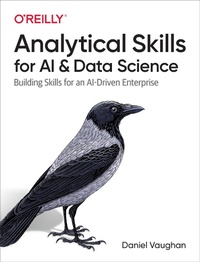
Analytical Skills for AI and Data Science
Description

While several market-leading companies have successfully transformed their business models by following data- and AI-driven paths, the vast majority have yet to reap the benefits. How can your business and analytics units gain a competitive advantage by capturing the full potential of this predictive revolution? This practical guide presents a battle-tested end-to-end method to help you translate business decisions into tractable prescriptive solutions using data and AI as fundamental inputs.
Author Daniel Vaughan shows data scientists, analytics practitioners, and others interested in using AI to transform their businesses not only how to ask the right questions but also how to generate value using modern AI technologies and decision-making principles. You'll explore several use cases common to many enterprises, complete with examples you can apply when working to solve your own issues.
- Break business decisions into stages that can be tackled using different skills from the analytical toolbox
- Identify and embrace uncertainty in decision making and protect against common human biases
- Customize optimal decisions to different customers using predictive and prescriptive methods and technologies
- Ask business questions that create high value through AI- and data-driven technologies
More details
Other editions
Additional editions
Content
- Cover
- Copyright
- Table of Contents
- Preface
- Why Analytical Skills for AI?
- Use Case-Driven Approach
- What This Book Isn't
- Who This Book Is For
- What's Needed
- Conventions Used in This Book
- Using Code Examples
- O'Reilly Online Learning
- How to Contact Us
- Acknowledgments
- Chapter 1. Analytical Thinking and the AI-Driven Enterprise
- What Is AI?
- Why Current AI Won't Deliver on Its Promises
- How Did We Get Here?
- The Data Revolution
- A Tale of Unrealized Expectations
- Analytical Skills for the Modern AI-Driven Enterprise
- Key Takeways
- Further Reading
- Chapter 2. Intro to Analytical Thinking
- Descriptive, Predictive, and Prescriptive Questions
- When Predictive Analysis Is Powerful: The Case of Cancer Detection
- Descriptive Analysis: The Case of Customer Churn
- Business Questions and KPIs
- KPIs to Measure the Success of a Loyalty Program
- An Anatomy of a Decision: A Simple Decomposition
- An Example: Why Did You Buy This Book?
- A Primer on Causation
- Defining Correlation and Causation
- Some Difficulties in Estimating Causal Effects
- Uncertainty
- Uncertainty from Simplification
- Uncertainty from Heterogeneity
- Uncertainty from Social Interactions
- Uncertainty from Ignorance
- Key Takeaways
- Further Reading
- Chapter 3. Learning to Ask Good Business Questions
- From Business Objectives to Business Questions
- Descriptive, Predictive, and Prescriptive Questions
- Always Start with the Business Question and Work Backward
- Further Deconstructing the Business Questions
- Example with a Two-Sided Platform
- Learning to Ask Business Questions: Examples from Common Use Cases
- Lowering Churn
- Cross-Selling: Next-Best Offer
- CAPEX Optimization
- Store Locations
- Who Should I Hire?
- Delinquency Rates
- Stock or Inventory Optimization
- Store Staffing
- Key Takeaways
- Further Reading
- Chapter 4. Actions, Levers, and Decisions
- Understanding What Is Actionable
- Physical Levers
- Human Levers
- Why Do We Behave the Way We Do?
- Levers from Restrictions
- Levers That Affect Our Preferences
- Levers That Change Your Expectations
- Revisiting Our Use Cases
- Customer Churn
- Cross-Selling
- Capital Expenditure (CAPEX) Optimization
- Store Locations
- Who Should I Hire?
- Delinquency Rates
- Stock Optimization
- Store Staffing
- Key Takeaways
- Further Reading
- Chapter 5. From Actions to Consequences: Learning How to Simplify
- Why Do We Need to Simplify?
- First- and Second-Order Effects
- Exercising Our Analytical Muscle: Welcome Fermi
- How Many Tennis Balls Fit the Floor of This Rectangular Room?
- How Much Would You Charge to Clean Every Window in Mexico City?
- Fermi Problems to Make Preliminary Business Cases
- Revisiting the Examples from Chapter 3
- Customer Churn
- Cross-Selling
- CAPEX Optimization
- Store Locations
- Delinquency Rates
- Stock Optimization
- Store Staffing
- Key Takeaways
- Further Reading
- Chapter 6. Uncertainty
- Where Does Uncertainty Come From?
- Quantifying Uncertainty
- Expected Values
- Making Decisions Without Uncertainty
- Making Simple Decisions Under Uncertainty
- Decisions Under Uncertainty
- Is This the Best We Can Do?
- But This Is a Frequentist Argument
- Normative and Descriptive Theories of Decision-Making
- Some Paradoxes in Decision-Making Under Uncertainty
- The St. Petersburg Paradox
- Risk Aversion
- Putting it All into Practice
- Estimating the Probabilities
- Estimating Expected Values
- Frequentist and Bayesian Methods
- Revisiting Our Use Cases
- Customer Churn
- Cross-Selling
- CAPEX Optimization
- Store Locations
- Who to Hire
- Delinquency Rates
- Stock Optimization
- Key Takeaways
- Further Reading
- Chapter 7. Optimization
- What Is Optimization?
- Numerical Optimization Is Hard
- Optimization Is Not New in Business Settings
- Price and Revenue Optimization
- Optimization Without Uncertainty
- Customer Churn
- Cross-Selling
- CAPEX Investment
- Optimal Staffing
- Optimal Store Locations
- Optimization with Uncertainty
- Customer Churn
- Cross-Selling
- Optimal Staffing
- Tricks for Solving Optimization Problems Under Uncertainty
- Key Takeaways
- Further Reading
- Chapter 8. Wrapping Up
- Analytical Skills
- Asking Prescriptive Questions
- Understanding Causality
- Simplify
- Embracing Uncertainty
- Tackling Optimization
- The AI-Driven Enterprise of the Future
- Back to AI
- Some Final Thoughts
- Appendix. A Brief Introduction to Machine Learning
- What Is Machine Learning?
- A Taxonomy of ML Models
- Supervised Learning
- Unsupervised Learning
- Semisupervised Learning
- Regression and Classification
- Making Predictions
- Caveats to the Plug-in Approach
- Where Do These Functions Come From?
- Making Good Predictions
- From Linear Regression to Deep Learning
- Linear Regression
- Neural Networks
- A Primer on A/B Testing
- Further Reading
- Index
- About the Author
- Colophon
