

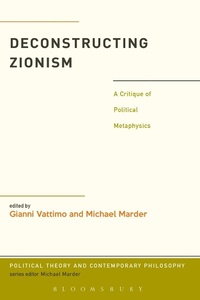
Deconstructing Zionism
A Critique of Political Metaphysics
1st Edition
Published on 21. November 2013
240 pages
978-1-4411-1477-8 (ISBN)
Description

This volume in the Political Theory and Contemporary Philosophy series provides a political and philosophical critique of Zionism.
While other nationalisms seem to have adapted to twenty-first century realities and shifting notions of state and nation, Zionism has largely remained tethered to a nineteenth century mentality, including the glorification of the state as the only means of expressing the spirit of the people. These essays, contributed by eminent international thinkers including Slavoj Zizek, Luce Irigaray, Judith Butler, Gianni Vattimo, Walter Mignolo, Marc Ellis, and others, deconstruct the political-metaphysical myths that are the framework for the existence of Israel.Collectively, they offer a multifaceted critique of the metaphysical, theological, and onto-political grounds of the Zionist project and the economic, geopolitical, and cultural outcomes of these foundations.
A significant contribution to the debates surrounding the state of Israel today, this groundbreaking work will appeal to anyone interested in political theory, philosophy, Jewish thought, and the Middle East conflict.
While other nationalisms seem to have adapted to twenty-first century realities and shifting notions of state and nation, Zionism has largely remained tethered to a nineteenth century mentality, including the glorification of the state as the only means of expressing the spirit of the people. These essays, contributed by eminent international thinkers including Slavoj Zizek, Luce Irigaray, Judith Butler, Gianni Vattimo, Walter Mignolo, Marc Ellis, and others, deconstruct the political-metaphysical myths that are the framework for the existence of Israel.Collectively, they offer a multifaceted critique of the metaphysical, theological, and onto-political grounds of the Zionist project and the economic, geopolitical, and cultural outcomes of these foundations.
A significant contribution to the debates surrounding the state of Israel today, this groundbreaking work will appeal to anyone interested in political theory, philosophy, Jewish thought, and the Middle East conflict.
Reviews / Votes
Deconstructing Zionism is by turn spectacular, compelling, difficult and tangential. For a practical-minded reader of politics, the contributions discussed here count amongst the best. * New Zealand International Review * As timely as one can get...Deconstructing Zionism serves as an important reminder that Zionism as such can never be simply deconstructed (indeed, the title of the volume is not Zionism Deconstructed), or its ideology set aside. Its appeal remains strong if not blinding. And as long as injustice for the Palestinians continues, Zionism will be there to justify the status quo, to deflect blame onto the other -whence the need for deconstructing it. * Journal of the Society for Contemporary Thought in the Islamicate World * A volume of eleven essays edited and introduced by a prominent Italian philosopher and public intellectual (Vattimo) and a polymathic young academic (Marder), Deconstructing Zionism is admirable for the revealing light through which it re-reads a phenomenon that, as the book's title aptly suggests, exemplifies the seemingly inextricability of politics from metaphysics - Zionism. * Middle East Media and Book Reviews Online * [A] welcome addition to the critique of Zionism. * E-International Relations * To open, to disassemble, to examine of what the assemblage is made. To think its conditions, its stakes, its possible or vanished meaning anew. That is what 'deconstruction' means. It arises from a real consideration, in the strongest sense, of the chosen object. Today, it is obviously necessary to make Zionism that object, among others-not only the word itself but also all the significations it carries. That is why one must salute the initiative behind this book. This unique book includes perceptive analyses of Zionism by some of today's leading philosophers. A 'must read' for anyone seeking the theoretical tools to address the conflict in the Middle East and committed to global social justice. For those of us who believe that the political and moral health of the global world depends on a just and fair solution to the problems that beset Palestine/Israel, this book is an illuminating contribution. These essays written by diverse and gifted hands explore the politics of nationhood and territorial coexistence from a plurality of philosophical, theological, and secular perspectives. The most interesting essays lead us towards the condition of the Middle East via a reflection on other political situations defined by proximity, ambivalence, and antagonism. This is an ambitious and engrossing volume.More details
Series
Edition
1. Auflage
Language
English
Place of publication
New York
United States
Publishing group
Bloomsbury Publishing PLC (Digital)
ISBN-13
978-1-4411-1477-8 (9781441114778)
Copyright in bibliographic data and cover images is held by Nielsen Book Services Limited or by the publishers or by their respective licensors: all rights reserved.
Schweitzer Classification
Other editions
Additional editions
Book
01/2014
Bloomsbury Academic USA
€35.00
Shipment within 15-20 days
Persons
Gianni Vattimo is emeritus professor of philosophy at the University of Turin and a member of the European Parliament. He is the author of Hermeneutic Communism (co-authored with S. Zabala), A Farewell to Truth; The Responsibility of the Philosopher; Christianity, Truth, and Weakening Faith (with R. Girard); Not Being God: A Collaborative Autobiography (with P. Paterlini); Art's Claim to Truth; After the Death of God (with John D. Caputo); Dialogue with Nietzsche; The Future of Religion (with Richard Rorty); Nihilism and Emancipation: Ethics, Politics, and Law; and After Christianity.
Michael Marder is Ikerbasque Research Professor in the Department of Philosophy at the University of the Basque Country, Vitoria-Gasteiz. He is the Associate Editor of Telos: A Quarterly Journal of Critical Thought and the author of The Event of The Thing: Derrida's Post-Deconstructive Realism (2009).
Michael Marder is Ikerbasque Research Professor in the Department of Philosophy at the University of the Basque Country, Vitoria-Gasteiz. He is the Associate Editor of Telos: A Quarterly Journal of Critical Thought and the author of The Event of The Thing: Derrida's Post-Deconstructive Realism (2009).
Content
Introduction: "If not now, when?"
Gianni Vattimo & Michael Marder
Chapter 1: Anti-Semitism and Its Transformations
Slavoj Zizek
Chapter 2: How to Become an Anti-Zionist
Gianni Vattimo
Chapter 3: Is Judaism Zionism? Or, Arendt and the Critique of the Nation-State
Judith Butler
Chapter 4: Decolonizing the Nation-State: Zionism in the Colonial Horizon of Modernity
Walter Mignolo
Chapter 5: Karl Marx and Hannah Arendt on the Jewish Question: Political Theology as a Critique
Artemy Magun
Chapter 6: Notes on the Prophetic Instability of Zionism
Marc H. Ellis
Chapter 7: The Spirit of Zionism: Derrida, Ruah, and the Purloined Birthright
Christopher Wise
Chapter 8: Rex, or the Negation of Wandering
Ranjana Khanna
Chapter 9: The Hermeneutical Stance: Being Discharged at the Margins of Political Zionism
Santiago Zabala
Chapter 10: The Zionist Synecdoche
Michael Marder
Chapter 11: Sharing Humanity: Towards Peaceful Coexistence in Difference
Luce Irigaray
Index
Gianni Vattimo & Michael Marder
Chapter 1: Anti-Semitism and Its Transformations
Slavoj Zizek
Chapter 2: How to Become an Anti-Zionist
Gianni Vattimo
Chapter 3: Is Judaism Zionism? Or, Arendt and the Critique of the Nation-State
Judith Butler
Chapter 4: Decolonizing the Nation-State: Zionism in the Colonial Horizon of Modernity
Walter Mignolo
Chapter 5: Karl Marx and Hannah Arendt on the Jewish Question: Political Theology as a Critique
Artemy Magun
Chapter 6: Notes on the Prophetic Instability of Zionism
Marc H. Ellis
Chapter 7: The Spirit of Zionism: Derrida, Ruah, and the Purloined Birthright
Christopher Wise
Chapter 8: Rex, or the Negation of Wandering
Ranjana Khanna
Chapter 9: The Hermeneutical Stance: Being Discharged at the Margins of Political Zionism
Santiago Zabala
Chapter 10: The Zionist Synecdoche
Michael Marder
Chapter 11: Sharing Humanity: Towards Peaceful Coexistence in Difference
Luce Irigaray
Index
