

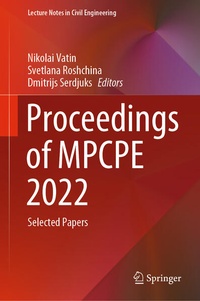
Proceedings of MPCPE 2022
Description

This book gathers selected contributions in the field of civil and structural engineering, as presented by international researchers and engineers at the International Conference on Materials Physics, Building Structures and Technologies in Construction, Industrial and Production Engineering (MPCPE), held in Vladimir, Russia, on April 26-28, 2022. The book covers a wide range of topics including the theory and design of capital construction facilities, engineering, and hydraulic structures; development of innovative solutions in the field of modeling and testing of reinforced concrete, metal, and wooden structures, as well as composite structures based on them; investigation of complex dynamic effects on construction objects, and many others directions. Intended for professional builders, designers, and researchers. The contributions, which were selected by means of a rigorous international peer-review process, highlight numerous exciting ideas that will spur novel research directions and foster multidisciplinary collaborations.
More details
Other editions
Additional editions
Persons
Prof. Nikolai Vatin is Chief Researcher, Professor at the Peter the Great Saint Petersburg Polytechnic University (Russia), and Head of the Laboratory of Self-Regenerating Structural Materials of the World-Class Research Center "Advanced Digital Technologies". In 2010, he joined the Professional Education Committee of the National Association of Builders (NOSTROI). In 2011, he was elected Dean of the Faculty of Civil Engineering, subsequently reorganized into the Institute of Civil Engineering, founder of the journal "Magazine of Civil Engineering" (Q1, Scopus), Chief Scientific Editor of the journals "Construction of Unique Buildings and Structures" and "AlfaBuild", and Author of more than 400 scientific publications (h-index = 36, Scopus).
Prof. Svetlana Roschina is Head of the Department of Building Structures, Professor at the Vladimir State University named after Alexander and Nikolay Stoletovs (Russia), Advisor of the Russian Academy of Architecture and Building Sciences, Member of the Presidium of the Vladimir regional branch of the All-Russian public organization "Russian Professorial Assembly", and Member of the editorial boards of the Russian journals "AlfaBuild" and "Construction and Architecture". The main scientific interests of Prof. S. Roschina are associated with the calculation and design of building structures, including reinforced wooden structures. Prof. Svetlana Roschina is Author of more than 300 scientific publications (including peer-reviewed books, papers in international and national journals), 20 patents, and certificates of the Russian Federation.
Prof. Dmitrijs Serdjuks is Professor of the Institute of Structural Engineering and Reconstruction, Faculty of Civil Engineering, Riga Technical University (Latvia), and Expert of the Latvian Council of Science in Civil and Transport Engineering. He specializes in the development of innovative intelligent structures using removable natural resources with increased durability and reliability for structural and infrastructure purposes, as well as in new cellular composite materials, and assessment of the quality and deterioration of the joints of building structures and is Author of more than 80 publications in international scientific journals and proceedings.
