

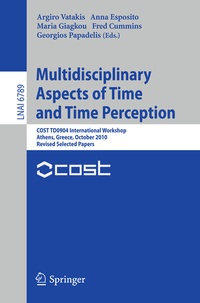
Multidisciplinary Aspects of Time and Time Perception
COST TD0904 International Workshop, Athens, Greece, October 7-8, 2010, Revised Selected Papers
Published on 22. November 2011
XII, 291 pages
978-3-642-21478-3 (ISBN)
Description

This book constitutes the documentation of the scientific outcome of the first meeting of the TIMELY network, the International Workshop on Multidisciplinary Aspects of Time and Time Perception, which took place in Athens, Greece, in October 2010. The 21 papers presented were carefully reviewed and selected for inclusion in the book. They cover the following topics: conceptual analysis and measurement of time; exploring factors associated with time perception variability; extending time research to ecologically-valid stimuli and real-world applications; and uncovering the neural correlates of time perception.
More details
Other editions
Additional editions
Argiro Vatakis | Anna Esposito | Maria Giagkou
Multidisciplinary Aspects of Time and Time Perception
COST TD0904 International Workshop, Athens, Greece, October 7-8, 2010, Revised Selected Papers
Book
11/2011
Springer
€53.49
Shipment within 7-9 days
Content
- Intro
- Title
- Preface
- Organization
- Table of Contents
- Further Steps in the Science of Temporal Consciousness?
- Introduction
- Two Approaches to Temporal Consciousness
- Bridging the Disciplines
- Summary
- References
- Temporal Illusions - Philosophical Considerations
- Introduction
- Time-Experience and Time-Perception
- Illusion
- Illusion in Imagination
- Illusions Could Have Alternative Interpretations
- Two Theories of Perception and Experience
- Time
- Temporal Features
- Metaphysical Conceptions of Time
- Temporal Illusions given only the Metaphysics
- Two Possible Temporal Illusions
- Simultaneity
- Experience of the Past
- Conclusion
- References
- A.N. Prior's Notion of the Present
- The Notion of the Present
- The Definition of Presentism
- Is Prior's Notion of the Present a Contradiction?
- Revisiting "The Notion of the Present"
- Presentism and Becoming
- Conclusion
- References
- Towards a Common Language for the Discussion of Time Based on Prior's Tense Logic
- The Conceptual Challenge in the Study of Time
- The Two Classical Languages on Time
- The Importance of the Dynamic Aspects of Reality
- The Origin of the Idea of Branching Time
- Instants and the Notion of Branching Time
- Temporal Logic and the Discussion of Time
- References
- The Problem with Perceptual Synchrony
- Prolegomenon
- Perceptual Synchrony, Neuro-phenomenological Equivalence and Epiphenomenality
- The Problem with Perceptual Synchrony
- A Solution But Some Implications
- Conclusions
- References
- New Perspectives on Vierordt's Law: Memory-Mixing in Ordinal Temporal Comparison Tasks
- Memory-Mixing and the Encoding of Temporal Information
- Memory-Mixing and Temporal Context
- Memory-Mixing and Modality Differences
- Memory-Mixing and Sequential Ordinal Comparisons
- Effects of the Previous Trial on Memory-Mixing
- Individual Differences in Memory-Mixing
- Feedback Effects on Memory-Mixing
- Summary
- References
- Reproduction of Duration: How Should I Count the Ways?
- Introduction
- Method
- Participants and Design
- Apparatus, Stimuli, and Procedure
- Data Screening
- Results and Discussion
- Individual Time Reproduction Functions
- Mean Reproduction, Coefficient of Variation (CV), and Mean Log(reproduction)
- Comparing Different Dependent Variables: (1) R/D and D/R Ratios, (2) Absolute Discrepancy (|R-D|), and (3) Absolute Error (|R-D|/D)
- Conclusions
- References
- Duration Discrimination Performance: No Cross-Modal Transfer from Audition to Vision Even after Massive Perceptual Learning
- Introduction
- Method
- Participants
- Apparatus and Stimuli
- Procedure
- Data Analyses
- Results
- Mean Individual Results
- With the Jackknife Method
- Performance in Auditory Duration Discrimination (Experimental Group)
- Discussion
- References
- An Investigation on Temporal Aspects in the Audio-Haptic Simulation of Footsteps
- Introduction
- Simulation Hardware and Software
- Experiment Design
- Participants
- Setup
- Task
- Haptic and Auditory Simulation
- Results
- Results of Condition 1 (Audio Condition)
- Results of Condition 2 (Haptic Condition)
- Results of Condition 3 (Audio and Audio-Haptic Condition)
- General Discussion
- Conclusion and Future Work
- References
- Enhanced Audiovisual Temporal Sensitivity When Viewing Videos That Appropriately Depict the Effect of Gravity on Object Movement
- Introduction
- Methods
- Results
- Discussion
- References
- About Musical Time - Effect of Age, Enjoyment, and Practical Musical Experience on Retrospective Estimate of Elapsed Duration during Music Listening
- Background
- Method
- Participants
- Stimulus
- Procedure
- Results
- Age - Children (Three Groups: 5-8, 9-10, 11-13)
- Age - 14 to Adult
- Enjoyment
- Musical Experience
- Profession - Teaching
- Discussion
- References
- The Impact of Attention on the Internal Clock in Prospective Timing: Is It Direct or Indirect?
- Introduction
- Manipulating Foreperiods
- The Present Study
- Method
- Participants
- Apparatus and Stimuli
- Procedure
- Data Analysis
- Results
- Variable Group
- Constant Group
- Comparison of Variable and Constant Groups
- Discussion
- The Attentional-Gate Model and Temporal Uncertainty
- Summary and Conclusions
- References
- Child and Time
- Introduction
- The Pioneering Studies of Time Estimation Capabilities in Children
- Temporal Conditioning
- Early Ability to Discriminate Time in Bisection: Weber's Law Holds!
- Age Similarities and Changes in Time Discrimination Capacities
- The Cognitive Sources of Children's Lesser Ability to Discriminate Time
- References
- Electrophysiological Evidence for an Accumulation Process in the Timing of Emotional Stimuli
- Introduction
- Method
- Participants
- Stimuli
- Experimental Procedure
- Skin Conductance Response Data Collection and Reduction
- EEG Data Collection and Reduction
- Data Analyses
- Results
- Subjective Reports
- SCR Analyses
- ERPs Analyses
- Correlations between Brain Potentials and Subjective Time
- Discussion
- Behavioral and SCR Results
- ERPs Results
- Conclusion
- References
- Temporal Information Processing and Mental Ability: A New Perspective
- Introduction
- Temporal Resolution Power, Speed of Information Processing, and Mental Ability
- Temporal Resolution Power, Working Memory Capacity, and Mental Ability
- The Relations of Mental Ability to Duration and Frequency Discrimination
- Temporal Resolution Power, General Discrimination Ability, and Mental Ability
- Summary and Perspectives
- References
- The Embodiment of Time Estimation
- Introduction
- Fractal Variation in Time Estimation
- The Meaning of Spectral Slopes
- The Nature of Control
- Conclusions
- References
- What Can Be Inferred from Multiple-task Psychophysical Studies about the Mechanisms for Temporal Processing?
- Introduction
- fMRI of Temporal Processing
- Psychophysics of Temporal Processing Across Behavioral Contexts
- Contribution of Learning Studies to the Knowledge of Timing Systems
- Interval Tuning Properties of an Artificial Neural Network
- Concluding Remarks
- References
- Quality Space Model of Temporal Perception
- Mental Qualities
- Constraints
- Temporal Boundary Detection and Filling-in Durations
- Cross-Modal Effects and Time
- Temporal Mental Qualities
- References
- On Clocks, Models and Metaphors
- Models and Theory Building
- Internal Clock: Model or Metaphor?
- Klepsydra Model, Its Working and Its Merits
- Modeling and Realism
- Timing without Numbers
- Concluding Remarks
- References
- Time Reference in Fluent Aphasia: Evidence from Serbian
- Introduction
- Verb System in Serbian
- Methods
- Participants
- Materials
- Procedure
- Scoring
- Results
- Evaluative Measures
- Production Results
- Comprehension Results
- Discussion
- References
- Logical and Experiential Time in Narratives
- Introduction
- Study One: Duration Estimation of Reading a Narrative
- Methods
- Results
- Discussion
- Study Two: Duration Estimation of Described Events in Text Narrative
- Methods
- Results
- Discussion
- General Discussion
- References
- Author Index
