

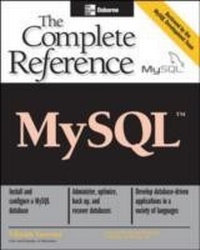
MySQL: The Complete Reference
1st Edition
Published on 18. December 2003
563 pages
978-0-07-178243-2 (ISBN)
Description

Get comprehensive coverage of all the powerful new features of MySQL, one of the fastest--and free--relational databases in use today. Written in conjunction with the MySQL development team, this expert resource covers transactional integrity, disaster recovery, scalability, support for mobile users, Web-based and client/server programming, and much more.
More details
Other editions
Additional editions
Book
01/2004
Osborne/McGraw-Hill
€52.10
Article not available at the moment
Content
- Cover Page
- MySQL: The Complete Reference
- Copyright Page
- Dedication
- About the Author
- Contents
- Foreword
- Acknowledgments
- Introduction
- Part I Installation
- 1 Introduction to Databases
- The Big Picture.
- .And the Little Database that Could
- History and Evolution
- Features
- Applications
- Summary
- 2 A Technical Tour of MySQL
- An Overview of MySQL Architecture
- Primary Subsystems
- Support Components
- Subsystem/Component Interaction and Control Flow
- The MySQL Engine
- Connectivity
- SQL
- Data Integrity
- Transactions
- Extensibility
- Symmetric Multiprocessing with MySQL
- Security
- Replication
- Application Programming Interfaces
- Add-On Tools
- Summary
- 3 MySQL Installation and Configuration
- Obtaining MySQL
- Choosing Which Version to Install
- Choosing Between Binary and Source Distributions
- Installing and Configuring MySQL
- Installing and Configuring MySQL on UNIX
- Installing and Configuring MySQL on Windows
- Testing MySQL
- Post-Installation Steps
- Summary
- Part II Usage
- 4 SQL Basics
- A Brief History of SQL
- An Overview of SQL
- A (My)SQL Tutorial
- Understanding an RDBMS
- Creating a Database
- Adding Tables
- Adding Records
- Removing and Modifying Records
- Executing Queries
- Summary
- 5 MySQL Data Types
- The Need and Rationale for Data Types
- MySQL Data Types
- Numeric Types
- String Types
- Date and Time Types
- Complex Types
- Data Type Selection
- Summary
- 6 MySQL Operators
- Arithmetic Operators
- Comparison Operators
- Logical Operators
- Bit Operators
- Summary
- 7 MySQL Functions
- Math Functions
- Aggregate Functions
- String Functions
- Date and Time Functions
- Encryption Functions
- Control Flow Functions
- Formatting Functions
- Type Conversion Functions
- System Information Functions
- Summary
- 8 Working with Databases and Tables
- Creating Databases
- Selecting Databases for Use
- Deleting Databases
- Creating Tables
- Field Types
- Field Constraints
- Indexes
- Primary Keys
- Foreign Keys
- Table Types
- Other Table Modifiers
- Copying Tables
- Modifying Tables
- Deleting Tables
- Obtaining Information About Databases, Tables, Fields, and Indexes
- Summary
- 9 Working with Data
- Inserting, Updating, and Deleting Records
- Inserting Records
- Updating Records
- Deleting Records
- Retrieving Records
- Retrieving Specific Rows and Columns
- Using Built-In Functions
- Aliasing Table and Column Names
- Limiting Query Results
- Sorting Query Results
- Grouping Query Results
- Using Variables
- Using Subqueries
- Controlling
- Copying, Importing, and Exporting Records
- Copying Records
- Importing Records
- Exporting Records
- Summary
- 10 Joins
- What Is a Join?
- Types of Joins
- Cross Joins
- Inner Joins
- Outer Joins
- Self Joins
- Unions
- Summary
- 11 Subqueries
- What Is a Subquery?
- Types of Subqueries
- Subqueries and the
- Subqueries and the
- Subqueries and Joins
- Subqueries and Other DML Statements
- Summary
- 12 Transactions
- What Is a Transaction?
- Transactions and the ACID Properties
- Life Cycle of a Transaction
- Controlling Transactional Behavior
- Automatic Commits
- Transaction Isolation Levels
- Transactions and Performance
- Pseudotransactions with Nontransactional Tables
- Table Locks as a Substitute for Transactions
- Implementing a Pseudotransaction with Table Locks
- Summary
- Part III Administration
- 13 Administration and Configuration
- Database Administration and MySQL
- Uptime
- Data Backup
- Security and Access Control
- Performance Optimization
- Basic Server Administration and Configuration Tasks
- Starting and Stopping the Server
- Checking MySQL Server Status
- Managing MySQL Client Processes
- Altering the Server Configuration
- Troubleshooting with the Error Log
- Summary
- 14 Security, Access Control, and Privileges
- The MySQL Grant Tables
- The
- The
- The
- Granting, Revoking, and Viewing User Privileges
- Using the
- Using the
- Viewing Privileges
- Reloading the Grant Tables
- Resetting the Grant Tables
- Changing User Passwords
- Setting the
- Resetting the
- Summary
- 15 Maintenance, Backup, and Recovery
- Maintenance
- Logging
- Checking and Repairing Tables
- Backup and Restore
- Backing Up Databases and Tables
- Restoring Databases and Tables from Backup
- Summary
- 16 Performance Optimization
- Indexing
- Query Caching
- Query Analysis
- Optimizing Multi-Table Queries
- Using Temporary Tables
- Optimizing Table Design
- Adjusting Server Settings
- Benchmarking
- Summary
- 17 MySQL Replication
- Replication Basics
- The Master-Slave Relationship
- Replication Threads
- Configuring MySQL for Replication
- Managing the Replication Process
- Summary
- Part IV Development
- 18 The MySQL APIs
- The MySQL APIs In Context
- Components of the MySQL API
- Language Support
- Selecting an API
- Summary
- 19 MySQL and C
- C
- History and Evolution
- Installation
- MySQL and C
- Connection Management
- Query Execution
- Result Set Processing
- Error Handling
- Ancillary Functions
- Real-World Usage
- The Interactive SQL Client
- The Expense Tracker
- Summary
- 20 MySQL and Perl
- Perl
- History and Evolution
- Installation
- MySQL and the Perl DBI
- Connection Management
- Query Execution
- Result Set Processing
- Error Handling
- Ancillary Functions
- A Real-World Example
- Designing the Database
- Building an Article Index
- Retrieving Article Contents
- Adding Comments
- Building a Threaded Comment Index
- Viewing Comments
- Summary
- 21 MySQL and PHP
- PHP: History and Evolution
- Installation
- MySQL and PHP
- Connection Management
- Query Execution
- Result Set Processing
- Error Handling
- Ancillary Functions
- A Real-World Example
- Designing the Database
- Retrieving Data
- Adding Data
- Removing Data
- Summary
- Index
