

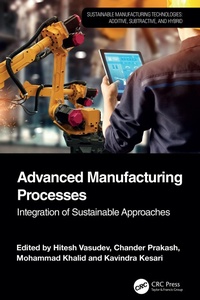
Advanced Manufacturing Processes
Integration of Sustainable Approaches
1st Edition
Published on 31. January 2025
338 pages
978-1-040-25394-6 (ISBN)
Description

The increasing demand for advanced manufacturing processes is making an impact on the Earth's resources, and its industrial practices are producing negative impacts on the environment, such as carbon footprints, energy resources, waste, etc. The trend of advanced manufacturing coincides with the acceleration of innovations in sustainable techniques.
Advanced Manufacturing Processes: Integration of Sustainable Approaches focuses on sustainability materials, the 6 Rs (reuse, recycle, redesign, remanufacture, reduce, and recover), lifecycle engineering, and life cycle assessment. It discusses sustainability in manufacturing and the impact on plant performance while keeping in mind IR 4.0, and highlights issues related to materials recovery and a circular economy. The book also presents the use of new sustainable materials in processes and their impact on the environment and plant performance. Case studies are offered to enable the reader to get a comparison of the manufacturing processes based on individual sustainability.
All aspects related to the implementation and adoption of sustainable advanced manufacturing approaches are encapsulated in this book along with their applications which makes this a useful book for industry, academic teaching, research scholars, and experts dealing with sustainability-related issues.
Advanced Manufacturing Processes: Integration of Sustainable Approaches focuses on sustainability materials, the 6 Rs (reuse, recycle, redesign, remanufacture, reduce, and recover), lifecycle engineering, and life cycle assessment. It discusses sustainability in manufacturing and the impact on plant performance while keeping in mind IR 4.0, and highlights issues related to materials recovery and a circular economy. The book also presents the use of new sustainable materials in processes and their impact on the environment and plant performance. Case studies are offered to enable the reader to get a comparison of the manufacturing processes based on individual sustainability.
All aspects related to the implementation and adoption of sustainable advanced manufacturing approaches are encapsulated in this book along with their applications which makes this a useful book for industry, academic teaching, research scholars, and experts dealing with sustainability-related issues.
More details
Series
Edition
1. Auflage
Language
English
Place of publication
London
United Kingdom
Publishing group
Taylor & Francis Ltd
Target group
Professional and scholarly
College/higher education
Illustrations
26 Tables, black and white; 81 Line drawings, black and white; 13 Halftones, black and white; 94 Illustrations, black and white
File size
34,77 MB
ISBN-13
978-1-040-25394-6 (9781040253946)
Copyright in bibliographic data and cover images is held by Nielsen Book Services Limited or by the publishers or by their respective licensors: all rights reserved.
Schweitzer Classification
Other editions
Additional editions
Hitesh Vasudev | Chander Prakash | Mohammad Khalid
Advanced Manufacturing Processes
Integration of Sustainable Approaches
Book
approx. 07/2026
1st Edition
CRC Press
€66.00
Not yet published
Hitesh Vasudev | Chander Prakash | Mohammad Khalid
Advanced Manufacturing Processes
Integration of Sustainable Approaches
Book
01/2025
1st Edition
CRC Press
€177.70
Shipment within 10-20 days

Advanced Manufacturing Processes
Integration of Sustainable Approaches
Book
12/2024
CRC Press
Unfortunately, price unknown
Available (delivery time upon request)
Persons
Dr. Hitesh Vasudev is a Professor in the School of Mechanical Engineering and Research and Development Cell at Lovely Professional University, India. He received a Ph.D. in Mechanical Engineering from Guru Nanak Dev Engineering College, India in 2018. He has contributed extensively to thermal spray coatings in reputed journals. He is a dedicated reviewer of reputable journals and has authored more than 100 International publications in various International Journals and conferences. He has published 15 book chapters related to surface engineering and manufacturing processes. Dr. Vasudev has also published a unique patent in the field of thermal spraying and has more than eight years of teaching experience. He received a "Research Excellence Award" in 2019, 2020 and 2021 at Lovely Professional University, India. He organized a National Conference and has participated in many International Conferences. His area of research is thermal spray coatings, especially for the development of new materials used for high-temperature erosion and oxidation resistance and microwave processing of materials.
Dr. Chander Prakash is a Pro-Vice-Chancellor and Professor at Chandigarh University, India, and serves as Project Co-Head and Leading Scientist at the Research Laboratory of Neuroelectronics and Memristive Nanomaterials (NEUROMENA Lab), Southern Federal University, Russia. He graduated from the Panjab University Chandigarh in 2016 with a Ph.D. in Mechanical Engineering and is also an Adjunct Professor (Honorary position) at the Institute for Computational Science, Ton Duc Thang University, Vietnam. Dr. Prakash is a dedicated teacher who embraces student-centric approaches, providing experiential learning to his students, and is a passionate researcher with diversified research interests in surface engineering of functional materials for Biomedical and Healthcare applications and other engineering applications. To date, he has published more than 330 scientific articles in various peer-reviewed reputed top-notch journals, conferences, and books in Materials Science and Manufacturing.
Dr. Mohammad Khalid is a Professor and Head of the Sunway Centre for Electrochemical Energy and Sustainable Technology at Sunway University, Malaysia. He completed his degree in Chemical Engineering from Visvesvaraya Technological University, India, an MSc in Chemical and Environmental Engineering from the University Putra Malaysia and a PhD in Engineering from International Islamic University Malaysia. Before joining Sunway University, he worked as an associate professor in the Department of Chemical and Environmental Engineering at the University of Nottingham Malaysia Campus. He has over 300 peer-reviewed scientific articles, six edited books, and five patents to his credit. Dr. Khalid is a Fellow of the Higher Education Academy (FHEA) and the Royal Society of Chemistry (FRSC), U.K. His research interests primarily include advanced nanomaterial synthesis for energy harvesting, storage, and conversion applications.
Dr. Kavindra Kesari is currently working as a Senior Scientist in the Faculty of Biological and Environmental Sciences, at the University of Helsinki, Finland. Previously, he was working as a Senior Researcher at the Department of Applied Physics, Aalto University, Finland. He has also been appointed as Commissioner at the International Commission on the Biological Effects of Electromagnetic Fields (ICBE EMF), USA to explore protective measures against radiation. Dr. Kesari is also an Honorary Faculty Member of Novel Global Community Educational Foundation, New South Wales, Australia, and serves as an Academy Fellow for Einstein Research Academy, India. He obtained a Doctoral degree in Biotechnology from India. He received Junior and Senior Research fellowships during his Doctoral studies at Jawaharlal Nehru University, New Delhi, India, and served as an Assistant Professor at Jaipur National University, Jaipur, India. He has published over 130 papers in reputable scientific journals, 30 book chapters, and 7 books and presented over 40 papers at national and international scientific meetings. Dr. Kesari has served as a subject expert for many international committees and is also an Editorial Board member and reviewer of repute.
Dr. Chander Prakash is a Pro-Vice-Chancellor and Professor at Chandigarh University, India, and serves as Project Co-Head and Leading Scientist at the Research Laboratory of Neuroelectronics and Memristive Nanomaterials (NEUROMENA Lab), Southern Federal University, Russia. He graduated from the Panjab University Chandigarh in 2016 with a Ph.D. in Mechanical Engineering and is also an Adjunct Professor (Honorary position) at the Institute for Computational Science, Ton Duc Thang University, Vietnam. Dr. Prakash is a dedicated teacher who embraces student-centric approaches, providing experiential learning to his students, and is a passionate researcher with diversified research interests in surface engineering of functional materials for Biomedical and Healthcare applications and other engineering applications. To date, he has published more than 330 scientific articles in various peer-reviewed reputed top-notch journals, conferences, and books in Materials Science and Manufacturing.
Dr. Mohammad Khalid is a Professor and Head of the Sunway Centre for Electrochemical Energy and Sustainable Technology at Sunway University, Malaysia. He completed his degree in Chemical Engineering from Visvesvaraya Technological University, India, an MSc in Chemical and Environmental Engineering from the University Putra Malaysia and a PhD in Engineering from International Islamic University Malaysia. Before joining Sunway University, he worked as an associate professor in the Department of Chemical and Environmental Engineering at the University of Nottingham Malaysia Campus. He has over 300 peer-reviewed scientific articles, six edited books, and five patents to his credit. Dr. Khalid is a Fellow of the Higher Education Academy (FHEA) and the Royal Society of Chemistry (FRSC), U.K. His research interests primarily include advanced nanomaterial synthesis for energy harvesting, storage, and conversion applications.
Dr. Kavindra Kesari is currently working as a Senior Scientist in the Faculty of Biological and Environmental Sciences, at the University of Helsinki, Finland. Previously, he was working as a Senior Researcher at the Department of Applied Physics, Aalto University, Finland. He has also been appointed as Commissioner at the International Commission on the Biological Effects of Electromagnetic Fields (ICBE EMF), USA to explore protective measures against radiation. Dr. Kesari is also an Honorary Faculty Member of Novel Global Community Educational Foundation, New South Wales, Australia, and serves as an Academy Fellow for Einstein Research Academy, India. He obtained a Doctoral degree in Biotechnology from India. He received Junior and Senior Research fellowships during his Doctoral studies at Jawaharlal Nehru University, New Delhi, India, and served as an Assistant Professor at Jaipur National University, Jaipur, India. He has published over 130 papers in reputable scientific journals, 30 book chapters, and 7 books and presented over 40 papers at national and international scientific meetings. Dr. Kesari has served as a subject expert for many international committees and is also an Editorial Board member and reviewer of repute.
Content
1. Additive manufacturing: Challenges on the Way to Greater Sustainability. 2. Sustainability of Additive Manufacturing: Using Finite Element Models and 3D Printing Techniques. 3. Cold spray a sustainable approach in industry for repairing applications. 4. From Manual to Automatic: A Historical Journey of Manufacturing Optimization. 5. Sustainable advanced manufacturing in industry 4.0 using blockchain technology. 6. Artificial intelligence and internet of things for sustainable advanced manufacturing. 7. A Comprehensive Review of Smart 4.0 Technologies Applications in the Manufacturing Industry and Engineering Education. 8. Ensuring Security and Privacy in Cloud-Based EHRs: A Proposed Framework for Modern Manufacturing and Healthcare Systems. 9. Dental implant materials and designs and failure during implant placement and loading- A review. 10. Application of Fuzzy Multi-Objective Optimization on Existing Technologies and Selection of Optimal Lattice in Artificial Skin Generation. 11. IOT Enabled EV Charging Infrastructure in Smart Cities. 12. Techno-Cities: Artificial Intelligence in the Evolution of Smart Cities. 13. A Comprehensive Review of Integration, Security, and Performance Aspects in Hybrid Cloud Computing in Manufacturing Sector. 14. Energy Conservation and Energy Efficiency Opportunities in Induction Motor. 15. Sustainable utilization of the urban wastes using technical maneuvers (ECAP) to yield a considerable extent of energy: A recycling approach. 16. Dimensions of Environmental Sustainability and the Use of AI: Challenges and Innovations in Sustainable Resource Management. 17. Effect of electro-corrosion behavior of different grades of stainless steel used in bio-implants - A Review. 18. Importance of Hydroxyapatite Coatings in Improving New Bone Osteogenesis - A Review. 19. Advancing Towards a Sustainable Future: The Synergy of Green Technology and Industry 4.0.
