

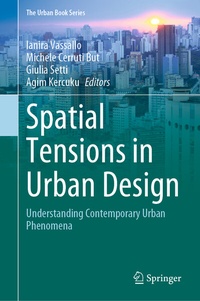
Spatial Tensions in Urban Design
Description

Through a collection of essays from various disciplines focusing on international case studies-from India to Europe to Latin America- the publication explores the multifaceted concept of "spatial tensions" as a lens for better understanding contemporary urban transformations. While tensions often depend on spatial dispositives and superstructures, they also offer a powerful key for design practices and strategies.
More details
Other editions
Additional editions
Persons
Ianira Vassallo is an architect, Ph.D., an assistant professor in Urban Planning at DIST, Politecnico di Torino. Her research interest focus on the relationship between urban practices and projects of spatial transformation in the contemporary cities. Since 2016, she has been part of the LABSUS Association staff, and she works on the production of discourses, spaces, knowledge and values related to the urban commons processes.
In 2021, she carried out a teaching and research experience at Institut d'Urbanisme et de Géographie Alpine (IUGA). Currently, she works in the research project "Lifelines" (2020-2022) that focuses on the possibility to analyze the "new infrastructures" of care, of work, of production that the COVID situation are defining.
His research focuses on the contemporary urban condition, specifically focusing on a collective transdisciplinary approach straddling urbanism, social sciences, and public arts and aiming at exploring the relations between society, economy, and territory. Since 2014, he works on the issue of the city making of contemporary manufacturing production, and on this topic he defended his Ph.D. research, co-authored and co-edited international peer-reviewed essays and books, and co-organized international conferences. He currently works on the issue of mediality and medial territories in Europe as the very platform of Western modernity and key space for tackling climate change.
Giulia Setti is an architect, Ph.D., an assistant professor in Architectural and Urban Design at DAStU Department, Politecnico di Milano. Her researches focus on disposal, reuse, and recovery of productive architectures, and to the different typologies of contemporary public spaces. Currently, she works in the research project called "Territorial Fragilities," coordinated by DAStU Department, with the aim to define projects and strategies able to respond to the growing fragilities of the Italian territory.
In 2014 - 2015, she carried out teaching and research activities at the School of Architecture, CEPT University, Ahmedabad (India). Moreover, between 2016 and 2018, she carried out research at Shanghai Jiao Tong University and Xi'an Jiao Tong University coordinating international exchange activities and workshops.
Agim Kërçuku is an architect and urbanist, has a Ph.D. in Urbanism at the Università IUAV di Venezia. Since December 2018, he is a research fellow at the DAStU Excellence Department of the Politecnico di Milano. In 2020, he carried out a visiting experience at Leibniz-Institut für Länderkunde (IfL). Research activity focuses on the dimension of fragility in the territory marked by dynamics of demographic contraction and lack of care and maintenance of social fixed capital.
