

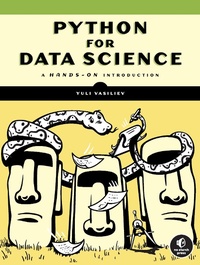
Python for Data Science
A Hands-On Introduction
Published on 2. August 2022
240 pages
978-1-7185-0221-5 (ISBN)
Description

A hands-on, real-world introduction to data analysis with the Python programming language, loaded with wide-ranging examples.
Python is an ideal choice for accessing, manipulating, and gaining insights from data of all kinds. Python for Data Science introduces you to the Pythonic world of data analysis with a learn-by-doing approach rooted in practical examples and hands-on activities. You'll learn how to write Python code to obtain, transform, and analyze data, practicing state-of-the-art data processing techniques for use cases in business management, marketing, and decision support.
You will discover Python's rich set of built-in data structures for basic operations, as well as its robust ecosystem of open-source libraries for data science, including NumPy, pandas, scikit-learn, matplotlib, and more. Examples show how to load data in various formats, how to streamline, group, and aggregate data sets, and how to create charts, maps, and other visualizations. Later chapters go in-depth with demonstrations of real-world data applications, including using location data to power a taxi service, market basket analysis to identify items commonly purchased together, and machine learning to predict stock prices.
Python is an ideal choice for accessing, manipulating, and gaining insights from data of all kinds. Python for Data Science introduces you to the Pythonic world of data analysis with a learn-by-doing approach rooted in practical examples and hands-on activities. You'll learn how to write Python code to obtain, transform, and analyze data, practicing state-of-the-art data processing techniques for use cases in business management, marketing, and decision support.
You will discover Python's rich set of built-in data structures for basic operations, as well as its robust ecosystem of open-source libraries for data science, including NumPy, pandas, scikit-learn, matplotlib, and more. Examples show how to load data in various formats, how to streamline, group, and aggregate data sets, and how to create charts, maps, and other visualizations. Later chapters go in-depth with demonstrations of real-world data applications, including using location data to power a taxi service, market basket analysis to identify items commonly purchased together, and machine learning to predict stock prices.
More details
Other editions
Additional editions
Book
08/2022
No Starch Press
€56.00
Available immediately
Person
Yuli Vasiliev is a programmer, freelance writer, and consultant, who has been working with databases for more than two decades. He specializes in open-source development, and is experienced in building data structures and models, as well as designing and implementing database backends for various applications using Oracle technologies, MySQL, and natural language processing. Vasiliev is the author of Natural Language Processing with spaCy (No Starch Press.
