

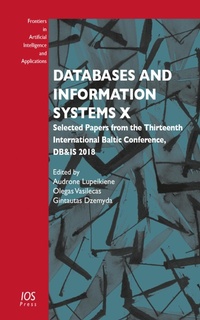
Databases and Information Systems X
Selected Papers from the Thirteenth International Baltic Conference, DB&IS 2018
1st Edition
Published on 15. January 2019
296 pages
978-1-61499-941-6 (ISBN)
Description

The importance of databases and information systems to the functioning of 21st century life is indisputable.
This book presents papers from the 13th International Baltic Conference on Databases and Information Systems, held in Trakai, Lithuania, from 1- 4 July 2018. Since the first of these events in 1994, the Baltic DB&IS has proved itself to be an excellent forum for researchers, practitioners and PhD students to deliver and share their research in the field of advanced information systems, databases and related areas.
For the 2018 conference, 69 submissions were received from 15 countries. Each paper was assigned for review to at least three referees from different countries. Following review, 24 regular papers were accepted for presentation at the conference, and from these presented papers the 14 best-revised papers have been selected for publication in this volume, together with a preface and three invited papers written by leading experts. The selected revised and extended papers present original research results in a number of subject areas: information systems, requirements and ontology engineering; advanced database systems; internet of things; big data analysis; cognitive computing; and applications and case studies.
These results will contribute to the further development of this fast-growing field, and will be of interest to all those working with advanced information systems, databases and related areas.
This book presents papers from the 13th International Baltic Conference on Databases and Information Systems, held in Trakai, Lithuania, from 1- 4 July 2018. Since the first of these events in 1994, the Baltic DB&IS has proved itself to be an excellent forum for researchers, practitioners and PhD students to deliver and share their research in the field of advanced information systems, databases and related areas.
For the 2018 conference, 69 submissions were received from 15 countries. Each paper was assigned for review to at least three referees from different countries. Following review, 24 regular papers were accepted for presentation at the conference, and from these presented papers the 14 best-revised papers have been selected for publication in this volume, together with a preface and three invited papers written by leading experts. The selected revised and extended papers present original research results in a number of subject areas: information systems, requirements and ontology engineering; advanced database systems; internet of things; big data analysis; cognitive computing; and applications and case studies.
These results will contribute to the further development of this fast-growing field, and will be of interest to all those working with advanced information systems, databases and related areas.
More details
Series
Language
English
Place of publication
London
Netherlands
Publishing group
IOS Press
Target group
Professional and scholarly
File size
10,44 MB
ISBN-13
978-1-61499-941-6 (9781614999416)
Copyright in bibliographic data and cover images is held by Nielsen Book Services Limited or by the publishers or by their respective licensors: all rights reserved.
Schweitzer Classification
Other editions
Additional editions

Olegas Vasilecas | Gintautas Dzemyda
Databases and Information Systems X
Selected Papers from the Thirteenth International Baltic Conference, DB&IS 2018
Book
01/2019
1st Edition
IOS Press,US
€144.34
Article exhausted; check different version
Content
- Intro
- Title Page
- In Memoriam. Prof. Ahto Kalja
- Preface
- DB&IS 2018 Organization
- Contents
- Invited Papers
- Smart City as a Platform-Based Ecosystem
- Some Highlights of Human Language Technology in Baltic Countries
- Intelligent Knowledge Assessment Systems: Myth or Reality
- Information Systems Engineering
- Towards the Trust Handling Framework for Industry 4.0
- Application of the Reference Model for Security Risk Management in the Internet of Things Systems
- Model Based Test Framework for Communications-Critical Internet of Things Systems
- Effectiveness of the Asynchronous Client-Side Coordination of Cluster Service Sessions
- Perspectives of Information Requirements Analysis in Big Data Projects
- Dependency of Color Ratings on Interface Types
- Knowledge and Ontologies
- A Semantic Model for Product Configuration in Timber Industry
- Advanced Database Systems
- Unrestricted Character Encoding for Japanese
- Fast Model Repository as Memory for Web Applications
- Big Data Analysis and Cognitive Computing
- Moving Hadoop to the Cloud for Big Data Analytics
- New Knowledge-Transmission Mechanisms Based Horizontal Collaborative Fuzzy Clustering Algorithms for Unequal-Length Time Series
- Morphology-Inspired Word Segmentation for Neural Machine Translation
- Applications
- Discovering Language of the Stocks
- Efficiency Thresholds for the Incremental Constrained Shortest Path Algorithm
- Subject Index
- Author Index
