

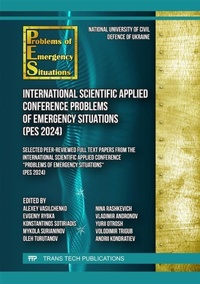
International Scientific Applied Conference Problems of Emergency Situations (PES 2024)
Published on 9. September 2024
170 pages
978-3-0364-1644-1 (ISBN)
Description

The publication contains research articles presented at the International Scientific Applied Conference "Problems of Emergency Situations" (PES 2024, May 16, 2024, Kharkiv, Ukraine) and will be interesting to specialists in construction, mechanical engineering and ecology.
More details
Language
English
Place of publication
Zurich
Switzerland
Target group
Professional and scholarly
Illustrations
Illustrations
File size
15,53 MB
ISBN-13
978-3-0364-1644-1 (9783036416441)
DOI
10.4028/b-x4MhZE
Copyright in bibliographic data and cover images is held by Nielsen Book Services Limited or by the publishers or by their respective licensors: all rights reserved.
Schweitzer Classification
Other editions
Additional editions
Alexey Vasilchenko | Evgeniy Rybka | Konstantinos Sotiriadis
International Scientific Applied Conference Problems of Emergency Situations (PES 2024)
Book
10/2024
Trans Tech Publications Ltd
€167.13
Shipment within 10-20 days
Content
Preface
Chapter 1: Mechanics of Structures
Effective Application of Numerical Approaches and Green Functions for the Process of Modelling Spheres
Use of the Boundary Element Method for Solving Problems of Predicting the Regularities of Formation of the Structure of Non-Isometric Components
Special Features of Using Mathematical Modeling for the Study of Tetrahedral Elements
Justification of the Dynamics of Extra-Project Loads on Building Structures
Chapter 2: Building Structures
Deformability and Crack Resistance of Reinforced Concrete and Fiber-Reinforced Concrete Cross-Beam Systems
Comparative Analysis of the Load-Bearing Capacity and Crack Resistance of Reinforced Concrete and Fiber-Reinforced Concrete Airfield Slabs
Modeling of Building Structures Resistance to Collapse Failure from Explosive Impact
Analytical Calculation of Beams on Winkler's Variable Elastic Foundation
Chapter 3: Research and Design of Machines and Equipment
Ways to Reduce the Mass of Body Parts of Closed Gears
Investigation of Diffraction of Electromagnetic Microwaves on Explosive Materials
Using of Hydrogen Sorbtion Storing Technology Based on Metal Hydrides for Cooling of High-Power Electric Generators with Steam Turbines
Mathematical Model of the Dynamics of Spherical Elements
Computer Modelling of the Process of Separation of Heterogeneous Elements (Spheres)
Chapter 4: Waste Recycling and Waste Management
Multi-Criteria Analysis of Technology that Ensure Environmental Safety in Waste Incineration
Development and Implementation of Environmentally Safe Biotechnologies for the Utilization of Aquatic Organisms Biomass
Chapter 1: Mechanics of Structures
Effective Application of Numerical Approaches and Green Functions for the Process of Modelling Spheres
Use of the Boundary Element Method for Solving Problems of Predicting the Regularities of Formation of the Structure of Non-Isometric Components
Special Features of Using Mathematical Modeling for the Study of Tetrahedral Elements
Justification of the Dynamics of Extra-Project Loads on Building Structures
Chapter 2: Building Structures
Deformability and Crack Resistance of Reinforced Concrete and Fiber-Reinforced Concrete Cross-Beam Systems
Comparative Analysis of the Load-Bearing Capacity and Crack Resistance of Reinforced Concrete and Fiber-Reinforced Concrete Airfield Slabs
Modeling of Building Structures Resistance to Collapse Failure from Explosive Impact
Analytical Calculation of Beams on Winkler's Variable Elastic Foundation
Chapter 3: Research and Design of Machines and Equipment
Ways to Reduce the Mass of Body Parts of Closed Gears
Investigation of Diffraction of Electromagnetic Microwaves on Explosive Materials
Using of Hydrogen Sorbtion Storing Technology Based on Metal Hydrides for Cooling of High-Power Electric Generators with Steam Turbines
Mathematical Model of the Dynamics of Spherical Elements
Computer Modelling of the Process of Separation of Heterogeneous Elements (Spheres)
Chapter 4: Waste Recycling and Waste Management
Multi-Criteria Analysis of Technology that Ensure Environmental Safety in Waste Incineration
Development and Implementation of Environmentally Safe Biotechnologies for the Utilization of Aquatic Organisms Biomass
