

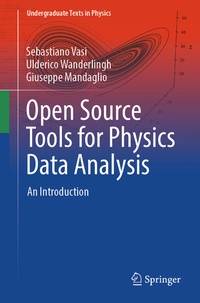
Open Source Tools for Physics Data Analysis
Description

This textbook aims to provide computing skills to analyze data collected by means of several types of experiments. Generally speaking, the analysis of data is complementary to experimental and/or theoretical activities, but, as a matter of fact, a fundamental part of the training process in scientific degree courses (such as physics, mathematics, chemistry, biology, and engineering) consists in different laboratory activities, collecting data and then analyzing and interpreting them. Different analysis tools are available for this purpose, including commercial and open-sources ones. Some of them allow to analyze data in a user-friendly manner, and it can be helpful for the first approach for a student to a data analysis problem, but, at the same time, it represents a limit on the real possibility that students can achieve by using the computation potentiality offered by a good knowledge of programming languages. For this reason, at least a computing course is generally present in scientific degree courses, as well as in experimental laboratories in which part of the training time is devoted to analyze and visualize data.
Part of the book is devoted to furnishing the rudiments of programming in C++, Python, and other open-source languages. In the second part, Root, a powerful and open-source data analysis framework, and the universe of the Python libraries will be introduced as a complete tool for data analysis, as well as their application and examples regarding physics experiments performed in laboratories.
More details
Other editions
Additional editions
Persons
Sebastiano Vasi received a B.Sc., a M.Sc., and a Ph.D. degrees in Physics from the University of Messina, Italy, in 2010, 2013, and 2017, respectively. Actually, he is a researcher at the MIFT Department of the University of Messina. His expertise is on experimental physics of matter, applied physics, and teaching of physics. The most important past activities concern the optical trapping of nanostructures, the thermodynamic study of the interaction between water and biological molecules, the fabrication of low-dimensional materials and investigation of their properties (thin film, 2D materials, etc.) and applications.
Ulderico Wanderlingh, Ph.D., is Associate Professor of Experimental Physics at the University of Messina. His research spans neutron spectroscopy, membrane biophysics, calcium dynamics in astrocytes, and water behavior in confined systems. He has over 80 publications and extensive experience in science education and outreach. Wanderlingh has also coordinated advanced physics courses and collaborated internationally, combining experimental techniques with computational modeling in the study of complex biological and physical systems.
Giuseppe Mandaglio earned his PhD in Physics in 2007 and is currently an Associate Professor in Experimental Physics of Fundamental Interactions at the University of Messina. His research has focused on investigating nuclear reactions for the synthesis of heavy and superheavy elements, as well as on meson photoproduction through the GRAAL and BGOOD experiments. He is also actively involved in hadron physics research with the KLOE2 and ALICE collaborations. Actually, Professor Mandaglio teaches data analysis to undergraduate physics students and Particle Physics to Master's students at the University of Messina.
Content
Introduction.- Operative systems and Linux Shells.- Rudimental in programming.- Why Object Oriented programming.- Analysis Framework.- Data elaboration and visualization.- Experimental data acquisition and analysis.
