

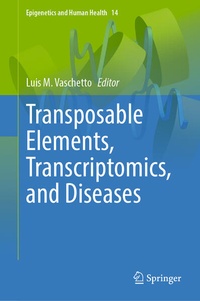
Transposable Elements, Transcriptomics, and Diseases
Description

Transposable elements (TEs) are mobile DNA sequences once referred to as "selfish DNA". While they have contributed significantly to genome evolution, their movement can often disrupt genes and lead to disease. To counteract this, organisms have developed post-transcriptional, transcriptional, and epigenetic mechanisms to control TE activity.
This book explores the complex interplay between mobile genetic elements and human health, providing a comprehensive overview of TE biology, their modes of action, and the strategies employed to suppress their movement, and offering valuable insights into potential therapeutic interventions targeting TE-related diseases. In particular, the book reviews how TEs affect gene expression and contribute to diseases such as cancer, neurodegenerative diseases, and inherited disorders. Other topics include TE polymorphisms, epigenetic control, co-opted functions, non-coding RNAs, and their roles in environmental stress and immune pathways.
Providing a comprehensive reference on the subject, this book is intended for researchers and advanced students in genetics and related disciplines.
More details
Other editions
Additional editions
Person
Luis María Vaschetto obtained his Ph.D. in Biological Sciences from the Universidad Nacional de Córdoba (Argentina). He was a postdoctoral researcher at the Consejo Nacional de Investigaciones Científicas y Técnicas (CONICET) and a Research Associate at the South Dakota State University (SDSU). He has first-authored over ten academic articles in top-tier journals such as WIREs RNA, Briefings in Functional Genomics, Journal of Cellular Biochemistry, Molecular Breeding, Current Gene Therapy, RNA Biology, and Current Genetics , and also published several book chapters. Currently, Luis Maria is Series Editor for the Book Series Epigenetics and Human Health ( EHH ), published by Springer Nature (Switzerland). He has edited and authored eight international books, including two for the EHH series and three for Methods in Molecular Biology ( MiMB , Springer Nature, USA). His research mainly focuses on understanding the epigenetic mechanisms involved in plant and animal development, as well as their effects on human health and diseases.
Content
Chapter 1. Transposable Elements and Genome Evolution in Vertebrates.- Chapter 2. Transposable Elements and Gene Duplication.- Chapter 3. Transposable Elements and their Roles in Genome Architecture.- Chapter 4. Epigenetic Control of Transposable Elements.- Chapter 5. Transposable Element-Derived Non-coding RNAs.- Chapter 6. Transposable Elements: The Role of the piRNA Pathway.- Chapter 7. The Role of Transposable Elements in Development.- Chapter 8. The Impact of Transposable Elements on Immune Pathways.- Chapter 9. Transposable Elements and Hereditary Diseases.- Chapter 10. Transposable Elements in Cancer.- Chapter 11. Transposable Elements as Drivers of Age-Related Neurodegenerative Disease.- Chapter 12. Retrotransposons: Silent Architects of Vascular Aging and Disease.- Chapter 13. The Role of Transposable Elements in Therapeutics.
