

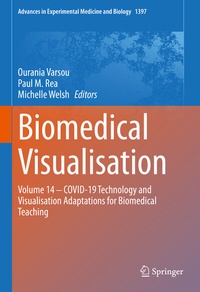
Biomedical Visualisation
Description

This book focuses on the challenges to biomedical education posed by the lockdowns and restrictions to on campus teaching brought about by the COVID-19 pandemic and highlights the tools and digital visualization technologies that have been successfully developed and used for remote teaching.
Biomedical education for science, medical, dental and allied health professionals relies on teaching visual and tactile knowledge using practice-based approaches. This has been delivered for decades via on-campus lectures, workshops and laboratories, teaching practical skills as well as fundamental knowledge and understanding. However, the arrival of the COVID-19 pandemic meant that education across the globe had to pivot very quickly to be able to deliver these skills and knowledge in a predominantly online environment. This brought with it many challenges, as Higher Education staff, had to adapt to deliver these visual subjects remotely.This book addresses the challenges and solutions faced by Higher Education staff in teaching visual content in distance education. Chapters include literature reviews, original research, and pedagogical reflections for a wide range of biomedical subjects, degrees such as medicine, dentistry and veterinary sciences with examples from undergraduate and postgraduate settings. The goal of the book is to provide a compendium of expertise based on evidence gathered during the COVID-19 pandemic, as well as reflections on the challenges and lessons learned from this dramatic shift in teaching. It also presents new examples of best practices that have emerged from this experience to ensure that they are not lost as we return to on-campus learning in a new era of biomedical teaching.
This book will be of interest to anyone looking for a helpful reference point when designing online or blended teaching for visual practice-based subjects.
More details
Other editions
Additional editions
Persons
Content
Chapter 1. Pandemic-Era Digital Education: Insights from an Undergraduate Medical Programme.- Chapter 2. Use of Lt Systems in Large Class Lab Delivery.- Chapter 3. COVID-19 Adaptations for Biomedical Teaching and Assessment Within the Undergraduate Dental Curriculum.- Chapter 4. One Size Does Not Fit All in Remote Anatomy Teaching.- Chapter 5. From Lecture Halls to Zoom Links: How Can Educational Theory Help Us to Deliver Effective and Engaging Teaching in an Online Environment?.- Chapter 6. Collaborative, Two-Directional Live Streaming to Deliver Hands-on Dissection Experience during the COVID-19 Lockdown.- Chapter 7. Livestreaming Can Augment the Observation of Veterinary Post-mortem Examinations.- Chapter 8. Virtual Reality for Anatomy and Surgical Teaching.- Chapter 9. Can Synchronous Online Near-Peer Teaching Offer the Same Benefits as the Face-to-Face Version When Used in Clinical Neuroanatomy Education?.- Chapter 10. COVID-19 Adaptations with Virtual Microscopy.- Chapter 11.The Challenges of Visualisation During Delivery and Assessment of Clinical Teaching Under COVID-19: A Reflective Account of Problem Solving.- Chapter 12. Not for Room 101.
