

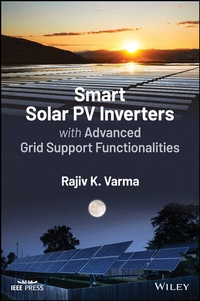
Smart Solar PV Inverters with Advanced Grid Support Functionalities
Description

Smart Solar PV Inverters with Advanced Grid Support Functionalities presents a comprehensive coverage of smart PV inverter technologies in alleviating grid integration challenges of solar PV systems and for additionally enhancing grid reliability. Accomplished author Rajiv Varma systematically integrates information from the wealth of knowledge on smart inverters available from EPRI, NREL, NERC, SIWG, EU-PVSEC, CIGRE, IEEE publications; and utility experiences worldwide. The book further presents a novel, author-developed and patented smart inverter technology for utilizing solar PV plants both in the night and day as a Flexible AC Transmission System (FACTS) Controller STATCOM, named PV-STATCOM. Replete with case studies, this book includes over 600 references and 280 illustrations.
Smart Solar PV Inverters with Advanced Grid Support Functionalities' features include:
* Concepts of active and reactive power control; description of different smart inverter functions, and modeling of smart PV inverter systems
* Distribution system applications of PV-STATCOM for dynamic voltage control, enhancing connectivity of solar PV and wind farms, and stabilization of critical motors
* Transmission system applications of PV-STATCOM for improving power transfer capacity, power oscillation damping (POD), suppression of subsynchronous oscillations, mitigation of fault induced delayed voltage recovery (FIDVR), and fast frequency response (FFR) with POD
* Hosting capacity for solar PV systems, its enhancement through effective settings of different smart inverter functions; and control coordination of smart PV inverters
* Emerging smart inverter grid support functions and their pioneering field demonstrations worldwide, including Canada, USA, UK, Chile, China, and India.
Perfect for system planners and system operators, utility engineers, inverter manufacturers and solar farm developers, this book will prove to be an important resource for academics and graduate students involved in electrical power and renewable energy systems.
More details
Other editions
Additional editions
Person
Rajiv K. Varma is Professor in Electrical and Computer Engineering at the University of Western Ontario in London, ON, Canada. He is an internationally renowned researcher in FACTS and grid integration of solar PV and wind power systems. He received the prestigious IEEE PES Nari Hingorani FACTS Award in 2021 "for advancing FACTS controllers application in education, research, and professional society, and for developing an innovative STATCOM technology utilizing PV solar farms." He became a Fellow of the Canadian Academy of Engineering in 2021 with the citation, "...Among his pioneering contributions has been a major ground-breaking utility-implemented award-winning technology, PV-STATCOM, that enables solar PV plants to provide FACTS functionalities at one-tenth cost of FACTS themselves..."
Content
About the Author xxiii
Foreword xxv
Preface xxvii
Acknowledgments xxxi
List of Abbreviations xxxiii
1 Impacts of High Penetration of Solar PV Systems and Smart Inverter Developments 1
2 Smart Inverter Functions 35
3 Modeling and Control of Three-Phase Smart PV Inverters 73
4 PV-STATCOM: A New Smart PV Inverter and a New FACTS Controller 107
5 PV-STATCOM Applications in Distribution Systems 145
6 PV-STATCOM Applications in Transmission Systems 205
7 Increasing Hosting Capacity by Smart Inverters - Concepts and Applications 301
8 Control Coordination of Smart PV Inverters 369
9 Emerging Trends with Smart Solar PV Inverters 431
Index 465
PREFACE
Solar photovoltaic (PV) systems are the fastest growing renewable energy systems, worldwide. It is expected that by 2050 about 35% of global electricity will be provided by solar PV systems. While this technology is helping reduce greenhouse gas emissions and meeting the climate targets for the planet, researchers worldwide have been engaged in developing technologies for additional and novel usages of solar systems.
Solar PV systems are based on inverters which have traditionally provided only active power generation from solar energy. Power electronics however allows several additional capabilities to be realized from the same inverters which can be of tremendous benefit in enhancing the stability and reliability of power systems. Efforts have been ongoing worldwide to develop such "advanced" or "smart" functionalities on solar PV inverters. Such inverters have been termed as "advanced inverters" or more commonly as "smart inverters." Smart inverter functions have been shown to not only mitigate the problems of integration of solar systems themselves but also to alleviate challenges in power systems caused by other sources, such as disturbance events. The developments of smart inverter functionalities have outpaced the Standards responsible for integrating solar PV systems in the grid. The interest and engagement of academics, utilities, system planners, regulators, operators, and manufacturers in the development of the smart inverter technologies is very high.
A wealth of literature has been published over the last two decades describing the controls, simulation studies, laboratory implementations and operating experiences of various functionalities of smart inverters, which continues to grow every day at a very rapid pace. Unfortunately, this invaluable literature is scattered and not available in a comprehensive form.
In 2008, the province of Ontario in Canada undertook a major initiative to develop innovative technologies for integrating solar PV systems at a large scale in transmission and distribution systems. The author of this book was privileged to be selected to lead three highly funded ($8.2 Million) multi-university multi-disciplinary multi-utility research grants in Ontario to achieve this objective. During this period, the author developed a new patented technology of utilizing solar PV systems in the night and day as STATic Synchronous COMpensator (STATCOM), naming it PV-STATCOM, for providing various grid support functionalities which are typically provided by Flexible AC Transmission System (FACTS).
The author was also fortunate to be the team-lead for the first-time delivery of the IEEE Tutorial on "Smart Inverters" with leading experts from EPRI, NREL, National Grid, Southern California Edison, Enphase Energy, and First Solar. This Tutorial was delivered with great success for four consecutive years in IEEE Power & Energy Society (PES) Conferences. This also provided the author a great learning experience of different perspectives of smart inverters. The author also presented several panels sessions in IEEE PES General Meetings, and invited lectures, courses and workshops on smart inverters in different countries.
All the above provided the motivation to compile and organize, even though on a minute scale, the enormously rich and vastly distributed literature on smart inverters in the form of a book. The author is very grateful to the immense knowledge contributed by researchers worldwide, and leading organizations such as IEEE, EPRI, NREL, NERC, WECC, LBNL, CAISO, CIGRE, IEA PVPS Task 14 Group, to name only a few, from whose knowledge and contributions this book has greatly benefited.
This book is organized into nine chapters.
Chapter 1 presents the concepts of reactive power and active power control, which form the basis of smart inverter functions. The impact of such controls on system voltage and frequency are explained. Different challenges of high solar PV penetration in transmission and distribution systems are briefly described. The evolution of smart inverter technology is then presented.
Chapter 2 presents different smart inverter functions for both reactive power and active power based voltage control. The voltage and frequency ride through functions are explained and their implementation in different Standards such as IEEE Standard 1547-2018 and NERC's Standard PRC 024-3 are described. Smart inverter functions for battery energy storage systems are further elucidated. The prioritization of different smart inverter functions are discussed. Emerging smart inverter functions are then introduced.
Chapter 3 presents the basic concepts of active and reactive power flow in a smart inverter system. The operating principles and models of different subsystems in the power circuit and control circuit of a smart PV inverter system are described. The implementation methodology of different smart inverter controls is explained with smart inverter voltage controller as an example. The principle of achieving a decoupled control of active power and reactive power is presented. The modeling needs of different smart inverter controllers are discussed.
Chapter 4 presents the basic concepts of FACTS technology and two of its main-shunt connected member Controllers - the Static Var Compensator (SVC) and STATCOM. The focus of this Chapter is to present a new technology developed by this book's author, of utilizing PV solar farms both during nighttime when solar farms are typically idle and during any time of system need during daytime as a STATCOM, named PV-STATCOM. The different nighttime and daytime operating modes of the PV-STATCOM are illustrated. The cost of transforming an existing solar PV system into PV-STATCOM as well as its operating costs are analyzed. Subsequently, the potential of PV-STATCOM technology in providing various benefits in transmission and distribution systems, is elucidated.
Chapter 5 describes different night and day applications of PV-STATCOM technology for providing various grid support functions related to distribution systems, with case studies. These include dynamic voltage control, enhancing connectivity of PV solar farms, increasing connectivity of neighboring wind farms, and stabilization of critical motors. These are the functions for which typically SVCs or STATCOMs are employed, which are quite expensive.
Chapter 6 presents different night and day grid support functions provided by PV-STATCOM in transmission systems. These comprise improving power transfer capacity in transmission lines, damping of power oscillations and alleviation of Fault Induced Delayed Voltage Recovery (FIDVR). These functionalities are provided by reactive power modulation at night and by a combination of active and reactive power modulation during daytime. PV-STATCOM applications are also presented for mitigation of subsynchronous oscillations in synchronous generators and induction generator based wind farms connected to series compensated transmission lines. A unique PV-STATCOM functionality of simultaneously providing fast frequency response and power oscillation damping is also described with a case study.
Chapter 7 explains the concept of hosting capacity for solar PV systems and its enhancement in distribution networks. Different non smart inverter based methods for increasing hosting capacity are presented. The characteristics of different smart inverter functions and their effectiveness in improving hosting capacity are discussed. The methodologies and guidelines for selecting the settings of different smart inverter functions are explained. Several simulation studies of increasing hosting capacity in utility networks are described. Finally, different worldwide field implementations of smart inverters in enhancing hosting capacity are presented and their key takeaways highlighted.
Chapter 8 presents the concepts of control coordination and discusses the lessons learned from control coordination of FACTS Controllers, which would be helpful in resolving control interaction issues in smart inverters. Control coordination issues of smart PV inverters with conventional voltage control equipment are presented. Case studies of control interactions between same and different smart inverter functions among neighboring smart inverters are described. A detailed small signal study of the various factors causing control interaction between two smart inverters in a distribution feeder, validated by electromagnetic transients simulations, is presented. A comprehensive control coordination study of 100 MW PV-STATCOM and 100 MW Doubly Fed Induction Generator (DFIG) based wind farm connected to series compensated line in mitigating subsynchronous oscillations is also described.
Chapter 9 deals with some of the fast-emerging trends with smart PV inverters. Some application examples are presented of enhanced grid support capabilities enabled by integrating the smart inverter functionalities of solar PV inverters, Battery Energy Storage Systems and Electric Vehicle Chargers. A new technology of "grid forming inverters" that is presently being widely researched across the world, is introduced.
The main focus of this Chapter is to describe the field demonstrations of novel smart PV inverter functions which can provide significant cost savings and benefits to power transmission and distribution systems. These advanced grid support functions are presently not mandated in any Standard worldwide for grid interconnection of solar PV...
