

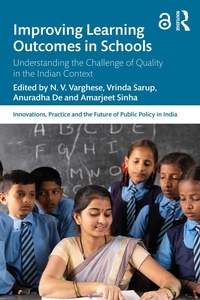
Improving Learning Outcomes in Schools
Understanding the Challenge of Quality in the Indian Context
Published on 20. October 2025
438 pages
978-1-040-62864-5 (ISBN)
Description

What does 'quality education' truly mean, and how can we ensure it is accessible to all children, regardless of their background? This book delves into these pressing questions, offering a comprehensive exploration of the challenges and opportunities within India's education system.
Why do millions of children in India attend school yet still struggle to acquire basic literacy and numeracy skills? This book examines the varied reasons behind poor learning outcomes, illustrating why high enrolment rates have not translated into meaningful educational progress. It underscores the urgent need to shift the focus from merely getting children into schools to ensuring they learn and thrive. Through real-world case studies, insightful policy analysis, and a focus on innovative state and national initiatives, the book unpacks what works in education - and what does not. From the role of teachers and school leadership to the importance of inclusive policies and community engagement, it offers a holistic view of the factors influencing student achievement.
As a part of the Innovations, Practice and the Future of Public Policy in India series, this open access volume will interest policy professionals, academics, and researchers in education, pedagogy, curriculum design, education economics, and development studies.
This book is freely available as a downloadable Open Access PDF at http://www.taylorfrancis.com under a Creative Commons (CC-BY-NC-ND) 4.0 license.
Why do millions of children in India attend school yet still struggle to acquire basic literacy and numeracy skills? This book examines the varied reasons behind poor learning outcomes, illustrating why high enrolment rates have not translated into meaningful educational progress. It underscores the urgent need to shift the focus from merely getting children into schools to ensuring they learn and thrive. Through real-world case studies, insightful policy analysis, and a focus on innovative state and national initiatives, the book unpacks what works in education - and what does not. From the role of teachers and school leadership to the importance of inclusive policies and community engagement, it offers a holistic view of the factors influencing student achievement.
As a part of the Innovations, Practice and the Future of Public Policy in India series, this open access volume will interest policy professionals, academics, and researchers in education, pedagogy, curriculum design, education economics, and development studies.
This book is freely available as a downloadable Open Access PDF at http://www.taylorfrancis.com under a Creative Commons (CC-BY-NC-ND) 4.0 license.
Reviews / Votes
'These volumes fill a unique niche in the continuum between academic research and advocacy. They go beyond merely identifying challenges in various aspects of human development, particularly health, nutrition, and education, and instead explore potential solutions through critical reviews of what works. This makes the collection immensely valuable to both academicians and practitioners, rendering these volumes essential reading for anyone interested in public policy.'Sonalde Desai, Professor, National Council of Applied Economic Research and University of Maryland, USA.
'Human development cannot be viewed segmentally through a reductionist lens, since the various elements are closely integrated and impact each other. Health is inseparable from nutrition, and both are influenced by education, environment and economic development. In each of these, equity is the litmus test of development serving its social purpose. These six volumes knit these varied skeins into a unified tapestry of human development. While detailing the key components of each of the main themes, the composite collection connects them to create a coherent design for accelerated and equitable people centric human development in India.'
K. Srinath Reddy, Founder (Past) President, Public Health Foundation of India
'These volumes compile the results of many micro studies in the areas of health, nutrition, education and rural livelihood development. These are critical areas where India needs to improve performance to achieve the objective of Viksit Bharat. Larger funding is unavoidable but even more important is to ensure efficiency of spending and it is here that these micro studies will provide evidence-based guidance in what works and in what circumstances. The solutions will not be the same across all states and this must be built into the design of each programme at the state level. The collection is an invaluable contribution in this very important area.'
Montek Singh Ahluwalia, Ex-Deputy Chairman, Planning Commission of India
'The volume's (Improving Learning Outcomes in Schools) thematic progression is logical and insightful. It transitions smoothly from policy to practice, covering critical dimensions of education reform while maintaining a focus on solutions and systemic transformation. The multi-faceted approach, incorporating governance, data, implementation, and teacher performance, makes it a well-rounded contribution to the discourse on improving school quality in India.'
Praveen Jha, Professor of Economics, Jawaharlal Nehru University, New Delhi
More details
Series
Language
English
Place of publication
London
United Kingdom
Publishing group
Taylor & Francis Ltd
Target group
College/higher education
Professional and scholarly
Product notice
Reflowable
Illustrations
47 Tables, black and white; 1 Line drawings, black and white; 17 Halftones, black and white; 18 Illustrations, black and white
File size
3,26 MB
ISBN-13
978-1-040-62864-5 (9781040628645)
Copyright in bibliographic data and cover images is held by Nielsen Book Services Limited or by the publishers or by their respective licensors: all rights reserved.
Schweitzer Classification
Other editions
Additional editions

N. V. Varghese | Vrinda Sarup | Anuradha De
Improving Learning Outcomes in Schools
Understanding the Challenge of Quality in the Indian Context
Book
10/2025
1st Edition
Routledge
€209.00
Shipment within 15-20 days
N. V. Varghese | Vrinda Sarup | Anuradha De
Improving Learning Outcomes in Schools
Understanding the Challenge of Quality in the Indian Context
Book
10/2025
1st Edition
Routledge
€65.00
Shipment within 15-20 days
Persons
N.V. Varghese is a distinguished visiting professor at IIT Bombay and former NIEPA vice chancellor. He is a global expert in educational planning, with over 40 books and 250 publications to his name.
Vrinda Sarup is a retired IAS officer. She led national education programmes like Sarva Shiksha Abhiyan and continues to advise on school education and public policy reforms.
Anuradha De is an economist, a senior policy advisor at CESP and director of CORD. She has led pioneering field-based research on education, welfare schemes, and development through CORD and major national studies like PROBE.
Amarjeet Sinha is a former IAS officer and policy expert. He has shaped key national programmes in education, health, and rural development, with a focus on inclusive and last-mile governance.
Vrinda Sarup is a retired IAS officer. She led national education programmes like Sarva Shiksha Abhiyan and continues to advise on school education and public policy reforms.
Anuradha De is an economist, a senior policy advisor at CESP and director of CORD. She has led pioneering field-based research on education, welfare schemes, and development through CORD and major national studies like PROBE.
Amarjeet Sinha is a former IAS officer and policy expert. He has shaped key national programmes in education, health, and rural development, with a focus on inclusive and last-mile governance.
Content
List of Figures xii List of Tables xiii List of Contributors xv Preface to Volume xxii Preface xxiv Acknowledgements xxvi Improving Learning Outcomes in Schools: Understanding the Challenge of Quality in the Indian Context 1 N.V. Varghese, Vrinda Sarup, Anuradha De, and Amarjeet Sinha PART I Overview 17 1 Global Learning Crisis and Cumulative Learning Deficit in India 19 N.V. Varghese 2 Improved Social Participation and Learning Outcomes in Schools: A Review of Initiatives Since 1986 40 Amarjeet Sinha 3 Managing Learning Outcomes: What Is to Be Done? 66 Vrinda Sarup 4 Improving Learning Outcomes at Scale: Learning from System-Focused Programmes 89 Dhir Jhingran PART II Data 111 5 Data and Governance in Education: A Review of the Indian Experience 113 Kiran Bhatty and Anuradha De 6 Improving Learning Outcomes in India Through Large-Scale Assessments: Learnings from Educational Initiatives 142 Sridhar Rajagopalan and Gayatri Vaidya 7 Evidence and Effective Interventions: What Do Studies Tell Us About Improving Learning Outcomes in India? 171 Rukmini Banerji and Deepak Kumar 8 Learning from the National Achievement Studies on Performance of States 201 Sridhar Srivastava PART III States 223 9 School Education Reforms in Karnataka: Focus on Teacher and Child 225 Sanjay Kaul 10 Activity-Based Learning (ABL) in Tamil Nadu 242 M. P. Vijaya Kumar 11 Evolving as a High-Performing Education System 255 Nand Kumar 12 Initiation for Improving Learning Outcomes in Bihar: Reflection on State-Specific Interventions 275 S. A. Moin and Chandra B. P. Singh 13 Improving Schools in Uttar Pradesh: Learning from Successes and Failures 290 Vijay Kiran Anand 14 Transformative Education Reforms in Punjab, India: A Comprehensive Overview 311 Aarushi Jain and B. Padmapriya PART IV Teachers 343 15 Against All Odds: DIETs and Quality Pre-service Teacher Education in India 345 Padma M. Sarangapani 16 The Valiant Government Schoolteachers of India: A View From the Ground 359 S. Giridhar 17 Challenges to Improve Learning Levels of All Children in Government Primary Schools in Rural Haryana 376 Anuradha De and Meera Samson Index 404
