

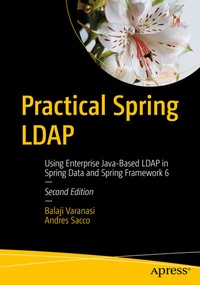
Practical Spring LDAP
Using Enterprise Java-Based LDAP in Spring Data and Spring Framework 6
2nd Edition
Published on 18. December 2023
XX, 322 pages
979-8-8688-0002-3 (ISBN)
Description

This revised edition is your practical, hands-on guide to developing Java-based enterprise applications with big data or batches of data using the Spring LDAP and the Spring Data LDAP frameworks. The book covers these popular Spring project modules and explains the purpose and fundamental concepts of LDAP before giving a comprehensive tour of the latest version of Spring LDAP and Spring Data LDAP as found in Spring Framework 6.
The book provides a detailed treatment of LDAP controls and the new features of Spring LDAP such as Object Directory Mapping and LDIF parsing. LDAP has become the de facto standard for storing and accessing information in enterprises. Despite its widespread adoption, developers often struggle when it comes to using this technology effectively. The traditional Java LDAP and JNDI approaches have proven to be painful and have resulted in complex, less modular applications. The Spring LDAP framework provides an ideal alternative.
After reading and using this book, you'll come away with a level of comfort for working with large batches of data or big data in your enterprise Spring applications development.
What You'll Learn
Intermediate to advanced Java and Spring software developers; programmers with at least some prior experience in Java, especially the Spring Framework
The book provides a detailed treatment of LDAP controls and the new features of Spring LDAP such as Object Directory Mapping and LDIF parsing. LDAP has become the de facto standard for storing and accessing information in enterprises. Despite its widespread adoption, developers often struggle when it comes to using this technology effectively. The traditional Java LDAP and JNDI approaches have proven to be painful and have resulted in complex, less modular applications. The Spring LDAP framework provides an ideal alternative.
After reading and using this book, you'll come away with a level of comfort for working with large batches of data or big data in your enterprise Spring applications development.
What You'll Learn
- Explore "What is Java LDAP?" and understand the Spring LDAP and Spring Data LDAP frameworks
- Search LDAP resources
- Sort and page your LDAP results
- Dive into object directory mapping
- Handle LDAP transactions and more
Intermediate to advanced Java and Spring software developers; programmers with at least some prior experience in Java, especially the Spring Framework
More details
Series
Edition
Second Edition
Language
English
Place of publication
Berkeley
United States
Publishing group
APRESS
Target group
Professional and scholarly
Product notice
Reflowable
Illustrations
XX, 322 p. 57 illus.
File size
7,95 MB
ISBN-13
979-8-8688-0002-3 (9798868800023)
DOI
10.1007/979-8-8688-0002-3
Schweitzer Classification
Other editions
Additional editions
Balaji Varanasi | Andres Sacco
Practical Spring LDAP
Using Enterprise Java-Based LDAP in Spring Data and Spring Framework 6
Book
12/2023
2nd Edition
APress
€53.49
Shipment within 10-15 days
Previous edition
E-Book
11/2013
APress
€39.58
Available for download
Persons
Balaji Varanasi
is a software development manager and technology entrepreneur. He has over 13 years of experience architecting and developing Java/.NET applications and, more recently, iPhone apps. During this period, he has worked in the areas of security, web accessibility, search, and enterprise portals. He has a master's degree in computer science and serves as adjunct faculty, teaching programming and information system courses. When not programming, he enjoys spending time with his lovely wife in Salt Lake City, Utah.
Andres Sacco has been working as a developer since 2007 in different languages, including Java, PHP, Node.js, Scala, and Kotlin. His background is mostly in Java and the libraries or frameworks associated with this language. At most of the companies he worked for, he researched new technologies to improve the performance, stability, and quality of the applications of each company. In 2017, he started to find new ways to optimizethe transference of data between applications to reduce the cost of infrastructure. He suggested some actions, some applicable in all of the manual microservices and others in just a few. All of this work includes creating a series of theoric-practical projects (available on Manning.com). Recently, he co-authored an Apress book on Beginning Scala 3. He also, published a set of theoric-practical projects about uncommon ways of testing, such as architecture tests and chaos engineering.
Andres Sacco has been working as a developer since 2007 in different languages, including Java, PHP, Node.js, Scala, and Kotlin. His background is mostly in Java and the libraries or frameworks associated with this language. At most of the companies he worked for, he researched new technologies to improve the performance, stability, and quality of the applications of each company. In 2017, he started to find new ways to optimizethe transference of data between applications to reduce the cost of infrastructure. He suggested some actions, some applicable in all of the manual microservices and others in just a few. All of this work includes creating a series of theoric-practical projects (available on Manning.com). Recently, he co-authored an Apress book on Beginning Scala 3. He also, published a set of theoric-practical projects about uncommon ways of testing, such as architecture tests and chaos engineering.
Content
1. Introduction to LDAP.- 2. Java Support for LDAP.- 3. Introducing Spring LDAP and Spring Data LDAP.- 4. Testing LDAP Code.- 5. Advanced Spring LDAP.- 6. Searching LDAP.- 7. Sorting and Paging Results.- 8. Object-Directory Mapping.- 9. LDAP Transactions.- 10. Odds and Ends.
