

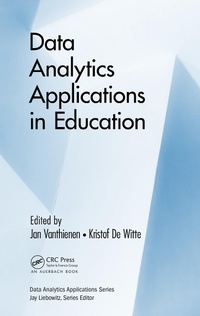
Data Analytics Applications in Education
Published on 29. September 2017
275 pages
978-1-4987-6928-0 (ISBN)
Description

The abundance of data and the rise of new quantitative and statistical techniques have created a promising area: data analytics. This combination of a culture of data-driven decision making and techniques to include domain knowledge allows organizations to exploit big data analytics in their evaluation and decision processes. Also, in education and learning, big data analytics is being used to enhance the learning process, to evaluate efficiency, to improve feedback, and to enrich the learning experience.
As every step a student takes in the online world can be traced, analyzed, and used, there are plenty of opportunities to improve the learning process of students. First, data analytics techniques can be used to enhance the student' s learning process by providing real-time feedback, or by enriching the learning experience. Second, data analytics can be used to support the instructor or teacher. Using data analytics, the instructor can better trace, and take targeted actions to improve, the learning process of the student. Third, there are possibilities in using data analytics to measure the performance of instructors. Finally, for policy makers, it is often unclear how schools use their available resources to "produce" outcomes. By combining structured and unstructured data from various sources, data analytics might provide a solution for governments that aim to monitor the performance of schools more closely.
Data analytics in education should not be the domain of a single discipline. Economists should discuss the possibilities, issues, and normative questions with a multidisciplinary team of pedagogists, philosophers, computer scientists, and sociologists. By bringing together various disciplines, a more comprehensive answer can be formulated to the challenges ahead. This book starts this discussion by highlighting some economic perspectives on the use of data analytics in education. The book begins a rich, multidisciplinary discussion that may make data analytics in education seem as natural as a teacher in front of a classroom.
As every step a student takes in the online world can be traced, analyzed, and used, there are plenty of opportunities to improve the learning process of students. First, data analytics techniques can be used to enhance the student' s learning process by providing real-time feedback, or by enriching the learning experience. Second, data analytics can be used to support the instructor or teacher. Using data analytics, the instructor can better trace, and take targeted actions to improve, the learning process of the student. Third, there are possibilities in using data analytics to measure the performance of instructors. Finally, for policy makers, it is often unclear how schools use their available resources to "produce" outcomes. By combining structured and unstructured data from various sources, data analytics might provide a solution for governments that aim to monitor the performance of schools more closely.
Data analytics in education should not be the domain of a single discipline. Economists should discuss the possibilities, issues, and normative questions with a multidisciplinary team of pedagogists, philosophers, computer scientists, and sociologists. By bringing together various disciplines, a more comprehensive answer can be formulated to the challenges ahead. This book starts this discussion by highlighting some economic perspectives on the use of data analytics in education. The book begins a rich, multidisciplinary discussion that may make data analytics in education seem as natural as a teacher in front of a classroom.
More details
Series
Language
English
Place of publication
Philadelphia, PA
United States
Publishing group
Taylor & Francis Inc
Target group
College/higher education
Illustrations
25 Illustrations, black and white
File size
8,23 MB
ISBN-13
978-1-4987-6928-0 (9781498769280)
Copyright in bibliographic data and cover images is held by Nielsen Book Services Limited or by the publishers or by their respective licensors: all rights reserved.
Schweitzer Classification
Other editions
Additional editions
Jan Vanthienen | Kristof De Witte
Data Analytics Applications in Education
Book
06/2021
1st Edition
Auerbach
€73.00
Shipment within 10-20 days
Jan Vanthienen | Kristof De Witte
Data Analytics Applications in Education
Book
09/2017
1st Edition
Auerbach Publishers Inc.
€186.01
Shipment within 15-20 days
Persons
Kristof De Witte is a tenured associate professor at the Faculty of Economics and Business at KU Leuven, Belgium, and he holds the chair in "Effectiveness and Efficiency of Educational Innovations" at Top Institute for Evidence-Based Education Research at Maastricht University, the Netherlands. Kristof De Witte is further an affiliated member of the CESifo Network (Ludwig-Maximilians University and Ifo Institute). At KU Leuven, Kristof De Witte is director of the research center "Leuven Economics of Education Research." His research interests include education economics, performance evaluation, and early school leaving. He has published his work in many international academic journals, including The Economic Journal, Journal of Urban Economics, European Journal of Operational Research, Economics of Education Research, European Journal of Political Economy, and Scientometrics.
Jan Vanthienen is full professor of information systems at KU Leuven, Belgium, Department of Decision Sciences and Information Management, Information Systems Group, where he is teaching and researching on business intelligence, analytics, business rules, processes and decisions, business information systems, and information management. He has published more than 200 full papers in reviewed top international journals (such as MIS Quarterly, Machine Learning, Management Science, Journal of Machine Learning Research, IEEE Transactions on Neural Networks, Expert Systems with Applications, IEEE Transactions on Knowledge and Data Engineering, Information Systems, and Health Information Management Journal) and conference proceedings. He is a founding member and currently coordinator of the Leuven Institute for Research in Information Systems (LIRIS) and co-chairholder of the bpost bank research chair on Actionable Analytics, and the Colruyt-Symeta Research Chair on Smart Marketing Analytics. He received an IBM Faculty Award in 2011 on smart decisions and the Belgian Francqui Chair 2009 at FUNDP on smart systems. He is co-founder and president-elect of the Benelux Association for Information Systems (BENAIS).
Jan Vanthienen is full professor of information systems at KU Leuven, Belgium, Department of Decision Sciences and Information Management, Information Systems Group, where he is teaching and researching on business intelligence, analytics, business rules, processes and decisions, business information systems, and information management. He has published more than 200 full papers in reviewed top international journals (such as MIS Quarterly, Machine Learning, Management Science, Journal of Machine Learning Research, IEEE Transactions on Neural Networks, Expert Systems with Applications, IEEE Transactions on Knowledge and Data Engineering, Information Systems, and Health Information Management Journal) and conference proceedings. He is a founding member and currently coordinator of the Leuven Institute for Research in Information Systems (LIRIS) and co-chairholder of the bpost bank research chair on Actionable Analytics, and the Colruyt-Symeta Research Chair on Smart Marketing Analytics. He received an IBM Faculty Award in 2011 on smart decisions and the Belgian Francqui Chair 2009 at FUNDP on smart systems. He is co-founder and president-elect of the Benelux Association for Information Systems (BENAIS).
Content
Introduction: Big Data Analytics in a Learning Environment. I. Data Analytics to Improve the Learning Process. Improved Student Feedback with Process and Data Analytics. Toward Data for Development: A Model on Learning Communities as a Platform for Growing Data Use. The Impact of Fraudulent Behavior on the Usefulness of Learning Analytics Applications: The Case of Question and Answer Sharing with Medium-Stakes Online Quizzing in Higher Education. II. Data Analytics to Measure Performance. Disentangling Faculty Efficiency from Students' Effort. Using Data Analytics to Benchmark Schools: The Case of Portugal. The Use of Educational Data Mining Procedures to Assess Students' Performance in a Bayesian Framework. Using Statistical Analytics to Study School Performance through Administrative Datasets. III. Policy Relevance and the Challenges Ahead. The Governance of Big Data in Higher Education. Evidence-Based Education and Its Implications for Research and Data Analytics with an Application to the Overeducation Literature.
