

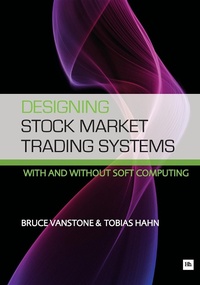
Designing Stock Market Trading Systems
With and without soft computing
1st Edition
Published on 20. May 2011
256 pages
978-0-85719-135-9 (ISBN)
Description

In Designing Stock Market Trading Systems Bruce Vanstone and Tobias Hahn guide you through their tried and tested methodology for building rule-based stock market trading systems using both fundamental and technical data. This book shows the steps required to design and test a trading system until a trading edge is found, how to use artificial neural networks and soft computing to discover an edge and exploit it fully.
Learn how to build trading systems with greater insight and dependability than ever before
Most trading systems today fail to incorporate data from existing research into their operation. This is where Vanstone and Hahn's methodology is unique. Designed to integrate the best of past research on the workings of financial markets into the building of new trading systems, this synthesis helps produce stock market trading systems with unrivalled depth and accuracy.
This book therefore includes a detailed review of key academic research, showing how to test existing research, how to take advantage of it by developing it into a rule-based trading system, and how to improve it with artificial intelligence techniques.
The ideas and methods described in this book have been tried and tested in the heat of the market. They have been used by hedge funds to build their trading systems. Now you can use them too.
More details
Other editions
Additional editions
Book
08/2010
Harriman House Publishing
€92.80
Shipment within 3-4 weeks
Persons
Dr. Bruce Vanstone is an Assistant Professor at Bond University in Australia. He completed his PhD in Computational Finance in 2006. He is a regular presenter and publisher of academic work on stock market trading systems at an international level. He teaches stock market trading courses at university, and is a consultant for a boutique hedge fund in Australia. More information on Bruce's research and methods can be found at http://trading.it.bond.edu.au.
Content
- Intro
- Contents
- Preface
- Acknowledgements
- Introduction
- Chapter 1: Designing Stock Market Trading Systems
- 1.1 Introduction
- 1.2 Motivation
- 1.3 Scope and data
- 1.4 The efficient market hypothesis
- 1.5 The illusion of knowledge
- 1.6 Investing versus trading
- 1.6.1 Investing
- 1.6.2 Trading
- 1.7 Building a mechanical stock market trading system
- 1.8 The place of soft computing
- 1.9 How to use this book
- Chapter 2: Introduction to Trading
- 2.1 Introduction
- 2.2 Different approaches to trading
- 2.2.1 Direction of trading
- 2.2.2 Time frame of trading
- 2.2.3 Type of behaviour exploited
- 2.2.3.1 Trend-based trading
- 2.2.3.2 Breakout trading
- 2.2.3.3 Momentum trading
- 2.2.3.4 Mean reversion trading
- 2.2.3.5 High frequency trading
- 2.3 Conclusion
- 2.4 The next step
- Chapter 3: Fundamental Variables
- 3.1 Introduction
- 3.1.1 Benjamin Graham and value investing
- 3.2 Informational advantage and market efficiency
- 3.3 A note on adjustments
- 3.4 Core strategies
- 3.4.1 Intrinsic value estimates
- 3.4.2 Fundamental filters
- 3.4.3 Ranking filters
- 3.5 The elements of a fundamentals-based filter
- 3.5.1 Wealth of a firm and its shareholders
- 3.5.1.1 Book value
- 3.5.1.2 Current assets vs. current liabilities
- 3.5.1.3 Leverage metrics
- 3.5.2 Earnings capacity
- 3.5.3 Ability to generate cash
- 3.6 Fundamental ratios and industry comparisons
- 3.7 A final note on cross-country investing and research
- 3.8 The next step
- 3.9 Case Study: Analysing a variable
- 3.9.1 Introduction
- 3.9.2 Example - P/E Ratio
- 3.9.3 Wealth-Lab
- 3.9.4 SPSS
- 3.9.5 Outliers
- Chapter 4: Technical Variables
- 4.1 Introduction
- 4.1.1 Charting
- 4.1.2 Technical indicators
- 4.1.3 Other approaches
- 4.2 Charting and pattern analysis
- 4.3 Technical indicators
- 4.3.1 Intermarket analysis
- 4.3.2 Moving averages
- 4.3.3 Volume
- 4.3.4 Momentum indicators
- 4.3.4.1 Moving Average Convergence/Divergence (MACD)
- 4.3.4.2 Relative Strength Indicator (RSI)
- 4.4 Alternative approaches
- 4.5 On use and misuse of technical analysis
- Case Study: Does Technical Analysis Have Any Credibility?
- Chapter 5: Soft Computing
- 5.1 Introduction
- 5.1.1 Types of soft computing
- 5.1.2 Expert systems
- 5.1.3 Case-based reasoning
- 5.1.4 Genetic algorithms
- 5.1.5 Swarm intelligence
- 5.1.6 Artificial neural networks
- 5.2 Review of research
- 5.2.1 Soft computing classifications
- 5.2.2 Research into time series prediction
- 5.2.3 Research into pattern recognition and classification
- 5.2.4 Research into optimisation
- 5.2.5 Research into ensemble approaches
- 5.3 Conclusion
- 5.4 The next step
- Chapter 6: Creating Artificial Neural Networks
- 6.1 Introduction
- 6.2 Expressing your problem
- 6.3 Partitioning data
- 6.4 Finding variables of influence
- 6.5 ANN architecture choices
- 6.6 ANN training
- 6.6.1 Momentum
- 6.6.2 Training rate
- 6.7 ANN in-sample testing
- 6.8 Conclusion
- 6.9 The next step
- Chapter 7: Trading Systems and Distributions
- 7.1 Introduction
- 7.2 Studying a group of trades
- 7.2.1 Average profitability metrics
- 7.2.1.1 The students t-test
- 7.2.1.2 The runs test
- 7.2.2 Winning metrics
- 7.2.3 Losing metrics
- 7.2.4 Summary metrics
- 7.2.5 Distributions
- 7.2.5.1 Short-term distribution
- 7.2.5.2 Medium-term distribution
- 7.2.5.3 Long-term distribution
- 7.2.6 Comparing two sets of raw trades
- 7.3 Conclusions
- 7.4 The next step
- Chapter 8: Position Sizing
- 8.1 Introduction
- 8.1.1 Fixed position sizing
- 8.1.2 Kelly method
- 8.1.3 Optimal-f
- 8.1.4 Percentage of equity
- 8.1.5 Maximum risk percentage
- 8.1.6 Martingale
- 8.1.7 Anti-martingale
- 8.2 Pyramiding
- 8.3 Conclusions
- 8.4 The next step
- Chapter 9: Risk
- 9.1 Introduction
- 9.2 Trade Risk
- 9.2.1 Stop-loss orders
- 9.2.2 Using maximum adverse excursion (MAE) to select the stoploss threshold
- 9.3 Risk of ruin
- 9.4 Portfolio Risk
- 9.5 Additional portfolio metrics
- 9.6 Monte Carlo Analysis
- Case study: are stops useful in trend trading systems?
- Chapter 10: Case Studies
- 10.1 Introduction
- 10.2 A note about data
- 10.3 A note about the case studies
- 10.4 Building a technical trading system with neural networks
- 10.4.1 Splitting data
- 10.4.2 Benchmark initial rules
- 10.4.3 Identify specific problems
- 10.4.4 Identify inputs and outputs for the ANN
- 10.4.5 Train the networks
- 10.4.6 Derive money management and risk settings
- 10.4.7 In-sample benchmarking
- 10.4.8 Out-of-sample benchmarking
- 10.4.9 Decide on final product
- 10.5 Building a fundamental trading system with neural networks
- 10.5.1 Splitting data
- 10.5.2 Benchmark initial rules
- 10.5.3 Identify specific problems
- 10.5.4 Identify inputs and outputs for ANN
- 10.5.5 Train the networks
- 10.5.6 Derive money management and risk settings
- 10.5.7 In-sample benchmarking
- 10.5.8 Out-of-sample benchmarking
- 10.5.9 Decide on final product
- Final thoughts
- Appendices
- Script segments
- Bibliography
- Index
