

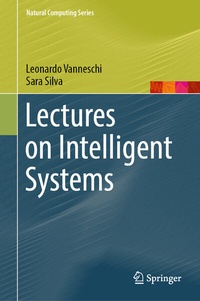
Lectures on Intelligent Systems
Description

This textbook provides the reader with an essential understanding of computational methods for intelligent systems. These are defined as systems that can solve problems autonomously, in particular problems where algorithmic solutions are inconceivable for humans or not practically executable by computers. Despite the rapidly growing applications in this field, the book avoids application details, instead focusing on computational methods that equip the reader with the methodological tools and competencies necessary to tackle current and future complex applications.
The book consists of two parts: computational intelligence methods for optimization, and machine learning. Part I begins with the concept of optimization, and introduces local search algorithms, genetic algorithms, and particle swarm optimization. Part II begins with an introduction to machine learning and covers several methods, many of which can be used as supervised learning algorithms, such as decision treelearning, artificial neural networks, genetic programming, Bayesian learning, support vector machines, and ensemble methods, plus a discussion of unsupervised learning.
This textbook is written in a self-contained style, suitable for undergraduate or graduate students in computer science and engineering, and for self-study by researchers and practitioners.
Reviews / Votes
"'Lectures on Intelligent Systems' provides a nuanced introduction to computational intelligence, balancing foundational topics with deeper dives into specific areas like GA and GP. . it encourages further exploration, making it a compelling addition to academic and professional libraries alike. Through their active research, Vanneschi and Silva offer fresh perspectives and authoritative guidance, cementing this text's place as a recommended resource for anyone venturing into the dynamic landscape of computational intelligence." (Beatrice M. Ombuki-Berman, Genetic Programming and Evolvable Machines, Vol. 25 (2), 2024)
More details
Other editions
Additional editions
Persons
Sara Silva is a Principal Investigator at the Computer Science and Engineering Research Centre (LASIGE) of the Universidade de Lisboa, Portugal. Her main research interests are machine learning and evolutionary computation, including interdisciplinary applications in the areas of remote sensing and bioinformatics. She is the author of around 100 peer-reviewed publications, having received more than 10 nominations and awards for best paper and best researcher. In 2018 she received the Evo* Award for Outstanding Contribution to Evolutionary Computation in Europe. She created the MATLAB Genetic Programming Toolbox (GPLAB).
