

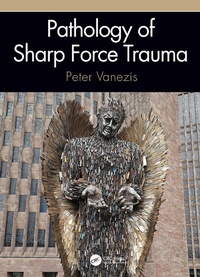
Pathology of Sharp Force Trauma
1st Edition
Published on 11. July 2021
322 pages
978-1-4987-6863-4 (ISBN)
Description

Pathology of Sharp Force Trauma illustrates and details sharp force trauma as seen in forensic pathology case work as well as in the clinical setting, outlining how one informs the other in interpreting such trauma for medico-legal purposes.
For the purposes of discussion, the author defines sharp force trauma as: "The application of force to produce an injury which results in a clear division or separation of the skin and underlying tissues". Sharp force trauma may be caused by all manner of implements with a sharp edge and/or pointed end, whether or not they have been produced for use as a weapon, and includes knives, broken glass, scissors and many others, to name but a few. Certain tools, such as axes or machetes, combine a sharp edge with heavy weight and produce injuries with both sharp and blunt impact elements.
In many countries, with the exception of those where firearms are readily available, sharp force trauma-particularly the use of knives-is the most common method of homicide and a frequent source of morbidity seen in emergency departments. Also, there has recently been an alarming upsurge in the use of knives in gang-related assaults and in terrorist incidents. As such, the book takes a comprehensive approach in explaining the different aspects of such trauma, most importantly the manner in which the victim has died. This includes cases of homicide, suicide or accident, indicating the type of weapon responsible, explaining how it was used, and presenting other such information to the investigation of such cases.
Features:
* Includes over 400 full-color graphic and illustrative images throughout
* Addresses all aspects of the investigation including trauma, crime scene findings, post-mortem examination, characteristics of injuries and categorization into homicide, suicide or accident
* Covers the biomechanics of knife trauma and tool mark examination techniques to identify implements used
* Illustrates penetrating injuries caused by pointed implements which have linear components, such as arrows, nails, spears, stakes and others
* Details cutting, penetrating, and other sharp force injuries resulting from medical intervention in a healthcare environment, such as might occur during surgical procedures
* Examines sharp injuries caused by domesticated and wild animals
* Written by one of the premier forensic pathologists in the world with over 40 years of first-hand case experience
Pathology of Sharp Force Trauma is the first substantive book published in English to look exclusively at this subject. Although primarily intended for pathologists and clinicians who are involved in the examination of such injuries in the post-mortem room or in a hospital environment, it will also be of interest to medical examiners, police and criminal investigators, attorneys and legal professionals, personnel in other forensic disciplines, and all doctors and medical students with an interested in trauma and its management.
For the purposes of discussion, the author defines sharp force trauma as: "The application of force to produce an injury which results in a clear division or separation of the skin and underlying tissues". Sharp force trauma may be caused by all manner of implements with a sharp edge and/or pointed end, whether or not they have been produced for use as a weapon, and includes knives, broken glass, scissors and many others, to name but a few. Certain tools, such as axes or machetes, combine a sharp edge with heavy weight and produce injuries with both sharp and blunt impact elements.
In many countries, with the exception of those where firearms are readily available, sharp force trauma-particularly the use of knives-is the most common method of homicide and a frequent source of morbidity seen in emergency departments. Also, there has recently been an alarming upsurge in the use of knives in gang-related assaults and in terrorist incidents. As such, the book takes a comprehensive approach in explaining the different aspects of such trauma, most importantly the manner in which the victim has died. This includes cases of homicide, suicide or accident, indicating the type of weapon responsible, explaining how it was used, and presenting other such information to the investigation of such cases.
Features:
* Includes over 400 full-color graphic and illustrative images throughout
* Addresses all aspects of the investigation including trauma, crime scene findings, post-mortem examination, characteristics of injuries and categorization into homicide, suicide or accident
* Covers the biomechanics of knife trauma and tool mark examination techniques to identify implements used
* Illustrates penetrating injuries caused by pointed implements which have linear components, such as arrows, nails, spears, stakes and others
* Details cutting, penetrating, and other sharp force injuries resulting from medical intervention in a healthcare environment, such as might occur during surgical procedures
* Examines sharp injuries caused by domesticated and wild animals
* Written by one of the premier forensic pathologists in the world with over 40 years of first-hand case experience
Pathology of Sharp Force Trauma is the first substantive book published in English to look exclusively at this subject. Although primarily intended for pathologists and clinicians who are involved in the examination of such injuries in the post-mortem room or in a hospital environment, it will also be of interest to medical examiners, police and criminal investigators, attorneys and legal professionals, personnel in other forensic disciplines, and all doctors and medical students with an interested in trauma and its management.
More details
Edition
1. Auflage
Language
English
Place of publication
London
United Kingdom
Publishing group
Taylor & Francis Ltd
Target group
College/higher education
Illustrations
16 Tables, color; 11 Line drawings, color; 226 Halftones, color; 240 Illustrations, color
ISBN-13
978-1-4987-6863-4 (9781498768634)
Copyright in bibliographic data and cover images is held by Nielsen Book Services Limited or by the publishers or by their respective licensors: all rights reserved.
Schweitzer Classification
Other editions
Additional editions
Peter Vanezis
Pathology of Sharp Force Trauma
Book
08/2024
1st Edition
CRC Press
€98.50
Shipment within 15-20 days
Peter Vanezis
Pathology of Sharp Force Trauma
Book
07/2021
1st Edition
CRC Press
€207.97
Shipment within 15-20 days
Peter Vanezis
Pathology of Sharp Force Trauma
Book
04/2021
CRC Press
Unfortunately, price unknown
Available (delivery time upon request)
Person
Peter Vanezis OBE, is Professor Emeritus of Forensic Medical Sciences at the William Harvey Research Institute, Queen Mary University of London. He began his career in forensic medicine at the London Hospital Medical College in 1974 in the department headed by Professor James Cameron. He became Reader and Head of the Forensic Department at the Charing Cross and Westminster Medical School in 1990, following which he was appointed Regius Professor of Forensic Medicine and Science in 1993 at the University of Glasgow. He was awarded the OBE in 2000 for leading the British Forensic team in the investigation of mass graves in Kosovo. After establishing a forensic pathology unit at the Forensic Science Service in 2003, he was appointed to the new chair of Forensic Medical Sciences at Queen Mary University of London where he pursued academic activities until his retirement in 2018. He continues his interest in forensic medical education and research through his Academy of Forensic Medical Sciences.
Professor Vanezis has a number of broad interests in the forensic medical sciences including human identification and human rights abuses. His previously published texts include Pathology of Neck injury, Essential Forensic Medicine and Suspicious Death-Scene Investigation as well as contributions to a number of forensic textbooks.
Professor Vanezis has a number of broad interests in the forensic medical sciences including human identification and human rights abuses. His previously published texts include Pathology of Neck injury, Essential Forensic Medicine and Suspicious Death-Scene Investigation as well as contributions to a number of forensic textbooks.
Content
1 Introduction, Scope and Historical Perspectives 2 Knife Crime ? Epidemiology, Impact on the Community and Legislation 3 Types of Knives and the Dynamics of Sharp Force Trauma 4 Scene Examination in Cases of Sharp Force Trauma 5 The Post-Mortem Examination in Sharp Force Trauma Deaths 6 Patterns of Wounding and Demographic Factors in Homicidal and Other Sharp Force Assaults 7 Morphology of Sharp Force Injuries and Type of Implements Responsible for Causing Them 8 Sharp Force Trauma ? Regional Location and Consequences of Injury 9 Defence Injuries 10 Intentional Self-inflicted Injuries 11 Accidental Injuries Including Injuries from Animals 12 Post-Mortem Injuries, the Effects of Putrefaction and Artefacts 13 Iatrogenic, Needlestick and Other Related Sharp Force Trauma 14 Presentation of Evidence and Issues Arising in Court in Sharp Force Trauma Cases
