

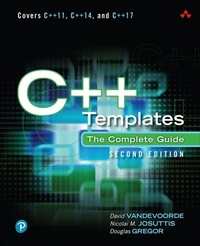
C++ Templates
The Complete Guide
2nd Edition
Published on 14. September 2017
832 pages
978-0-13-477874-7 (ISBN)
Description

Templates are among the most powerful features of C++, but they remain misunderstood and underutilized, even as the C++ language and development community have advanced. In C++ Templates, Second Edition, three pioneering C++ experts show why, when, and how to use modern templates to build software that's cleaner, faster, more efficient, and easier to maintain.
Now extensively updated for the C++11, C++14, and C++17 standards, this new edition presents state-of-the-art techniques for a wider spectrum of applications. The authors provide authoritative explanations of all new language features that either improve templates or interact with them, including variadic templates, generic lambdas, class template argument deduction, compile-time if, forwarding references, and user-defined literals. They also deeply delve into fundamental language concepts (like value categories) and fully cover all standard type traits.
The book starts with an insightful tutorial on basic concepts and relevant language features. The remainder of the book serves as a comprehensive reference, focusing first on language details and then on coding techniques, advanced applications, and sophisticated idioms. Throughout, examples clearly illustrate abstract concepts and demonstrate best practices for exploiting all that C++ templates can do.
Understand exactly how templates behave, and avoid common pitfalls
Use templates to write more efficient, flexible, and maintainable software
Master today's most effective idioms and techniques
Reuse source code without compromising performance or safety
Benefit from utilities for generic programming in the C++ Standard Library
Preview the upcoming concepts feature
The companion website, tmplbook.com, contains sample code and additional updates.
Now extensively updated for the C++11, C++14, and C++17 standards, this new edition presents state-of-the-art techniques for a wider spectrum of applications. The authors provide authoritative explanations of all new language features that either improve templates or interact with them, including variadic templates, generic lambdas, class template argument deduction, compile-time if, forwarding references, and user-defined literals. They also deeply delve into fundamental language concepts (like value categories) and fully cover all standard type traits.
The book starts with an insightful tutorial on basic concepts and relevant language features. The remainder of the book serves as a comprehensive reference, focusing first on language details and then on coding techniques, advanced applications, and sophisticated idioms. Throughout, examples clearly illustrate abstract concepts and demonstrate best practices for exploiting all that C++ templates can do.
Understand exactly how templates behave, and avoid common pitfalls
Use templates to write more efficient, flexible, and maintainable software
Master today's most effective idioms and techniques
Reuse source code without compromising performance or safety
Benefit from utilities for generic programming in the C++ Standard Library
Preview the upcoming concepts feature
The companion website, tmplbook.com, contains sample code and additional updates.
All prices
More details
Edition
2nd edition
Language
English
Place of publication
Boston
United States
Publishing group
Pearson Education (US)
Target group
Professional and scholarly
College/higher education
File size
64,47 MB
ISBN-13
978-0-13-477874-7 (9780134778747)
Copyright in bibliographic data and cover images is held by Nielsen Book Services Limited or by the publishers or by their respective licensors: all rights reserved.
Schweitzer Classification
Other editions
Additional editions
Book
11/2017
2nd Edition
Addison Wesley
€74.50
Shipment within 10-20 days
Persons
David Vandevoorde started programming C++ in the late 1980s. After obtaining a PhD from the Rensselaer Polytechnic Institute, he became technical lead of Hewlett-Packard's C++ compiler team. In 1999 he joined the Edison Design Group (EDG), whose C++ compiler technology is widely recognized as the industry's most advanced. He is an active member of the C++ Standard Committee and a moderator of the newsgroup comp.lang.c++.moderated (which he co-founded). He is the author of C++ Solutions, the companion to The C++ Programming Language, 3rd Edition.
Nicolai M. Josuttis is well known for his best-selling de-facto standard bookThe C++ Standard Library - A Tutorial and Reference. He is an independent technical consultant who designs object-oriented software for the telecommunications, traffic, finance, and manufacturing industries. He is an active member of the C++ Standard Committee and a partner at System Bauhaus, a German group of prominent object-oriented system development experts. Josuttis has written several other books on object-oriented programming and C++.
Douglas Gregor is Senior Swift/C++/Objective-C Compiler Engineer at Apple. He holds a PhD in computer science from Rensselaer Polytechnic Institute, and did post-doctoral work at Indiana University.
Nicolai M. Josuttis is well known for his best-selling de-facto standard bookThe C++ Standard Library - A Tutorial and Reference. He is an independent technical consultant who designs object-oriented software for the telecommunications, traffic, finance, and manufacturing industries. He is an active member of the C++ Standard Committee and a partner at System Bauhaus, a German group of prominent object-oriented system development experts. Josuttis has written several other books on object-oriented programming and C++.
Douglas Gregor is Senior Swift/C++/Objective-C Compiler Engineer at Apple. He holds a PhD in computer science from Rensselaer Polytechnic Institute, and did post-doctoral work at Indiana University.
Content
Part I: The Basics
Chapter 1: Function Templates
Chapter 2: Class Templates
Chapter 3: Nontype Template Parameters
Chapter 4: Variadic Templates
Chapter 5: Tricky Basics
Chapter 6: Move Semantics and enable_if<>
Chapter 7: By-Value or By-Reference?
Chapter 8: Compile-Time Programming
Chapter 9: Using Templates in Practice
Chapter 10: Basic Template Terminology
Chapter 11: Generic Libraries
Part II: Templates in Depth
Chapter 12: Fundamentals in Depth
Chapter 13: Names in Templates
Chapter 14: Instantiation
Chapter 15: Template Argument Deduction
Chapter 16: Specialization and Overloading
Chapter 17: Future Directions
Part III: Templates and Design
Chapter 18: The Polymorphic Power of Templates
Chapter 19: Implementing Traits
Chapter 20: Overloading on Type Properties
Chapter 21: Templates and Inheritance
Chapter 22: Bridging and Static and Dynamic Polymorphism
Chapter 23: Metaprograms
Chapter 24: Typelists
Chapter 25: Tuples
Chapter 26: Discriminated Unions
Chapter 27: Expression Templates
Chapter 28: Debugging Templates
Appendixes
Appendix A: The One-Definition Rule
Appendix B: Value Categories
Appendix C: Overload Resolution
Appendix D: Standard Type and Meta Utilities
Appendix E: Concepts
Bibliography
Glossary
Index
Chapter 1: Function Templates
Chapter 2: Class Templates
Chapter 3: Nontype Template Parameters
Chapter 4: Variadic Templates
Chapter 5: Tricky Basics
Chapter 6: Move Semantics and enable_if<>
Chapter 7: By-Value or By-Reference?
Chapter 8: Compile-Time Programming
Chapter 9: Using Templates in Practice
Chapter 10: Basic Template Terminology
Chapter 11: Generic Libraries
Part II: Templates in Depth
Chapter 12: Fundamentals in Depth
Chapter 13: Names in Templates
Chapter 14: Instantiation
Chapter 15: Template Argument Deduction
Chapter 16: Specialization and Overloading
Chapter 17: Future Directions
Part III: Templates and Design
Chapter 18: The Polymorphic Power of Templates
Chapter 19: Implementing Traits
Chapter 20: Overloading on Type Properties
Chapter 21: Templates and Inheritance
Chapter 22: Bridging and Static and Dynamic Polymorphism
Chapter 23: Metaprograms
Chapter 24: Typelists
Chapter 25: Tuples
Chapter 26: Discriminated Unions
Chapter 27: Expression Templates
Chapter 28: Debugging Templates
Appendixes
Appendix A: The One-Definition Rule
Appendix B: Value Categories
Appendix C: Overload Resolution
Appendix D: Standard Type and Meta Utilities
Appendix E: Concepts
Bibliography
Glossary
Index
