

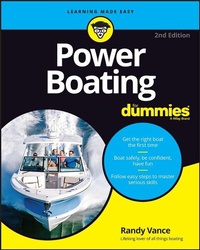
Power Boating For Dummies
Description

Power Boating For Dummies, Second Edition teaches you everything you need to know about buying, choosing, operating, maintaining, and enjoying a power boat, and provides expert guidance for new boaters. This is also a fantastic book for experienced boaters, because it's full of tips and ideas on improving boating skills and getting the most out of water-time with the latest tech. With this guide, you can ace your boating pilot's exam and master the techniques you'll need to stay safe and have fun out there. You'll also find recommendations on great destinations for boating trips, plus coverage of all that's new in the world of boating--touch-screen navigation, automatic docking, smart boats, and even running routes right from your iPhone. Get on board!
* Choose the right boat for your needs and learn the safety rules
* Get good at piloting your boat in all kinds of conditions
* Outfit your boat with the right gear and supplies
* Discover new tech gadgets to make boating even more fun
For complete beginners who are new to power boating, as well as more experienced boaters looking for a complete reference, Power Boating For Dummies, Second Edition, is a must.
More details
Other editions
Additional editions
Person
Content
Part 1: Getting On the Right Boating Track 7
Chapter 1: Powering Up to Be a Boater 9
Chapter 2: Choosing the Right Boat Type and Engine for Your Boating Needs 21
Chapter 3: Finding and Buying the Right Boat for You 41
Chapter 4: Accessorizing Your Boat for Safety and Fun 67
Part 2: Safely Operating Your Boat 83
Chapter 5: Towing Your Boat and Maintaining Your Trailer 85
Chapter 6: Launching and Loading Your Trailered Boat 101
Chapter 7: Hitting the Open Water: Driving Your Boat 129
Chapter 8: Docking, Rafting Up, and Anchoring 147
Chapter 9: Finding a Safe Harbor for Your Boat 167
Part 3: With Much Boating Fun Comes Much Responsibility 189
Chapter 10: Rules Do Apply: Navigating to Avoid Collisions and Confusion 191
Chapter 11: Finding Your Way on the Water 207
Chapter 12: Navigating Bad Weather 229
Chapter 13: Preparing for and Handling Boating Emergencies 247
Part 4: Keeping Your Boat Shipshape 267
Chapter 14: Keeping Up with Routine Boat Maintenance 269
Chapter 15: Getting Your Boat Ready for Winter and Spring 295
Chapter 16: Repairing Leaks and Other Damage to Your Boat 303
Part 5: The Part of Tens 325
Chapter 17: Ten Tactics That Separate Pros from Amateurs 327
Chapter 18: Ten Important Items to Keep Onboard 335
Chapter 19: Ten (Plus Two) Mechanical Checks for Buying a Pre-Owned Boat 341
Index 349
Introduction
I've been power boating for 55 years, and I've even sailed a little, too. I've been in the boating business in one way or another for 45 of those years. The sport has given me the pleasure of guiding fishermen, teaching my kids, grandkids, and friends to water-ski, and in many ways ushering new boaters into the fun and adventure of a lifestyle I wouldn't consider life much fun without. In all that time, I've written newspaper columns and magazine articles on the how-to's of power boating. For 22 years I've been first the editor-in-chief of Boating and currently editor at large. My job now takes me to the pages of Boating magazine and the YouTube channels of boat builders and boaters as I review and report on top boats in the country. And I create boating safety content for our partnership channel Boatingmag.com/safety with the U.S. Coast Guard.
In Power Boating For Dummies, I do my best to protect you from trouble by helping you know just what to expect from a boat and boating before you ever get your hands on the controls. New boaters don't get into trouble from the complexity of boating but from acting on their preconceived notions of how boating should be done.
Among non-boaters and especially among sailing boaters, there's often an unjustified assumption that power boaters are googans who bungle along with beer in hand as they pilot crafts they know nothing about. Well, every group has a few outlaws, and I've had the fortune of watching diligent water cops take them out of the game. But I've also had the pleasure of helping others who want to get better at boating to avoid the stereotype.
The power boater you will become as you absorb the strategies, tips, and warnings in this book will be a responsible person seeking family unity, friendship, and personal growth in a pastime that requires the ultimate in teamwork. In all cases, power boaters want to get outdoors in a place filled with like-minded individuals and enjoy nature, each other's company, and maybe a little bit of adventure. But most of all, power boaters don't want their fun to depend on something as fickle as the wind! If you're in this group, this book is for you.
About This Book
Power Boating For Dummies is a comprehensive guide to practically everything you need to know about buying, owning, operating, and maintaining a boat to about 35 feet in length. However, you'll find that the information and recommendations in this book also give you great foundational knowledge for handling larger boats as well.
If you read this book before ever stepping foot on a boat, I walk you through the process of imagining what kind of boating you may like to do. If you have some boating experience but haven't yet looked into buying your own boat, I escort you through that process as well. If you already have a boat but want to know more about how to pilot it, equip it, store it, tow it, or handle emergencies on it, this is the book for you. Even if you already have some experience captaining your own boat, this book could help fill in some gaps in your knowledge and give you some new ideas for improving your boating experience.
Of course, no single book could tell you all there is to know about boating; here are a few facts you need to investigate on your own:
- Boating rules vary by state. When it comes to boating, every U.S. state has its own jurisdictional quirks regarding safety, equipment, and licensing, among other things. Although I give you some tips about how to find out about your local regulations, you need to do some investigating on your own to be fully informed.
- Boat brands and specifications vary by manufacturer. Boats are all similar, but none are the same. In my years as a boater, I've owned a dozen different boats and several different kinds of boats. As first editor, then editor at large of Boating magazine, I've driven literally thousands of boats. In this book, I've tried to make some reliable generalizations that hold true for nearly all makes and styles of boats. Of course, you should find out all the specifics about your own boat, starting by thoroughly studying the owner's manual.
- Boating activities and preferences vary by geography. I've boated in enough places to know that people tend to boat different ways in different regions. For instance, brand loyalty to certain boats or motors can be so fierce in some regions that you'll just want to go with the flow, in case you ever want to resell your boat in that area. I recommend that you fully immerse yourself in your local boating culture to learn the local lore.
Conventions Used in This Book
If you've ever watched a movie or read a book about sailors or pirates or other nautical types, the marine world is filled with specialized jargon. Many of these terms are commonly used in power boating as well, especially words for boating gear and the parts of a boat.
Long-time boaters sometimes develop a little bit of snobbery about their mastery of boat jargon. Over the years of creating and curating content for Boating magazine, I've received a few snide emails about an occasional inadvertent failure to adhere to every dictate of boating jargon. You will undoubtedly run into a few boaters like that; respond to them or not with a salute of your choosing. Most boaters are eager to share their skills with boaters humble enough to recognize their good-hearted advice for what it is. But reading Power Boating For Dummies will certainly minimize your chances of needing the latter or enduring the former!
For this book, I've sprinkled in some boating jargon, but I put those terms in italics and define them upon first mention in every chapter, so you won't get lost even if you skip around in the book.
What You're Not to Read
Of course I'd love for you to read every word of this book - I worked so hard on it and all. However, if you're pressed for time or would rather be out on your boat than reading every sage word, you can skip or skim some parts and grab some of the basics from the lead paragraphs.
Throughout the book, you'll see sidebars, which appear in gray boxes. The topics of these sidebars are ancillary to the overall topic of a particular section or chapter, but again, you won't miss out on critical information if you decide not to read them.
Foolish Assumptions
In writing this book, I assumed you were either a newbie to boating or someone with some experience who wanted to hone your skills in a systematic way. You're on the verge of getting into the sport, or you've been in it just long enough to thump a dock real hard with your boat or get embarrassed because you missed the trailer when you were loading up. Thanks to the cool For Dummies format, you can jump in, grab just the information you want and need, and get out there to try it out while it's fresh in your mind.
That's what I was thinking when I wrote this book. That and one other thing: Everybody makes mistakes in everything, including boating. I still make them, and they're more embarrassing now than ever. In this book, I don't try to hide my blunders if I think you can learn from them. Some people won't play games they can't play perfectly. I hope you're not that way, because you'll quickly abandon boating if you are.
How This Book Is Organized
The format of Power Boating For Dummies helps you find exactly what you want to know and gives the information to you in bite-sized pieces. Here's a quick rundown of how this particular book is organized, so you know where to look for exactly what you need.
Part 1: Getting On the Right Boating Track
Part 1 is about getting geared up for boating. In it, I assume you don't yet have a boat or the gear you need to operate it safely. I explain how to determine what kind of boat is right for you and how to go about shopping for it, plus the goodies that make it fun and safe to operate. And, I introduce you to boat clubs as an outstanding way to spend a year or two with many different boats at your fingertips.
Part 2: Safely Operating Your Boat
In this part, I assume you've never driven a boat, or if you have, you've found the experience intimidating and uncomfortable.
If you can set aside what you may already know about boat operation, tell yourself that driving a car is not like driving a boat, and read the chapters in this part from a perspective of complete ignorance, you'll quickly get your handling skills up to snuff and be better than 90 percent of boaters out there.
Part 3: With Much Boating Fun Comes Much Responsibility
There's more to boating than just racing toward the open water to kick back, soak up some rays, maybe do a little fishing, and splash around in the refreshing waters. In this part, I help you become a more responsible boater, starting with the rules and regulations of boating. To boat safely, you need to know the boating laws in your state and locality. And you can't be a safe boater unless you take a boating safety course approved by your state.
This part also explores navigation tools, navigating your boat in all sorts of conditions, and dealing with common boating emergencies. And, it gives you an...
