

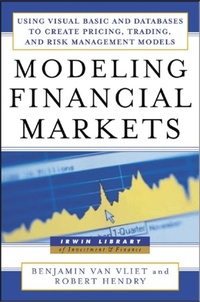
Modeling Financial Markets
1st Edition
Published on 22. January 2004
400 pages
978-0-07-144288-6 (ISBN)
Description

Limitations in today's software packages for financial modeling system development can threaten the viability of any system--not to mention the firm using that system. Modeling Financial Markets is the first book to take financial professionals beyond those limitations to introduce safer, more sophisticated modeling methods. It contains dozens of techniques for financial modeling in code that minimize or avoid current software deficiencies, and addresses the crucial crossover stage in which prototypes are converted to fully coded models.
More details
Other editions
Additional editions
Benjamin Van Vliet | Robert Hendry
Modeling Financial Markets
Book
03/2004
McGraw-Hill Professional
€47.03
Article exhausted; check different version
Content
- Intro
- Terms of Use
- Want to learn more?
- Contents
- Acknowledgments
- Section One: Trading System Development
- Chapter 1: Introduction
- Chapter 2: Development Methodology
- Kumiega-Van Vliet Trading System Development Methodology
- Phase I. Research and Document Calculations
- Phase II. Back-Test
- Phase III. Implement
- Phase IV. Manage Portfolio and Risk
- Summary
- Problems
- Section Two: Introduction to VB.NET Algorithm Development
- Chapter 3: Getting Started with VB.NET
- Different Versions of Visual Basic
- The VB.NET Integrated Development Environment
- Creating an Executable Program
- Summary
- Problems
- Chapter 4: Value Types and Operators
- Declaring Variables
- Constants
- Variable Scope
- Representing Dates and Times
- Option Strict
- Structures
- Enumerations
- Operators
- Stock Index Futures
- Summary
- Problems
- Chapter 5: Control Structures
- Selection Structures
- Repetition Structures
- The Exit Commands
- Nested Loops
- Estimating and Forecasting Volatility
- Summary
- Problems
- Chapter 6: Procedures
- Input Arguments
- Return Values
- Black-Scholes Option Pricing Formula
- Math Functions
- String Functions
- Formatting Numbers for Output
- Conversion Functions
- Validation Functions
- Date Functions
- Financial Functions
- MsgBox Function
- Random Number Functions
- Implied Volatility
- Summary
- Problems
- Chapter 7: Objects
- Objects and Classes
- Abstraction
- Encapsulation
- Inheritance
- Polymorphism
- Events
- Access Modifiers
- Overloading
- Nothing
- Calculating At-The-Money Volatility
- Summary
- Problems
- Chapter 8: Arrays
- One-Dimensional Arrays
- Two-Dimensional Arrays
- Jagged Arrays
- Array Methods
- Dynamic Array Sizing
- Passing Arrays to Functions
- The Erase Statement
- Ubound Function
- Using Arrays for Data
- Using Arrays for Matrix Algebra
- Using Arrays for Trees
- Summary
- Problems
- Chapter 9: Problem Solving
- Syntax Errors
- Logic Errors
- Run-Time Errors
- Forecasting Covariance
- Breakpoints
- Other Debugging Windows and Commands
- Exception Handling
- The Throw Statement
- Summary
- Problems
- Chapter 10: .NET Type System
- Types
- Assemblies
- Namespaces
- Imports Statement
- Building An Options Library
- Volatility Smiles
- Summary
- Problems
- Section Three: Database Programming Back Testing
- Chapter 11: Relational Databases
- Tables
- Fields
- Records
- Primary Keys
- Foreign Keys
- Relationships
- Queries
- Normalization
- Database Design
- Access Databases
- Summary
- Problems
- Chapter 12: ADO.NET
- Connections
- Dataadapter
- Dataset
- Datatable
- Columns, DataColumnCollections, and DataColumns
- Rows, DataRowCollections, and DataRows
- Connecting to a Database
- Summary
- Problems
- Chapter 13: Structured Query Language
- Data Manipulation Language
- Aggregate SQL Functions
- Data Definition Language
- Summary
- Problems
- Chapter 14: Introduction to Data Structures
- Collection Object
- Creating a Customized Collection Class
- Cleaning Data
- Creating a Data Transformation Management System
- Summary
- Problems
- Chapter 15: Advanced Data Structures
- Hash Tables
- Summary
- Problems
- Section Four: Advanced VB.NET Implementation
- Chapter 16: Software Connectivity And Interoperability
- Application Programming Interfaces
- Exchange Application Programming Interfaces
- Com Interoperation
- Summary
- Problems
- Chapter 17: Connecting to Trading Software
- Connecting to a Futures Market
- Connecting to an Options Market
- Summary
- Problems
- Chapter 18: XML
- XML and Financial Markets
- Creating a Markup Language
- Document Type Definition
- Creating XML Documents
- Sending XML Messages
- XML Data Sources
- Summary
- Problems
- Chapter 19: XML Protocols in Financial Markets
- FpML
- FIX and FIXML
- Summary
- Problems
- Section Five: Object-Oriented Programming Risk Management
- Chapter 20: Unified Modeling Language
- Unified Modeling Language
- Model Management Diagrams
- Value at Risk
- Stress Testing
- Structural Diagrams
- Behavior Diagrams
- Activity Diagram
- Summary
- Problems
- References
- Chapter 1
- Chapter 2
- Chapter 4
- Chapter 5
- Chapter 6
- Chapter 7
- Chapter 8
- Chapter 9
- Chapter 10
- Chapter 11
- Chapter 13
- Chapter 15
- Chapter 16
- Chapter 17
- Chapter 18
- Chapter 19
- Chapter 20
- Acronyms
- Index
