

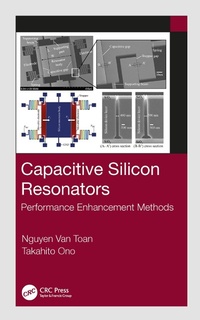
Capacitive Silicon Resonators
Performance Enhancement Methods
1st Edition
Published on 10. July 2019
176 pages
978-0-429-55652-4 (ISBN)
Description

Microfabricated resonators play an essential role in a variety of applications, including mass sensing, timing reference applications, and filtering applications. Many transduction mechanisms including piezoelectric, piezoresistive, and capacitive mechanisms, have been studied to induce and detect the motion of resonators. This book is meant to introduce and suggest several technological approaches together with design considerations for performance enhancement of capacitive silicon resonators, and will be useful for those working in field of micro and nanotechnology.
Features
Introduces and suggests several technological approaches together with design considerations for performance enhancement of capacitive silicon resonators
Provides information on the various fabrication technologies and design considerations that can be employed to improve the performance capacitive silicon resonator which is one of the promising options to replace the quartz crystal resonator.
Discusses several technological approaches including hermetic packaging based on the LTCC substrate, deep reactive ion etching, neutral beam etching technology, and metal-assisted chemical etching, as well as design considerations for mechanically coupled, selective vibration of high-order mode, movable electrode structures, and piezoresistive heat engines were investigated to achieve small motional resistance, low insertion loss, and high quality factor.
Focusses on a capacitive sensing method based on the measurement of the change in capacitance between a sensing electrode and the resonant body.
Reviews recent progress in performance enhancement methods for capacitive silicon resonator, which are mainly based on the works of the authors.
Features
Introduces and suggests several technological approaches together with design considerations for performance enhancement of capacitive silicon resonators
Provides information on the various fabrication technologies and design considerations that can be employed to improve the performance capacitive silicon resonator which is one of the promising options to replace the quartz crystal resonator.
Discusses several technological approaches including hermetic packaging based on the LTCC substrate, deep reactive ion etching, neutral beam etching technology, and metal-assisted chemical etching, as well as design considerations for mechanically coupled, selective vibration of high-order mode, movable electrode structures, and piezoresistive heat engines were investigated to achieve small motional resistance, low insertion loss, and high quality factor.
Focusses on a capacitive sensing method based on the measurement of the change in capacitance between a sensing electrode and the resonant body.
Reviews recent progress in performance enhancement methods for capacitive silicon resonator, which are mainly based on the works of the authors.
More details
Edition
1. Auflage
Language
English
Place of publication
London
United Kingdom
Publishing group
Taylor & Francis Ltd
Target group
Professional and scholarly
Illustrations
19 Tables, black and white; 119 Illustrations, black and white
ISBN-13
978-0-429-55652-4 (9780429556524)
Copyright in bibliographic data and cover images is held by Nielsen Book Services Limited or by the publishers or by their respective licensors: all rights reserved.
Schweitzer Classification
Other editions
Additional editions
Book
06/2019
1st Edition
CRC Press
€155.01
Shipment within 15-20 days
Persons
Nguyen Van Toan received his B.S. degree in 2006 and his M.S. degree in 2009 in physics and electronics, respectively, from University of Science, Vietnam National University, Ho Chi Minh City, Viet Nam. He received his Dr. Eng. degree from Tohoku University in 2014 for research on silicon capable of integrating LSI for application to timing devices. He is working as an assistant professor in the Department of Mechanical Engineering, Graduate School of Engineering at Tohoku University. His current research interests include capacitive silicon resonators, optical modulator devices, capacitive micromachined ultrasonic transducers, thermal electric power generators, Knudsen pump, ion transportation, and metal-assisted chemical etching.
Takahito Ono is currently a Professor at Mechanical Systems Engineering, Graduate School of Engineering in Tohoku University. He was born in Hokkaido, Japan on 12 July 1967. He received the B.S. degree in physic from Hirosaki University, Japan, in 1990 and the M.S. degree in physics from Tohoku University, Japan. He received the Dr.Eng. degree in mechatronics and precision engineering from Tohoku University in 1996. During 1996-2001, he has been a Research Associate, and Lecturer in the Department of Mechatronics and Precision Engineering, Tohoku University. He had studied about nanomachining, scanning probe and its related technologies including high density storage devices. During 2001-2009, he has been an Associate Professor, and have developed nanomechanics and nanomechanical sensors. Since 2009, he is the Professor of Tohoku University. His expertise is in the area of microelectromechnical systems (MEMSs), nanoelectromechanical systems (NEMSs), silicon based nanofabrication, ultrasensitive sensing based on NEMSs/MEMSs. Also during 2012-2014 he was director of Micro/Nanomachining Research and Education Center, Tohoku University. Since 2010 he serves a co-director of "Microsystem Integration Center (?SiC), Tohoku University. Since 2013, he has additional post, a Professor of Guest Courses, Mechanical Departments, The University of Tokyo, and working on Nanomechanics.
Takahito Ono is currently a Professor at Mechanical Systems Engineering, Graduate School of Engineering in Tohoku University. He was born in Hokkaido, Japan on 12 July 1967. He received the B.S. degree in physic from Hirosaki University, Japan, in 1990 and the M.S. degree in physics from Tohoku University, Japan. He received the Dr.Eng. degree in mechatronics and precision engineering from Tohoku University in 1996. During 1996-2001, he has been a Research Associate, and Lecturer in the Department of Mechatronics and Precision Engineering, Tohoku University. He had studied about nanomachining, scanning probe and its related technologies including high density storage devices. During 2001-2009, he has been an Associate Professor, and have developed nanomechanics and nanomechanical sensors. Since 2009, he is the Professor of Tohoku University. His expertise is in the area of microelectromechnical systems (MEMSs), nanoelectromechanical systems (NEMSs), silicon based nanofabrication, ultrasensitive sensing based on NEMSs/MEMSs. Also during 2012-2014 he was director of Micro/Nanomachining Research and Education Center, Tohoku University. Since 2010 he serves a co-director of "Microsystem Integration Center (?SiC), Tohoku University. Since 2013, he has additional post, a Professor of Guest Courses, Mechanical Departments, The University of Tokyo, and working on Nanomechanics.
Content
Preface. Acknowledgements. About the Authors. 1. Introduction. 2. Capacitive Silicon Resonator Structures. 3. Fabrication Techniques for Capacitive Silicon Resonators. 4. Hermetically Packaged Capacitive Silicon Resonators on LTCC Substrate. 5. A Long Bar Type Capacitive Silicon Resonators with High-Quality Factors. 6. Capacitive Silicon Resonators Using Neutral Beam Etching Technology. 7. Capacitive Silicon Resonators with Narrow Gaps Formed by Metal-Assisted Chemical Etching. 8. Mechanically Coupled Capacitive Nanomechanical Silicon Resonators. 9. Capacitive Silicon Nanomechanical Resonators with Selective Vibration of High-Order Mode. 10. Capacitive Silicon Resonators with Movable Electrode. 11. Capacitive Silicon Resonators with Piezoresistive Heat. References. Conclusions
