

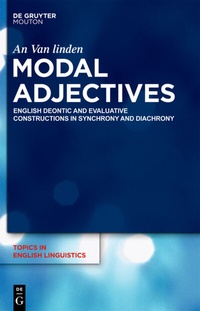
Modal Adjectives
Description

The book revisits the notion of deontic modality from the perspective of an understudied category in the modal domain, viz. adjectives. On the basis of synchronic and diachronic corpus studies, it analyses the semantics of English adjectives like essential and appropriate , and uses this to refine traditional definitions of deontic modality, which are mainly based on the study of modal verbs.
In a first step, it is shown that the set of meanings expressed by extraposition constructions with deontic adjectives is quite different from the set of meanings identified in the literature on modal verbs. Adjectival complement constructions lack the directive meanings of obligation or permission, which are traditionally regarded as the core deontic categories, and they have semantic extensions towards non-modal meanings in the evaluative domain. In a second step, the analysis of adjectives is used to propose an alternative definition of deontic modality, which covers both the meanings of verbs and adjectives, and which can deal with the different extensions towards modal and non-modal categories. This is integrated into a conceptual map, which works both in diachrony, defining pathways of change from premodal to modal to evaluative meaning, and in synchrony, accommodating refinements within each set of meanings. In the process, this study points to the emergence of partially filled constructions, and it offers additional evidence for well-established changes in the history of English, such as the decline of the subjunctive and the rise of the to -infinitive in complement constructions.
The book is of particular interest to researchers and graduate students with a focus on mood and modality, and the interface between syntax, semantics and pragmatics, as well as that between synchrony and diachrony.
Reviews / Votes
"[...] this is a valuable addition to the field of historical semantics and to the literature on modality. It is a useful, detailed, clearly written volume. Van linden's approach is solidly empirical, and her data lead to a focused and cohesive conceptual map of adjectival modality and evaluation. This book is highly recommended to researchers with an interest in historical linguistics as well as to those studying adjectival semantics."James A. Berry in: Linguist List 23.5148More details
Other editions
Additional editions
Person
Content
2 - List of tables [Seite 12]
3 - List of figures [Seite 17]
4 - Abbreviations [Seite 19]
5 - Introduction [Seite 21]
6 - Chapter 1 The notion of modality [Seite 31]
6.1 - 1.1. Dynamic - deontic - epistemic modality: The basic categories [Seite 32]
6.1.1 - 1.1.1. Dynamic modality [Seite 32]
6.1.2 - 1.1.2. Deontic modality [Seite 36]
6.1.3 - 1.1.3. Epistemic modality [Seite 40]
6.1.4 - 1.1.4. Alternative organizations of the modal domain [Seite 41]
6.2 - 1.2. Relations between the basic categories [Seite 47]
6.2.1 - 1.2.1. Conceptual relations [Seite 47]
6.2.2 - 1.2.2. Formal, diachronic and ontogenetic relations [Seite 52]
6.3 - 1.3. Categories at the edges of modality [Seite 57]
6.3.1 - 1.3.1. Mood [Seite 57]
6.3.2 - 1.3.2. Volition [Seite 58]
6.3.3 - 1.3.3. Rational modality [Seite 60]
6.3.4 - 1.3.4. Evaluation [Seite 61]
6.4 - 1.4. Conclusion [Seite 63]
7 - Chapter 2 Adjectives in the modal-evaluative domain [Seite 65]
7.1 - 2.1. The adjectives studied: Weak versus strong [Seite 67]
7.2 - 2.2. Constructions with adjectives: Conceptual types [Seite 72]
7.2.1 - 2.2.1. Adjectives and dynamic modality [Seite 72]
7.2.2 - 2.2.2. Adjectives and deontic modality [Seite 74]
7.2.3 - 2.2.3. A reassessment of (deontic) modality [Seite 82]
7.3 - 2.3. The conceptual map [Seite 87]
8 - Chapter 3 Data and methods of the diachronic analysis [Seite 97]
8.1 - 3.1. The data [Seite 97]
8.2 - 3.2. The corpora [Seite 100]
8.3 - 3.3. Queries and glosses [Seite 105]
9 - Chapter 4 The semantic development of the adjectival matrix [Seite 107]
9.1 - 4.1. The data: Latin and Romance loans [Seite 108]
9.2 - 4.2. The semantic development of essential [Seite 109]
9.3 - 4.3. The semantic development of vital [Seite 116]
9.4 - 4.4. Essential and vital: A first pathway to deontic meaning [Seite 124]
9.5 - 4.5. The semantic development of crucial [Seite 125]
9.6 - 4.6. The semantic development of critical [Seite 131]
9.7 - 4.7. Crucial and critical: A second pathway to deontic meaning [Seite 138]
9.8 - 4.8. Adjectival pathways to deontic meaning [Seite 140]
10 - Chapter 5 The diachrony of the clausal complement patterns [Seite 146]
10.1 - 5.1. The relation between matrix and complement [Seite 147]
10.1.1 - 5.1.1. The development of the copular extraposition construction [Seite 149]
10.1.2 - 5.1.2. Copular and transitive verb constructions in the conceptual map [Seite 155]
10.2 - 5.2. The types of clausal complement [Seite 159]
10.2.1 - 5.2.1. That-clauses [Seite 161]
10.2.2 - 5.2.2. To-clauses [Seite 181]
10.2.3 - 5.2.3. The distribution of that-clauses and to-clauses [Seite 200]
10.3 - 5.3. Conclusion [Seite 213]
11 - Chapter 6 The diachrony of the complex constructions: The development of propositional complements [Seite 217]
11.1 - 6.1. The construction types and data [Seite 218]
11.2 - 6.2. Towards a synchronic functional description [Seite 220]
11.2.1 - 6.2.1. The interaction between matrix and complement: Mandative versus propositional primary complements [Seite 220]
11.2.2 - 6.2.2. The types of primary mandative and propositional complements [Seite 228]
11.2.3 - 6.2.3. Secondary complements [Seite 235]
11.3 - 6.3. Diachronic development of mandative complements [Seite 237]
11.4 - 6.4. Diachronic development of propositional complements [Seite 241]
11.4.1 - 6.4.1. The adjectives of importance [Seite 244]
11.4.2 - 6.4.2. The adjectives of appropriateness [Seite 247]
11.5 - 6.5. Summary and questions for further research [Seite 252]
11.6 - 6.6. Conclusions from the diachronic analysis [Seite 256]
12 - Chapter 7 Data and methods of the synchronic synthesis and refinement [Seite 259]
13 - Chapter 8 Synchronic constructions: Refinements of the conceptual map [Seite 263]
13.1 - 8.1. Non-modal evaluation [Seite 264]
13.1.1 - 8.1.1. Mental focus on proposition [Seite 265]
13.1.2 - 8.1.2. Genuine non-modal evaluative use [Seite 268]
13.1.3 - 8.1.3. Specialized use [Seite 270]
13.1.4 - 8.1.4. Locative use [Seite 273]
13.1.5 - 8.1.5. Knowledge/acquisition of knowledge use [Seite 277]
13.1.6 - 8.1.6. Conclusion [Seite 283]
13.2 - 8.2. Bridging contexts [Seite 288]
13.3 - 8.3. Deontic and dynamic modality [Seite 292]
13.3.1 - 8.3.1. SoA-related and speaker-related deontic uses [Seite 293]
13.3.2 - 8.3.2. Text-building use [Seite 297]
13.3.3 - 8.3.3. Combined pattern of mental focus on proposition [Seite 299]
13.3.4 - 8.3.4. Strong adjectives: The distinction between dynamic and deontic modality [Seite 308]
13.3.5 - 8.3.5. SoA-related deontic expressions with weak adjectives [Seite 316]
13.3.6 - 8.3.6. Conclusion [Seite 319]
13.4 - 8.4. Directive meaning [Seite 323]
13.5 - 8.5. Conclusion [Seite 329]
14 - Chapter 9 Conclusion [Seite 334]
15 - References [Seite 346]
16 - Author index [Seite 370]
17 - Subject index [Seite 373]
