

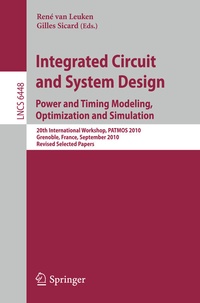
Integrated Circuit and System Design. Power and Timing Modeling, Optimization, and Simulation
20th International Workshop, PATMOS 2010, Grenoble, France, September 7-10, 2010, Revised Selected Papers
Published on 16. January 2011
XII, 260 pages
978-3-642-17752-1 (ISBN)
Description

This book constitutes the refereed proceedings of the 20th International Conference on Integrated Circuit and System Design, PATMOS 2010, held in Grenoble, France, in September 2010.
The 24 revised full papers presented and the 9 extended abstracts were carefully reviewed and are organized in topical sections on design flows; circuit techniques; low power circuits; self-timed circuits; process variation; high-level modeling of poweraware heterogeneous designs in SystemC-AMS; and minalogic.
More details
Other editions
Additional editions
Rene Van Leuken | Gilles Sicard
Integrated Circuit and System Design. Power and Timing Modeling, Optimization, and Simulation
20th International Workshop, PATMOS 2010, Grenoble, France, September 7-10, 2010, Revised Selected Papers
Book
02/2011
1st Edition
Springer
€53.49
Shipment within 5-7 days
Content
- Title Page
- Preface
- Organization
- Table of Contents
- Session 1: Design Flows
- A Power-Aware Online Scheduling Algorithm for Streaming Applications in Embedded MPSoC
- Introduction
- Related Work
- Power-Aware Streaming Application Scheduling
- Implementation
- Results
- Conclusion
- References
- An Automated Framework for Power-Critical Code Region Detection and Power Peak Optimization of Embedded Software
- Introduction
- Related Work
- Automated Power-Critical Code Region Detection and Power Peak Optimization of Embedded Software
- Run-Time Power Profiling Based on Power Emulation
- Power-Critical Code Region Detection
- Optimization of Power-Critical Source Code Regions
- Experimental Results
- Test System for Power Peak Optimization
- Comparison of Original and Optimized Power Consumption and Supply Voltage Profiles
- Impact of Power Peak Optimization on Execution Time and Code Size
- Conclusions
- References
- System Level Power Estimation of System-on-Chip Interconnects in Consideration of Transition Activity and Crosstalk
- Introduction
- Related Work
- Modeling of Dynamic Power Dissipation on Links
- Bit Level Statistics
- Simulation Results
- Simulation Accuracy
- Simulation Performance
- Conclusion
- References
- Residue Arithmetic for Designing Low-Power Multiply-Add Units
- Introduction
- Review of RNS Basics
- Low-Power in RNS
- RNS and Binary Multiply-Add Units
- Results and Comparisons
- Conclusions
- References
- Session 2: Circuit Techniques 1
- An On-Chip Flip-Flop Characterization Circuit
- Introduction
- Binary and Quaternary Look-Up Tables Overview
- Look-Up Tables Implementation
- Quaternary-to-Binary Converter
- Binary vs Quaternary Look-Up Tables
- Variability and Noise Margin in Quaternary Circuits
- Conclusions
- References
- A Low-Voltage Log-Domain Integrator Using MOSFET in Weak Inversion
- Introduction
- MOSFET Biased in Weak Inversion as a Trans-linear Element
- MOSFET in Weak Inversion
- Trans-linear Principle
- Companding Method and Log-Domain Filters
- Circuit Design and Simulation Results
- Circuit Design
- CADENCE Simulation Results
- Discussion and Conclusions
- References
- Physical Design Aware Comparison of Flip-Flops for High-Speed Energy-Efficient VLSI Circuits
- Introduction
- Framework for FFs Comparison and Selected FF Topologies
- Adopted Analysis/ Design Strategies and Inclusion of Layout Impact
- High-Speed FF Topologies: Pulsed and Differential Classes
- Energy-Delay Tradeoff and Energy-Efficient Curves
- Pulsed FFs
- Differential FFs
- Area and Tradeoff with Delay
- Conclusion
- References
- A Temperature-Aware Time-Dependent Dielectric Breakdown Analysis Framework
- Introduction
- Related Work
- Time-Dependent Dielectric Breakdown Mechanism
- The Proposed Interconnect Reliability Framework
- Estimation of Delay Impact on Interconnects
- Evaluation of the TDDB Framework to a LEON3-Based MP-SoC
- Experimental Results and Discussion
- Conclusion and Hints for Future Work
- References
- Session 3: Low Power Circuits
- An Efficient Low Power Multiple-Value Look-Up Table Targeting Quaternary FPGAs
- Introduction
- Binary and Quaternary Look-Up Tables Overview
- Look-Up Tables Implementation
- Quaternary-to-Binary Converter
- Binary vs Quaternary Look-Up Tables
- Variability and Noise Margin in Quaternary Circuits
- Conclusions
- References
- On Line Power Optimization of Data Flow Multi-core Architecture Based on Vdd-Hopping for Local DVFS
- Introduction
- Low Power GALS NoC Architecture
- IP Unit Integration for Power Optimization
- Local DVFS Using Two Voltages Set Points
- Local DVFS Control
- NI Task Synchronization
- Core Task Synchronization
- Local On-Line Optimization
- Case Study on a 3GPP LTE Telecom Application
- Simulation Platform and Applicative Scenarios
- Obtained Energy Savings
- Conclusions
- References
- Self-Timed SRAM for Energy Harvesting Systems
- Introduction
- Existing Asynchronous SRAM Memory
- Latency Investigation on SRAM Cells under Different Vdds
- Asynchronous SRAM Solutions
- Intuitive Speed Independent SRAM
- More Practical Speed Independent SRAM
- A Possible Bundled SRAM Based on SI Delay Elements
- 1Kb Memory Bank Design and Measurements
- Conclusions and Future Work
- References
- L1 Data Cache Power Reduction Using a Forwarding Predictor
- Introduction
- Background
- Filtering DL1 Accesses Using a Forwarding Predictor
- Rationale
- Overall Structure
- Supporting Coherence and Consistency
- Experimental Framework
- Evaluation
- Main Results
- Forwarding Predictors
- Conclusions
- References
- Session 4: Self-Timed Circuits
- Statistical Leakage Power Optimization of Asynchronous Circuits Considering Process Variations
- Introduction
- Background
- Dual-Vth Circuit Design
- Timed Petri-NET
- Statistical Dual Vth Asynchronous Circuits Design Framework
- A Vth-Assignment Algorithm
- Statistical Mathematical Operations
- Performance and Leakage Power Analysis
- Fitness Function
- Experimental Results
- Conclusions
- References
- Optimizing and Comparing CMOS Implementations of the C-Element in 65nm Technology: Self-Timed Ring Case
- Introduction
- Self-Timed Rings
- Propagation Rules
- Configurability
- Phase Noise
- C-Element Implementations
- Design of the Ring Stages
- Designing with the Logical Effort Method
- Designing with Electrical Simulations
- Modified Self-Timed Ring Stage
- Performances Comparison
- Conclusions
- References
- Hermes-A - An Asynchronous NoC Router with Distributed Routing
- Introduction
- Related Work
- The Hermes-A Router Architecture
- Network Interface
- ASIC Implementation
- Conclusions and Future Work
- References
- Practical and Theoretical Considerations on Low-Power Probability-Codes for Networks-on-Chip
- Introduction
- Probability-Multiplex Coding
- Dynamic Power Considerations
- Static Power Considerations
- Analysis of Probability-Coding in NoCs with VC
- Experimental Results
- Conclusions
- References
- Session 5: Process Variation
- Logic Architecture and VDD Selection for Reducing the Impact of Intra-die Random VT Variations on Timing
- Introduction
- Intra-die Random Variability
- Conventional PV Compensation Techniques
- Performance Degradation Due to Random PV versus VDD
- Proposed Idea
- Simulation Results
- Discussions
- Details of the LP-S and HP-F Circuits
- References
- Impact of Process Variations on Pulsed Flip-Flops: Yield Improving Circuit-Level Techniques and Comparative Analysis
- Introduction
- Pulsed Flip-Flop Topologies and Simulation Methodology
- Circuit-Level Techniques to Improve Yield
- Comparative Analysis and Discussion
- Conclusions
- References
- Transistor-Level Gate Modeling for Nano CMOS Circuit Verification Considering Statistical Process Variations
- Introduction
- GLM Limitations and Optimization Trends
- Statistical Simplified Transistor Model (SSTM)
- Current Source Modeling
- Intrinsic Capacitance Modeling
- Non-MC Statistical Simulator
- Experimental Results
- Conclusion
- References
- White-Box Current Source Modeling Including Parameter Variation and Its Application in Timing Simulation
- Introduction
- Current Source Modeling
- White-Box CSM Characterization
- Nominal Characterization
- Handling Parameter Variations
- Implementation
- Results
- Conclusion
- References
- Session 6: Circuit Techniques 2
- Controlled-Precision Pure-Digital Square-Wave Frequency Synthesizer
- Introduction
- Functioning Principle of the Solution
- Theoritical Aspect of the Solution
- Precision
- Switching Time
- Frequency Bandwidth
- Implementation Results
- Conclusion
- References
- An All-Digital Phase-Locked Loop with High Resolution for Local On-Chip Clock Synthesis
- Introduction
- Digitally Controlled Oscillator
- Clock Divider
- Phase Frequency Detector
- Control Unit
- Linear - Non-linear Controller
- Recursive Filter
- Smoothing Recursive Filter
- Chip Layout
- Simulation and Experimental Results
- Conclusion
- References
- Clock Network Synthesis with Concurrent Gate Insertion
- Introduction
- Preliminaries
- Clock Tree and Controller Tree
- Switched Capacitance
- Methodology
- Power Aware Topology Generation
- Concurrent Gate and Buffer Insertion
- Experimental Results
- Conclusion
- References
- Modeling Time Domain Magnetic Emissions of ICs
- Introduction
- Magnetic Field Simulation Flow
- Basic Concept
- Current Extraction Step
- Magnetic Field Calculation Step
- Additional Mandatory Steps
- Validation
- Conclusion
- References
- Special Session 1: High-Level Modeling of Power-Aware Heterogeneous Designs in SystemC-AMS (Abstracts)
- Power Profiling of Embedded Analog/Mixed-Signal Systems
- Open-People: Open Power and Energy Optimization PLatform and Estimator
- Early Power Estimation in Heterogeneous Designs Using SoCLib and SystemC-AMS
- ASTEC: Asynchronous Technology for Low Power and Secured Embedded Systems
- OPENTLM and SOCKET: Creating an OpenEco System for Virtual Prototyping of Complex SOCs
- Keynotes (Abstracts)
- Variability-Conscious Circuit Designs for Low-Voltage Memory-Rich Nano-Scale CMOS LSIs
- 3D Integration for Digital and Imagers Circuits: Opportunities and Challenges
- Signing Off Industrial Designs on Evolving Technologies
- Author Index
