

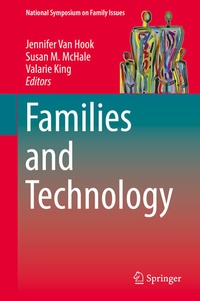
Families and Technology
Description

This timely reference takes a rigorous look at the myriad ways technology, from smartphones to dating apps to social media, is affecting family life and opening new areas for study. The book features cross-disciplinary perspectives on current trends in the role of technology in couple and family contexts. It focuses on the roles of parents in monitoring children's screen time, of technology in relationship formation, and of technology in changing family dynamics. Nuanced coverage considers the emerging conflicts and paradoxes associated with digital family life-closeness versus isolation, children versus parents as experts, and privacy versus surveillance. Contributors also identify new research opportunities as family roles and structures continue to evolve and technology becomes a greater lens for family studies.
Among the topics covered:-
How parents manage young children's mobile media use
-
Adolescents as the family technology innovators
-
Online dating: changing intimacy one swipe at a time
-
Technology in relational systems: roles, rules, and boundaries
-
Television "effects" on international family change
-
Interplay between families and technology: future investigations
Families and Technology
is a valuable resource for researchers and students in the fields of family studies, sociology, marriage and family therapy, social welfare, public health, and psychology. The book also appeals to policymakers and human services personnel dedicated to better understanding the impact of rapidly spreading technologies on families around the globe.
More details
Other editions
Additional editions
Persons
Jennifer Van Hook, PhD, is Roy C. Buck Professor of Sociology and Demography and Director of the Graduate Program in Sociology at Penn State and non-resident fellow at the Migration Policy Institute. She has expertise in the demographics of immigrant populations and the socioeconomic integration of immigrants and their children. One strand of her work uses demographic methods to estimate the size, characteristics, and dynamics of the unauthorized foreign-born population. Another strand of her work focuses on the health and well-being of immigrants and their children. She is currently co-editor of Demography, the flagship journal for population science.
Susan M. McHale, PhD, is Director of the Social Science Research Institute and Distinguished Professor of Human Development and Professor of Demography at Penn State. Her research focuses on children's and adolescents' family roles, relationships, and daily experiences and how these family dynamics are linked to youth development and adjustment. Dr. McHale's research highlights family gender dynamics, including how differential family experiences of sisters and brothers are linked to the choices they make in the areas of education, work, and family formation. Dr. McHale also investigates the socio-cultural contexts of family dynamics including how parents' and youths' values, practices, and daily experiences have implications for family life and youth adjustment in African American and Mexican American families. Most recently her work has extended to the links between family dynamics, particularly family stressors, and youths' physical health.
Content
How Parents Manage Young Children's Mobile Media Use.- Adolescents as the Family Technology Innovators.- Families and Technologies in an Era of Migration.- Online Dating: Changing Intimacy One Swipe at a Time.- Technology in Relational Systems: Roles, Rules, and Boundaries.- Are Tinder and Dating Apps Changing Dating and Mating in the U.S.?.- Television "Effects" on International Family Change.- Did Mobile Phones Increase Adult Children's Maternal Contact?.- Mental Health Risk with Social Media Use: "REAL" Communication.- Interplay Between Families and Technology: Future Investigations.
