

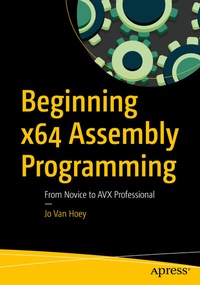
Beginning x64 Assembly Programming
From Novice to AVX Professional
Published on 31. October 2019
XIX, 413 pages
978-1-4842-5076-1 (ISBN)
Description

Program in assembly starting with simple and basic programs, all the way up to AVX programming. By the end of this book, you will be able to write and read assembly code, mix assembly with higher level languages, know what AVX is, and a lot more than that.
The code used in Beginning x64 Assembly Programming is kept as simple as possible, which means: no graphical user interfaces or whistles and bells or error checking. Adding all these nice features would distract your attention from the purpose: learning assembly language. The theory is limited to a strict minimum: a little bit on binary numbers, a short presentation of logical operators, and some limited linear algebra. And we stay far away from doing floating point conversions.
The assembly code is presented in complete programs, so that you can test them on your computer, play with them, change them, break them. This book will also show you what tools can beused, how to use them, and the potential problems in those tools. It is not the intention to give you a comprehensive course on all of the assembly instructions, which is impossible in one book: look at the size of the Intel Manuals. Instead, the author will give you a taste of the main items, so that you will have an idea about what is going on. If you work through this book, you will acquire the knowledge to investigate certain domains more in detail on your own.
The majority of the book is dedicated to assembly on Linux, because it is the easiest platform to learn assembly language. At the end the author provides a number of chapters to get you on your way with assembly on Windows. You will see that once you have Linux assembly under your belt, it is much easier to take on Windows assembly.
This book should not be the first book you read on programming, if you have never programmed before, put this book aside for a while and learn some basics of programming with a higher-level language such as C.
What You Will Learn
Who This Book Is For
Programmers in high level languages. It is also for systems engineers and security engineers working for malware investigators. Required knowledge: Linux, Windows, virtualization, and higher level programming languages (preferably C or C++).
The code used in Beginning x64 Assembly Programming is kept as simple as possible, which means: no graphical user interfaces or whistles and bells or error checking. Adding all these nice features would distract your attention from the purpose: learning assembly language. The theory is limited to a strict minimum: a little bit on binary numbers, a short presentation of logical operators, and some limited linear algebra. And we stay far away from doing floating point conversions.
The assembly code is presented in complete programs, so that you can test them on your computer, play with them, change them, break them. This book will also show you what tools can beused, how to use them, and the potential problems in those tools. It is not the intention to give you a comprehensive course on all of the assembly instructions, which is impossible in one book: look at the size of the Intel Manuals. Instead, the author will give you a taste of the main items, so that you will have an idea about what is going on. If you work through this book, you will acquire the knowledge to investigate certain domains more in detail on your own.
The majority of the book is dedicated to assembly on Linux, because it is the easiest platform to learn assembly language. At the end the author provides a number of chapters to get you on your way with assembly on Windows. You will see that once you have Linux assembly under your belt, it is much easier to take on Windows assembly.
This book should not be the first book you read on programming, if you have never programmed before, put this book aside for a while and learn some basics of programming with a higher-level language such as C.
What You Will Learn
- Discover how a CPU and memory works
- Appreciate how a computer and operating system work together
- See how high-level language compilers generate machine language, and use that knowledge to write more efficient code
- Be better equipped to analyze bugs in your programs
- Get your program working, which is the fun part
- Investigate malware and take the necessary actions and precautions
Who This Book Is For
Programmers in high level languages. It is also for systems engineers and security engineers working for malware investigators. Required knowledge: Linux, Windows, virtualization, and higher level programming languages (preferably C or C++).
More details
Series
Edition
1st ed.
Language
English
Place of publication
Berkeley
United States
Publishing group
APRESS
Target group
Professional and scholarly
Product notice
Reflowable
Illustrations
XIX, 413 p. 114 illus., 1 illus. in color.
File size
11,28 MB
ISBN-13
978-1-4842-5076-1 (9781484250761)
DOI
10.1007/978-1-4842-5076-1
Schweitzer Classification
Other editions
Additional editions
Book
10/2019
APress
€48.14
Shipment within 15-20 days
Person
Jo Van Hoey has 40 years of experience in IT, in diverse functions, multiple IT companies, and multiple computing platforms. He recently retired from IBM, where he was a mainframe software account manager. He has always been interested in IT security and knowledge of assembly language is an essential skill in defending IT infrastructure against attacks and malware.
Content
1. Your First Program: "hello, world".- 2. Binary numbers, hexadecimal numbers and registers.- 3. Program Analysis with a Debugger: gdb.- 4. Your Next Program: Alife and Kicking!.- 5. Assembly is based on logic.- 6. Data Display Debugger.- 7. Jumping and Looping.- 8. Memory.- 9. Integer Arithmetic.- 10. The Stack.- 11. Floating-Point Arithmetic.- 12. Functions.- 13. Stack Alignment and Stack Frame.- 14. External Functions.- 15. Calling Conventions.- 16. Bit Operations.- 17. Macros.- 18. Console I/O.- 19. File I/O.- 20. Command Line Arguments.- 21. From C to Assembler.- 22. Inline assembler.- 23. Strings.- 24. Got some ID?.- 25. SIMD.- 26. Watch your MXCSR.- 27. SSE.- 28. SSE Packed Integers.- 29. SSE String manipulation.- 30. Search a String for a Character.- 31. Compare Strings.- 32. Do the Shuffle.- 33. SSE String Masks.- 34. Advanced Vector Extensions - AVX.- 35. AVX matrix operations.- 36. Matrix Transpose.- 37. Performance Optimization.- 38. Hello, Windows World.- 39. Using the Windows API.- 40. Using a Window.- 41. Windows Argument Passing.- 42. Variadic functions.- 43. Windows Files.- Afterword. Where to go from here?.
