

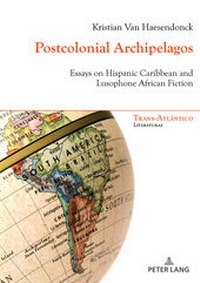
Postcolonial Archipelagos
Description

Writers from different postcolonial regions are usually classified according to their different nationalities or linguistic areas, and have rarely been brought together in one volume. Moving in a new direction, Postcolonial Archipelagos crosses not only geographical but also linguistic boundaries, by focusing on two contexts which seemingly have little or nothing in common with one another: the Hispanic Caribbean, and Lusophone Africa. Kristian Van Haesendonck thus opens new ground, in two ways: first, by making connections between contemporary Caribbean and African writers, moving beyond the topos of slavery and negritude in order to analyse the (im)possibility of conviviality in postcolonial cultures; and secondly, by exploring new ways of approaching these literatures as postcolonial archipelagic configurations with historical links to their respective metropoles, yet also as elements of what Glissant and Hannerz have respectively called "Tout-Monde" and a "world in creolization". Although the focus is on writers from Lusophone Africa (Mia Couto, José Luis Mendonça and Guilherme Mendes da Silva) and the Hispanic Caribbean (Junot Díaz, Eduardo Lalo, Marta Aponte, James Stevens-Arce and Edgardo Rodríguez Juliá), connections are made with and within the broader global context of intensified globalization.
More details
Other editions
Additional editions
Person
Kristian Van Haesendonck is a research fellow and member of the Postcolonial Literatures Research Group at the University of Antwerp. His interests lie in Ibero-American and Caribbean literatures and cultures, as well as in writing from Lusophone Africa. He has taught in the United States (Princeton, Villanova), Belgium (Universiteit Antwerpen, Universiteit Gent), the Netherlands (Universiteit Leiden) and Portugal (University of Lisbon). He is the author of ¿Encanto o espanto? Identidad y nación en la novela puertorriqueña actual (Iberoamericana), Going Caribbean! New Perspectives on Caribbean Literature and Art (Humus), and Caribbeing: Comparing Caribbean Literatures and Cultures (Rodopi).
