

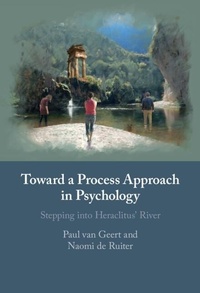
Toward a Process Approach in Psychology
Stepping into Heraclitus' River
Published on 13. July 2022
382 pages
978-1-108-85789-5 (ISBN)
Description

Psychological science constructs much of the knowledge that we consume in our everyday lives. This book is a systematic analysis of this process, and of the nature of the knowledge it produces. The authors show how mainstream scientific activity treats psychological properties as being fundamentally stable, universal, and isolable. They then challenge this status quo by inviting readers to recognize that dynamics, context-specificity, interconnectedness, and uncertainty, are a natural and exciting part of human psychology - these are not things to be avoided and feared, but instead embraced. This requires a shift toward a process-based approach that recognizes the situated, time-dependent, and fundamentally processual nature of psychological phenomena. With complex dynamic systems as a framework, this book sketches out how we might move toward a process-based praxis that is more suitable and effective for understanding human functioning.
Reviews / Votes
'Contemporary psychology has supplemented its traditional cabinet of curiosities, where inner substances such as 'intelligence' and 'extraversion' have long been on display, with the discovery of several others we didn't know we have. Virtuous substances such as 'self-esteem', 'grit', and 'self-compassion' are now exhibited alongside more noxious substances, such as post-traumatic stress disorder or Borderline Personality Disorder. For those who might, at this point, feel there are just too many inner substances to keep track of, Paul van Geert and Naomi de Ruiter offer some relief. They argue that many research programs in psychology get caught up in their own dubious assumptions, neglecting the vicissitudes of individual lives as lived over time. With learning and humor, ranging from Ancient Greece to Monty Python, they invite readers to contemplate a less rigid, more dynamic and process-oriented research agenda in psychology.' Paul Harris, Victor S. Thomas Professor of Education, Harvard University, USA 'Van Geert and de Ruiter present a bold and comprehensive denouncement of status quo psychological science to argue for a more ontologically valid process and systems orientation. A guide for how to move the science forward, this is a must-read for all social scientists at any level of experience.' Tom Hollenstein, Professor in the Department of Psychology, Queen's University, Canada 'This book is a breath of fresh air for psychology. It inspires us to question conventional assumptions and practices, and to think about human behavior in new ways. Using an impressive range of interdisciplinary sources, van Geert and de Ruiter masterfully and convincingly demonstrate how systems theory and a process framework can significantly advance basic and applied psychology.' Catherine Raeff, Ph.D., Theoretical and Developmental Psychologist, USA 'This important book has it all. It provides an in-depth yet highly accessible explanation of the complex systems approach to psychology, while exposing the limitations of conventional approaches. This is a must-read for anyone who yearns to understand the dynamics of human experience and is looking for the path forward.' Robin R. Vallacher, Professor and Interim Chair, Florida Atlantic University, USA and Research Associate, Center for Complex Systems, University of Warsaw, Poland 'Van Geert and de Ruiter provide psychological scientists with a timely admonition: our discipline's mainstream research practices and assumptions have yielded a base of knowledge and view of reality wholly out of touch with the time- and context-sensitive dynamics of people and their functioning. Written with exceptional clarity, precision, and scope, this remarkable new book adds immeasurably to the growing list of scholarly works challenging science's orthodox ontology of substance in favor of a process ontology.' David Witherington, Associate Professor, The University of New Mexico, USAMore details
Language
English
Place of publication
Cambridge
United Kingdom
Illustrations
Worked examples or Exercises
File size
5,39 MB
ISBN-13
978-1-108-85789-5 (9781108857895)
Copyright in bibliographic data and cover images is held by Nielsen Book Services Limited or by the publishers or by their respective licensors: all rights reserved.
Schweitzer Classification
Other editions
Additional editions
Paul Van Geert | Naomi de Ruiter
Toward a Process Approach in Psychology
Stepping into Heraclitus' River
Book
07/2022
Cambridge University Press
€136.70
Shipment within 15-20 days
Persons
Content
Introduction; 1. Change, the final frontier; 2. A (selected) foundation for a process approach; 3. The goal of Socrates; 4. Esteeming entities; 5. A person acting amongst persons; 6. Cliffhangers and utilitarian infants; 7. Causes, kings and interventions; 8. (Compl)explanation and King Alfonso's lament; 9. What's in a name?; 10. (Un)certainties; 11. Troubled waters of Hercalitus' river?; 12. Psychological science as a complex dynamic system.
