

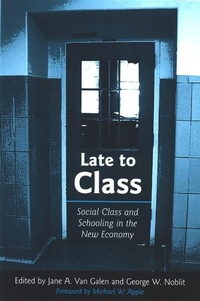
Late to Class
Description

b>Winner of the 2007 Critics' Choice Award presented by the American Educational Studies Association
Late to Class presents theoretical, empirical, and pedagogical perspectives on social class and schooling in the United States. Grounding their analyses at the intersections of class, ethnicity, gender, geography, and schooling, the contributors examine the educational experiences of poor, working class, and middle class students against the backdrop of complicated class stratification in a shifting global economy. Together, they explore the salience of class in understanding the social, economic, and cultural landscapes within which young people in the United States come to understand the meaning of their formal education in times of changing opportunity.
Jane A. Van Galen is Professor of Education at the University of Washington at Bothell and the coeditor (with Deborah Eaker-Rich) of
More details
Other editions
Additional editions
Persons
Jane A. Van Galen is Professor of Education at the University of Washington at Bothell and the coeditor (with Deborah Eaker-Rich) of Caring in an Unjust World: Negotiating Borders and Barriers in Schools, also published by SUNY Press. George W. Noblit is Joseph R. Neikirk Distinguished Professor of Sociology of Education at the University of North Carolina at Chapel Hill. His many books include The Social Construction of Virtue: The Moral Life of Schools (coauthored with Van O. Dempsey), also published by SUNY Press.
Content
Foreword
Introduction
Jane A. Van Galen
Part 1: Getting to Class
1. Growing Up as Poor, White Trash: Stories of Where I Come From
Beth Hatt
2. Class/Culture/Action: Representation, Identity, and Agency in Educational Analysis
Bill J. Johnston
Part 2: Class Work
3. Living Class as a Girl
Deborah Hicks and Stephanie Jones
4. Marginalization and Membership
Jill Koyama and Margaret A. Gibson
5. Orchestrating Habitus and Figured Worlds: Chicana/o Educational Mobility and Social Class
Luis Urrieta Jr.
6. High School Students' Exploration of Class Differences in a Multicultural Literature Class
Richard Beach, Daryl Parks, Amanda Thein, and Timothy Lensmire
7. Social Class and African-American Parental Involvement
Cheryl Fields-Smith
8. Social Heteroglossia: The Contentious Practice or Potential Place of Middle-Class Parents in Home-School Relations
Janice Kroeger
Part 3: After Class
9. (Re)Turning to Marx to Understand the Unexpected Anger Among "Winners" in Schooling: A Critical Social Psychology Perspective
Ellen Brantlinger
10. The Problem of Poverty: Shifting Attention to the Non-Poor
Maike Ingrid Philipsen
11. Intersections on the Back Road: Class, Culture, and Education in Rural and Appalachian Places
Van Dempsey
12. Class-Déclassé
George W. Noblit
List of Contributors
Name Index
Subject Index
