

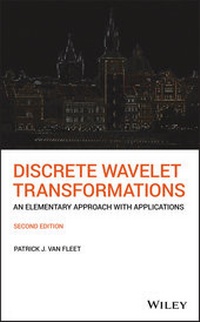
Discrete Wavelet Transformations
Description

The new edition of Discrete Wavelet Transformations continues to guide readers through the abstract concepts of wavelet theory by using Dr. Van Fleet's highly practical, application-based approach, which reflects how mathematicians construct solutions to challenges outside the classroom. By introducing the Haar, orthogonal, and biorthogonal filters without the use of Fourier series, Van Fleet allows his audience to connect concepts directly to real-world applications at an earlier point than other publications in the field.
Leveraging extensive graphical displays, this self-contained volume integrates concepts from calculus and linear algebra into the constructions of wavelet transformations and their applications, including data compression, edge detection in images and denoising of signals. Conceptual understanding is reinforced with over 500 detailed exercises and 24 computer labs.
The second edition discusses new applications including image segmentation, pansharpening, and the FBI fingerprint compression specification. Other notable features include:
* Two new chapters covering wavelet packets and the lifting method
* A reorganization of the presentation so that basic filters can be constructed without the use of Fourier techniques
* A new comprehensive chapter that explains filter derivation using Fourier techniques
* Over 120 examples of which 91 are "live examples," which allow the reader to quickly reproduce these examples in Mathematica or MATLAB and deepen conceptual mastery
* An overview of digital image basics, equipping readers with the tools they need to understand the image processing applications presented
* A complete rewrite of the DiscreteWavelets package called WaveletWare for use with Mathematica and MATLAB
* A website, www.stthomas.edu/wavelets, featuring material containing the WaveletWare package, live examples, and computer labs in addition to companion material for teaching a course using the book
Comprehensive and grounded, this book and its online components provide an excellent foundation for developing undergraduate courses as well as a valuable resource for mathematicians, signal process engineers, and other professionals seeking to understand the practical applications of discrete wavelet transformations in solving real-world challenges.
More details
Other editions
Additional editions
Person
PATRICK J. VAN FLEET is Professor and Chair of the Department of Mathematics at the University of St. Thomas in St. Paul, Minnesota. He has authored several journal articles on (multi)wavelets and conducted sponsored workshops for developing and teaching an applications-first course on wavelets. He received his PhD in Mathematics from Southern Illinois University-Carbondale in 1991.
Content
1 Introduction: Why Wavelets? 1
2 Vectors and Matrices 15
2.1 Vectors, Inner Products, and Norms 16
Problems 21
2.2 Basic Matrix Theory 23
Problems 38
2.3 Block Matrix Arithmetic 40
Problems 48
2.4 Convolution and Filters 51
Problems 65
3 An Introduction to Digital Images 69
3.1 The Basics of Grayscale Digital Images 70
Problems 88
Computer Lab 91
3.2 Color Images and Color Spaces 91
Problems 103
Computer Lab 106
3.3 Huffman Coding 106
Problems 113
3.4 Qualitative and Quantitative Measures 114
Problems 120
Computer Labs 123
4 The Haar Wavelet Transformation 125
4.1 Constructing the Haar Wavelet Transformation 127
Problems 137
Computer Lab 140
4.2 Iterating the Process 140
Problems 146
Computer Lab 147
4.3 The Two-Dimensional Haar Wavelet Transformation 147
Problems 159
Computer Lab 161
4.4 Applications: Image Compression and Edge Detection 161
Problems 177
Computer Labs 181
5 Daubechies Wavelet Transformations 183
5.1 Daubechies Filter of Length 4 185
Problems 196
Computer Lab 203
5.2 Daubechies Filter of Length 6 203
Problems 212
Computer Lab 215
5.3 Daubechies Filters of Even Length 215
Problems 225
Computer Lab 228
6 Wavelet Shrinkage: An Application to Denoising 231
6.1 An Overview of Wavelet Shrinkage 232
Problems 237
Computer Lab 238
6.2 VisuShrink 238
Problems 245
Computer Lab 246
6.3 SureShrink 246
Problems 257
Computer Labs 260
7 Biorthogonal Wavelet Transformations 261
7.1 The (5; 3) Biorthogonal Spline Filter Pair 262
Problems 273
Computer Lab 278
7.2 The (8; 4) Biorthogonal Spline Filter Pair 278
Problems 283
Computer Lab 288
7.3 Symmetry and Boundary Effects 288
Problems 307
Computer Lab 311
7.4 Image Compression and Image Pansharpening 312
Computer Lab 320
8 Complex Numbers and Fourier Series 321
8.1 The Complex Plane and Arithmetic 322
Problems 332
8.2 Fourier Series 334
Problems 344
8.3 Filters and Convolution in the Fourier Domain 349
Problems 360
9 Filter Construction in the Fourier Domain 365
9.1 Filter Construction 366
Problems 377
9.2 Daubechies Filters 378
Problems 382
9.3 Coiflet Filters 382
Problems 395
9.4 Biorthogonal Spline Filter Pairs 400
Problems 410
Computer Lab 413
9.5 The Cohen-Daubechies-Feauveau 9/7 Filter 414
Problems 423
Computer Lab 426
10 Wavelet Packets 427
10.1 The Wavelet Packet Transform 428
Problems 435
10.2 Cost Functions and the Best Basis Algorithm 436
Problems 444
10.3 The FBI Fingerprint Compression Specification 446
Computer Lab 460
11 Lifting 461
11.1 The LeGall Wavelet Transform 462
Problems 471
Computer Lab 473
11.2 Z-Transforms and Laurent Polynomials 474
Problems 484
11.3 A General Construction of the Lifting Method 486
Problems 499
11.4 The Lifting Method - Examples 504
Problems 517
12 The JPEG2000 Image Compression Standard 525
12.1 An Overview of JPEG 526
Problems 532
12.2 The Basic JPEG2000 Algorithm 533
Problems 539
12.3 Examples 540
A Basic Statistics 547
A.1 Descriptive Statistics 547
Problems 549
A.2 Sample Spaces, Probability, and Random Variables 550
Problems 553
A.3 Continuous Distributions 553
Problems 559
A.4 Expectation 559
Problems 565
A.5 Two Special Distributions 566
Problems 568
PREFACE TO THE FIRST EDITION
(Abridged and edited)
Why This Book?
How do you apply wavelets to images? This question was asked of me by a bright undergraduate student while I was a professor in the mid-1990s at Sam Houston State University. I was part of a research group there and we had written papers in the area of multiwavelets, obtained external funding to support our research, and hosted an international conference on multiwavelets. So I fancied myself as somewhat knowledgeable on the topic. But this student wanted to know how they were actually used in the applications mentioned in articles she had read. It was quite humbling to admit to her that I could not exactly answer her question. Like most mathematicians, I had a cursory understanding of the applications, but I had never written code that would apply a wavelet transformation to a digital image for the purposes of processing it in some way. Together, we worked out the details of applying a discrete Haar wavelet transformation to a digital image, learned how to use the output to identify the edges in the image (much like what is done in Section 4.4), and wrote software to implement our work.
My first year at the University of St. Thomas was 1998-1999 and I was scheduled to teach Applied Mathematical Modeling II during the spring semester. I wanted to select a current topic that students could immediately grasp and use in concrete applications. I kept returning to my positive experience working with the undergraduate student at Sam Houston State University on the edge detection problem. I was surprised by the number of concepts from calculus and linear algebra that we had reviewed in the process of coding and applying the Haar wavelet transformation. I was also impressed with the way the student embraced the coding portion of the work and connected to it ideas from linear algebra. In December 1998, I attended a wavelet workshop organized by Gilbert Strang and Truong Nguyen. They had just authored the book Wavelets and Filter Banks [88], and their presentation of the material focused a bit more on an engineering perspective than a mathematical one. As a result, they developed wavelet filters by using ideas from convolution theory and Fourier series.
I decided that the class I would prepare would adopt the approach of Strang and Nguyen and I planned accordingly. I would attempt to provide enough detail and background material to make the ideas accessible to undergraduates with backgrounds in calculus and linear algebra. I would concentrate only on the development of the discrete wavelet transformation. The course would take an "applications first" approach. With minimal background, students would be immersed in applications and provide detailed solutions. Moreover, the students would make heavy use of the computer by writing their own code to apply wavelet transformations to digital audio or image files. Only after the students had a good understanding of the basic ideas and uses of discrete wavelet transformations would we frame general filter development using classical ideas from Fourier series. Finally, wherever possible, I would provide a discussion of how and why a result was obtained versus a statement of the result followed by a concise proof and example. The first course was enough of a success to try again. To date, I have taught the course seven times and developed course materials (lecture notes, software, and computer labs) to the point where colleagues can use them to offer the course at their home institutions.
As is often the case, this book evolved out of several years' worth of lecture notes prepared for the course. The goal of the text is to present a topic that is useful in several of today's applications involving digital data in such a way that it is accessible to students who have taken calculus and linear algebra. The ideas are motivated through applications - students learn the ideas behind discrete wavelet transformations and their applications by using them in image compression, image edge detection, and signal denoising. I have done my best to provide many of the details for these applications that my SHSU student and I had to discover on our own. In so doing, I found that the material strongly reinforces ideas learned in calculus and linear algebra, provides a natural arena for an introduction of complex numbers, convolution, and Fourier series, offers motivation for student enrollment in higher-level undergraduate courses such as real analysis or complex analysis, and establishes the computer as a legitimate learning tool. The book also introduces students to late-twentieth century mathematics. Students who have grown up in the digital age learn how mathematics is utilized to solve problems they understand and to which they can easily relate. And although students who read this book may not be ready to perform high-level mathematical research, they will be at a point where they can identify problems and open questions studied by researchers today.
To the Student
Many of us have learned a foreign language. Do you remember how you formulated an answer when your instructor asked you a question in the foreign language? If you were like me, you mentally translated the question to English, formulated an answer to the question, and then translated the answer back to the foreign language. Ultimately, the goal is to omit the translation steps from the process, but the language analogy perfectly describes an important mathematical technique.
Mathematicians are often faced with a problem that is difficult to solve. In many instances, mathematicians will transform the problem to a different setting, solve the problem in the new setting, and then transform the answer back to the original domain. This is exactly the approach you use in calculus when you learn about u-substitutions or integration by parts. What you might not realize is that for applications involving discrete data (lists or tables of numbers), matrix multiplication is often used to transform the data to a setting more conducive to solving the problem. The key, of course, is to choose the correct matrix for the task.
In this book, you will learn about discrete wavelet transformations and their applications. For now, think of the transformation as a matrix that we multiply with a vector (audio) or another matrix (image). The resulting product is much better suited than the original image for performing tasks such as compression, denoising, or edge detection. A wavelet filter is simply a list of numbers that is used to construct the wavelet matrix. Of course, this matrix is very special, and as you might guess, some thought must go into its construction. What you will learn is that the ideas used to construct wavelet filters and wavelet transformation matrices draw largely from calculus and linear algebra.
The first wavelet filters will be easy to construct and the ad hoc approached can be mimicked, to a point, to construct other filters. But then you will need to learn more about convolution and Fourier series in order to systematically construct wavelet filters popular in many applications. The hope is that by this point, you will understand the applications sufficiently to be highly motivated to learn the theory. If your instructor covers the material in Chapters 8 and 9, work hard to master it. In all likelihood, it will be new mathematics for you but the skill you gain from this approach to filter construction will greatly enhance your problem-solving skills.
Questions you are often asked in mathematics courses start with phrases such as "solve this equation," "differentiate/integrate this function," or "invert this matrix." In this book, you will see why you need to perform these tasks since the questions you will be asked often start with "denoise this signal," "compress this image," or "build this filter." At first you might find it difficult to solve problems without clear-cut instructions, but understand that this is exactly the approach used to solve problems in mathematical research or industry.
Finally, if your instructor asks you to write software to implement wavelet transformations and their inverses, understand that learning to write good mathematical programs takes time. In many cases, you can simply translate the pseudocode from the book to the programming language you are using. Resist this temptation and take the extra time necessary to deeply understand how the algorithm works. You will develop good programming skills and you will be surprised at the amount of mathematics you can learn in the process.
To the Instructor
The technique of solving problems in the transform domain is common in applied mathematics as used in research and industry, but we do not devote as much time to it as we should in the undergraduate curriculum. It is my hope that faculty can use this book to create a course that can be offered early in the curriculum and fill this void.
I have found that it is entirely tractable to offer this course to students who have completed calculus I and II, a computer programming course, and sophomore linear algebra. I view the course as a post-sophomore capstone course that strengthens student knowledge in the prerequisite courses and provides some rationale and motivation for the mathematics they will see in courses such as real analysis.
The aim is to make the presentation as elementary as possible. Toward this end, explanations are not quite as terse as they could be, applications are...
