

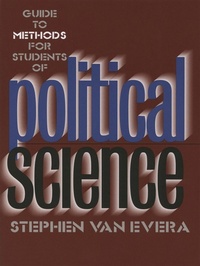
Guide to Methods for Students of Political Science
Published on 15. April 2015
144 pages
978-0-8014-5444-8 (ISBN)
Description

Stephen Van Evera greeted new graduate students at MIT with a commonsense introduction to qualitative methods in the social sciences. His helpful hints, always warmly received, grew from a handful of memos to an underground classic primer. That primer evolved into a book of how-to information about graduate study, which is essential reading for graduate students and undergraduates in political science, sociology, anthropology, economics, and history - and for their advisers.
-How should we frame, assess, and apply theories in the social sciences? "I am unpersuaded by the view that the prime rules of scientific method should differ between hard science and social science. Science is science."
-A section on case studies shows novices the ropes.
-Van Evera contends the realm of dissertations is often defined too narrowly "Making and testing theories are not the only games in town.... If everyone makes and tests theories but no one ever uses them, then what are they for?"
-In "Helpful Hints on Writing a Political Science Ph.D. Dissertation," Van Evera focuses on presentation, and on broader issues of academic strategy and tactics.
-Van Evera asks how political scientists should work together as a community. "All institutions and professions that face weak accountability need inner ethical rudders that define their obligations in order to stay on course."
-How should we frame, assess, and apply theories in the social sciences? "I am unpersuaded by the view that the prime rules of scientific method should differ between hard science and social science. Science is science."
-A section on case studies shows novices the ropes.
-Van Evera contends the realm of dissertations is often defined too narrowly "Making and testing theories are not the only games in town.... If everyone makes and tests theories but no one ever uses them, then what are they for?"
-In "Helpful Hints on Writing a Political Science Ph.D. Dissertation," Van Evera focuses on presentation, and on broader issues of academic strategy and tactics.
-Van Evera asks how political scientists should work together as a community. "All institutions and professions that face weak accountability need inner ethical rudders that define their obligations in order to stay on course."
More details
Language
English
Place of publication
Ithaca
United States
Product notice
Reflowable
ISBN-13
978-0-8014-5444-8 (9780801454448)
Copyright in bibliographic data and cover images is held by Nielsen Book Services Limited or by the publishers or by their respective licensors: all rights reserved.
Schweitzer Classification
Other editions
Additional editions
Stephen Van Evera
Guide to Methods for Students of Political Science
Property, Proof, and Dispute in Catalonia Around the Year 1000
Book
10/1997
Cornell University Press
€14.50
Shipment within 10-20 days
Person
Stephen Van Evera is Professor of Political Science at the Massachusetts Institute of Technology and Associate Director of the MIT Center for International Studies. He is the author of Causes of War: Power and the Roots of Conflict, also from Cornell.
Content
INTRODUCTION1. HYPOTHESES, LAWS, AND THEORIES: A USER'S GUIDE
What Is a Theory?
What Is a Specific Explanation?
What Is a Good Theory?
How Can Theories Be Made?
How Can Theories Be Tested?
Strong vs. Weak Tests: Predictions and Tests
Helpful Hints for Testing Theories
How Can Specific Events Be Explained?
Methodology Myths2. WHAT ARE CASE STUDIES? HOW SHOULD THEY BE PERFORMED?
Case Studies in Perspective
Testing Theories with Case Studies
Creating Theories with Case Studies
Inferring Antecedent Conditions from Case Studies
Testing Antecedent Conditions with Case Studies
Explaining Cases
Strong vs. Weak Tests: Predictions and Tests
Interpreting Contradictory Results
Case-Selection Criteria3. WHAT IS A POLITICAL SCIENCE DISSERTATION?4. HELPFUL HINTS ON WRITING A POLITICAL SCIENCE DISSERTATION
Topic Selection
Organization
Your Dissertation Prospectus
Your Introductory Chapter
Your Concluding Chapter
Study Design and Presentation
Writing
Style
Vetting
Your Abstract
Dealing with your Dissertation Committee
Dealing with Your Head, Your Family, and Your Friends
How to Learn More about How to Write a Dissertation5. THE DISSERTATION PROPOSAL6. PROFESSIONAL ETHICSAPPENDIX: HOW TO WRITE A PAPER
FURTHER READING
INDEX
What Is a Theory?
What Is a Specific Explanation?
What Is a Good Theory?
How Can Theories Be Made?
How Can Theories Be Tested?
Strong vs. Weak Tests: Predictions and Tests
Helpful Hints for Testing Theories
How Can Specific Events Be Explained?
Methodology Myths2. WHAT ARE CASE STUDIES? HOW SHOULD THEY BE PERFORMED?
Case Studies in Perspective
Testing Theories with Case Studies
Creating Theories with Case Studies
Inferring Antecedent Conditions from Case Studies
Testing Antecedent Conditions with Case Studies
Explaining Cases
Strong vs. Weak Tests: Predictions and Tests
Interpreting Contradictory Results
Case-Selection Criteria3. WHAT IS A POLITICAL SCIENCE DISSERTATION?4. HELPFUL HINTS ON WRITING A POLITICAL SCIENCE DISSERTATION
Topic Selection
Organization
Your Dissertation Prospectus
Your Introductory Chapter
Your Concluding Chapter
Study Design and Presentation
Writing
Style
Vetting
Your Abstract
Dealing with your Dissertation Committee
Dealing with Your Head, Your Family, and Your Friends
How to Learn More about How to Write a Dissertation5. THE DISSERTATION PROPOSAL6. PROFESSIONAL ETHICSAPPENDIX: HOW TO WRITE A PAPER
FURTHER READING
INDEX
