

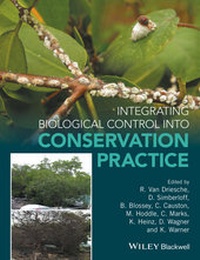
Integrating Biological Control into Conservation Practice
Description

More details
Other editions
Additional editions
Persons
Roy G. Van Driesche, Department of Environmental Conservation, University of Massachusetts, USA.
Daniel Simberloff, Department of Ecology & Evolutionary Biology, University of Tennessee, USA.
Bernd Blossey, Department of Natural Resources, Cornell University, USA.
Chrlotte Causton, Charles Darwin Foundation, Galapagos Islands.
Mark S. Hoddle, Department of Entomology, University of California, Riverside, USA.
Christian O. Marks, The Nature Conservancy, Connecticut River Program, USA.
Kevin M. Heinz, Department of Entomology, Texas A & M University, USA.
David Wagner, Department of Ecology & Evolutionary Biology, University of Connecticut, USA.
Keith Warner, Center for Science, Technology and Society, Santa Clara University, USA.
Content
CHAPTER 1
Integrating biological control into a conservation context: why is it necessary?
Kevin M. Heinz1, Roy G. Van Driesche2, and Daniel Simberloff3
1 Department of Entomology, Texas A & M University, USA
2 Department of Environmental Conservation, University of Massachusetts, USA
3 Department of Ecology & Evolutionary Biology, University of Tennessee, USA
Potential problems if integration is lacking
The basic argument of this book is that, for pests of wildlands1, biological control should be one of the tools considered for use. Not to do so would lead to inadequate restoration for many pests because, while they might be controlled in small areas, they would remain uncontrolled over much of the landscape. We further argue that biological control will be done better if integrated into conservation biology because that will force greater consideration of the role of the invader as the true source, or not, of ecosystem degradation (see Chapter 2) and would incorporate into the control program more detailed knowledge of the invaded community's ecology, which may exist best within the conservation biology community. Finally, we argue that biological control in areas of conservation importance can be done safely with modern methods of evaluation for assessing pest impact and natural enemy host range.
When conservation biologists seek to restore natural communities damaged by invasive species, if they give no thought to biological control, their efforts may be far less successful. Without biological control in the mix of potential tools, restoration efforts move toward eradication if possible, suppression over large areas by changing processes (e.g., fire, flood, or grazing regimes) at the landscape level if relevant, or suppressing the invader on small patches with chemical or mechanical tools if these methods work and money can be found for long-term management. Many invaders, however, cannot be eradicated if they are widespread, or their biology may not be appropriate to control over the long term with pesticides or mechanical tools. Similarly, while some plants or insects may have become highly invasive because people have altered historical landscape processes (MacDougall and Turkington, 2005), this factor surely does not account for the damage caused by some invaders. Certainly, it applies to few if any invasive insects: virtually none of the invasive insects that have so damaged North American forests (Campbell and Schlarbaum, 1994; Van Driesche and Reardon, 2014) could be said to have such factors driving their destructive effects. In contrast, some invasive plants quite likely are augmented in their densities by such forces, but clearly not all are. This leaves many highly damaging insects and plants for which restoration of ecological processes toward historical norms will not lead to restoration of the ecosystem. In such cases, then, restoration efforts are limited to saving fragments through intensive efforts at the preserve rather than the landscape level. While these efforts may protect rare species with small, threatened ranges, they do nothing to preserve average habitat conditions for the bulk of species across the broader landscape. Working with biological control scientists can sometimes provide a solution that can safely (if well conceived and executed) protect the landscape rather than just a few isolated preserves.
To succeed at biological control is not easy and requires cross-disciplinary collaborations to understand fully the implications of releasing natural enemies of the invader. If such collaborations with conservation biologists are lacking, decisions may be taken that undervalue certain native species, miss important ways in which these species are interacting, or fail to consider fully the potential impacts of the introduced biological control agents on the native ecosystem or what other forces may be at work driving ecosystem change. If biological control scientists work within a broader restoration team that includes conservation biologists, these potential pitfalls are more likely to be recognized and avoided.
Carrying out a biological control program typically requires a commitment to travel to the invader's native range and determine what natural enemies affect the invader's population dynamics there and which of these are plausibly sufficiently specialized that they might be safe for release in the invaded region. These demands require training in natural enemy biology and population dynamics, as well as knowledge of foreign cultures and geography. If the targeted invader is a plant, the biological control scientist must also have extensive understanding of plant taxonomy, physiology, and how both biotic and abiotic factors affect plant demography. If the invader is an insect, the practitioner must also be familiar with the taxonomy and biology of parasitoids or predators, how to rear them, and how they overcome host defenses. Training in these diverse subjects may leave little time to develop a deep appreciation for the community ecology and details of the particular ecosystems invaded by the pest. This leaves the biological control scientist vulnerable to making decisions that fail to take such information fully into account, and hence underscores the value of collaborative projects within a conservation biology framework, working with specialists on the ecology of the invaded communities.
Book organization
The practices of biological control and ecological restoration can be viewed as large-scale field experiments that unintentionally test many fundamental principles in ecology, as noted previously for both biological control (e.g., Hawkins and Cornell, 1999; Wajnberg et al., 2001; Roderick et al., 2012) and species conservation and habitat restoration (e.g., Young, 2000; Groom et al., 2005). Several issues need addressing when one attempts to integrate biological control of pests of wildlands into the larger framework of conservation biology. In the chapters that follow, experts illustrate some of the problems that can arise when such integration is lacking and provide insights for avoiding problems that may affect the management program or conservation interests.
In Chapter 2, readers are presented with a conceptual framework for confirming whether an invasive species is the primary cause of environmental change and for deciding how to minimize its impacts, potentially as part of a larger package of restoration activities. Approaches potentially able to generate the desired outcomes are discussed and illustrated with the example of conservation threats to floodplain forests in New England. Chapter 3 subsequently addresses the means (tools) available to control invasive species. Depending on circumstances, control goals may be eradication, human-sustained invader suppression with periodic mechanical or chemical control plus monitoring, or permanent area-wide invader suppression through alteration of ecosystem processes or programs of biological control. Once goals are set, a variety of tools may be relevant and are discussed (mechanical, chemical, biological, combinations) in terms of the system or pest attributes that affect efficacy, control cost, and effects on the environment. Chapter 4 examines tradeoffs among risks posed by major control methods using case histories of particular projects. Chapter 5 continues this discussion through an examination of how the risks and benefits of biological control projects against wildland pests can best be recognized and compared, through the planned interaction of biological control scientists and conservation biologists. At the end of these chapters, readers should have a better understanding of when biological control may be the right or wrong option.
The next block of chapters shifts to the practice of biological control within the context of environmental restoration projects. Chapter 6 discusses the importance of systematics and accurate taxonomic identification, both of pests and natural enemies, for biological control programs. The discussion includes recent developments in molecular techniques applicable to modern biological control programs. Chapter 7 addresses our ability to forecast unwanted impacts of biological control, describing the nature of the concern, reviewing the historical record, and ending with a discussion of unresolved issues. Chapters 8 and 9 discuss how to measure and evaluate outcomes of biological control projects. Because biological control is costly in terms of financial and human resources, there is an increasing demand for accountability as to efficacy when biological control is used to restore or protect native ecosystems or species. Addressed directly in these chapters are the difficult tasks associated with delineating the damaged system's starting conditions and measuring the progress toward achieving restoration goals. Chapter 8 takes a broad conceptual view of the task, while Chapter 9 reviews techniques used for such assessments and their limits and requirements for application. Chapter 10 discusses a series of biological control projects conducted in wildland ecosystems. These cases provide concrete examples of the kinds of damage that can be corrected with biological control, and the discussions of project details highlight the variety of issues that can affect such work.
Concluding chapters address societal and economic matters. Chapter 11 discusses laws and regulations that affect biological control. The evolution of regulations and regulatory agencies from several parts of...
