

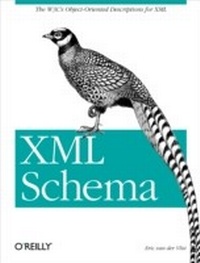
XML Schema
The W3C's Object-Oriented Descriptions for XML
1st Edition
Published on 25. June 2002
400 pages
978-1-4493-1592-4 (ISBN)
Description

If you need to create or use formal descriptions of XML vocabularies, the W3C's XML Schema offers a powerful set of tools for defining acceptable document structures and content. An alternative to DTDs as the way to describe and validate data in an XML environment, XML Schema enables developers to create precise descriptions with a richer set of datatypes?such as booleans, numbers, currencies, dates and times?that are essential for today?s applications.Schemas are powerful, but that power comes with substantial complexity. This concise book explains the ins and outs of XML Schema, including design choices, best practices, and limitations. Particularly valuable are discussions of how the type structures fit with existing database and object-oriented program contexts. With XML Schema, you can define acceptable content models and annotate those models with additional type information, making them more readily bound to programs and objects. Schemas combine the easy interchange of text-based XML with the more stringent requirements of data exchange, and make it easier to validate documents based on namespaces.You?ll find plenty of examples in this book that demonstrate the details necessary for precise vocabulary definitions. Topics include:Foundations of XML Schema syntaxFlat, "e;russian-doll"e;, and other schema approachesWorking with simple and complex types in a variety of contextsThe built-in datatypes provided by XML SchemaUsing facets to extend datatypes, including regular expression-based patternsUsing keys and uniqueness rules to limit how and where information may appearCreating extensible schemas and managing extensibilityDocumenting schemas and extending XML Schema capabilities through annotationsIn addition to the explanatory content, XML Schemaprovides a complete reference to all parts of both the XML Schema Structures and XML Schema Datatypes specifications, as well as a glossary. Appendices explore the relationships between XML Schema and other tools for describing document structures, including DTDs, RELAX NG, and Schematron, as well as work in progress at the W3C to more tightly integrate XML Schema with existing specifications.No matter how you intend to use XML Schema - for data structures or document structures, for standalone documents or part of SOAP transactions, for documentation, validation, or data binding ? all the foundations you need are outlined in XML Schema.
More details
Other editions
Additional editions
Content
- Intro
- Table of Contents
- Preface
- Who Should Read This Book?
- Who Should Not Read This Book?
- About the Examples
- Organization of This Book
- Conventions Used in This Book
- How to Contact Us
- Acknowledgments
- Chapter 1: Schema Uses and Development
- What Schemas Do for XML
- Validation
- Documentation
- Querying Support
- Data Binding
- Guided Editing
- W3C XML Schema
- Chapter 2: Our First Schema
- The Instance Document
- Our First Schema
- First Findings
- W3C XML Schema Is Modular
- W3C XML Schema Is Both About Structure and Datatyping
- Flat Design, Global Components
- Chapter 3: Giving Some Depth to Our First Schema
- Working From the Structure of the Instance Document
- New Lessons
- Depth Versus Modularity?
- Russian Doll and Object-Oriented Design
- Where Have the Element Types Gone?
- Chapter 4: Using Predefined Simple Datatypes
- Lexical and Value Spaces
- Whitespace Processing
- String Datatypes
- No Whitespace Replacement
- Normalized Strings
- Collapsed Strings
- Tokens
- Qualified names
- URIs
- Notations
- Binary string-encoded datatypes
- Numeric Datatypes
- Decimal Types
- Float Datatypes
- xs:boolean
- Date and Time Datatypes
- The Realm of ISO 8601
- Datatypes
- List Types
- What About anySimpleType?
- Back to Our Library
- Chapter 5: Creating Simple Datatypes
- Derivation By Restriction
- Facets
- Whitespace collapsed strings
- Other strings
- Float datatypes
- Date and time datatypes
- Integer and derived datatypes
- Decimals
- Booleans
- List datatypes
- Multiple Restrictions and Fixed Attribute
- Facet that can be changed but needs to be more restrictive
- Facet that cannot be changed
- Facet that performs the intersection of the lexical spaces
- Facet that does its job before the lexical space
- Fixed facets
- Derivation By List
- List Datatypes
- Derivation By Union
- Some Oddities of Simple Types
- Beware of the Order
- Using or Abusing Lists to Change the Behavior of Length Constraining Facets
- Back to Our Library
- Chapter 6: Using Regular Expressions to Specify Simple Datatypes
- The Swiss Army Knife
- The Simplest Possible Patterns
- Quantifying
- More Atoms
- Special Characters
- Wildcard
- Character Classes
- Classical Perl character classes
- Unicode character classes
- User-defined character classes
- Oring and Grouping
- Common Patterns
- String Datatypes
- Unicode blocks
- Counting words
- URIs
- Numeric and Float Types
- Leading zeros
- Fixed format
- Datetimes
- Time zones
- Back to Our Library
- Chapter 7: Creating Complex Datatypes
- Simple Versus Complex Types
- Examining the Landscape
- Content Models
- Named Versus Anonymous Types
- Creation Versus Derivation
- Simple Content Models
- Creation of Simple Content Models
- Derivation from Simple Contents
- Derivation by extension
- Derivation by restriction
- Comparison of these two methods
- Complex Content Models
- Creation of Complex Content
- Compositors and particles
- Element and attribute groups
- Unique Particle Attribution Rule
- Consistent Declaration Rule
- Limitations on unordered content models
- Derivation of Complex Content
- Derivation by extension
- Derivation by restriction
- Asymmetry of these two methods
- Mixed Content Models
- Creating Mixed Content Models
- Derivation of Mixed Content Models
- Derivation by extension
- Derivation by restriction
- Derivation between complex and mixed content models
- Empty Content Models
- Creation of Empty Content Models
- As simple content models
- As complex content models
- Derivation of Empty Content Models
- Derivation by extension
- Derivation by restriction
- Simple or Complex Content Models for Empty Content Models?
- Back to Our Library
- Derivation or Groups
- Chapter 8: Creating Building Blocks
- Schema Inclusion
- Schema Inclusion with Redefinition
- Redefining of Simple and Complex Types
- Redefinition of Element and Attribute Groups
- Extension
- Restriction
- Other Alternatives
- External Parsed Entities
- XInclude
- Simplifying the Library
- Chapter 9: Defining Uniqueness, Keys, and Key References
- xs:ID and xs:IDREF
- XPath-Based Identity Checks
- Uniqueness
- Composite Fields
- Keys
- Key References
- Permitted XPath Expressions
- ID/IDREF Versus xs:key/xs:keyref
- Using xs:key and xs:unique As Co-occurrence Constraints
- Chapter 10: Controlling Namespaces
- Namespaces Present Two Challenges to Schema Languages
- Namespace Declarations
- To Qualify Or Not to Qualify?
- Disruptive Attributes
- Namespaces and XPath Expressions
- Referencing Other Namespaces
- Schemas for XML, XML Base and XLink
- XML Attributes
- XLink Attributes
- Namespace Behavior of Imported Components
- Importing Schemas with No Namespaces
- Chameleon Design
- Allowing Any Elements or Attributes from a Particular Namespace
- Chapter 11: Referencing Schemas and Schema Datatypes in XML Documents
- Associating Schemas with Instance Documents
- Defining Element Types
- Defining Simple Types
- Defining Complex Types
- Defining Nil (Null) Values
- Beware the Intrusive Nature of These Features...
- Chapter 12: Creating More Building Blocks Using Object-Oriented Features
- Substitution Groups
- Using a "Traditional" Group
- Substitution Groups
- Using substitution groups
- Abstract elements
- Trees of substitution groups
- Traditional Declarations or Substitution Groups?
- Fuzzy Recommendation
- Extension of xs:choice through group redefinitions
- Restricting substitution groups
- Controlling Derivations
- Attributes
- Elements
- Block attribute
- Final elements
- Abstract elements
- Complex Types
- Blocking complex types
- Final complex types
- Abstract complex types
- Simple Types
- Other Components and Redefinitions
- Chapter 13: Creating Extensible Schemas
- Extensible Schemas
- Global Components
- Elements
- Attributes
- final and fixed Attributes
- Splitting Schema Components
- The Need for Open Schemas
- xsi:type
- Wildcards
- And Substitution Groups?
- Chapter 14: Documenting Schemas
- Style Matters
- Keep It Simple
- Think Globally
- When It's Similar, Show It
- The W3C XML Schema Annotation Element
- Foreign Attributes
- XML 1.0 Comments
- Which One and What For?
- Chapter 15: Elements Reference Guide
- xs:all (outside a group)
- xs:all (within a group)
- xs:annotation
- xs:any
- xs:anyAttribute
- xs:appinfo
- xs:attribute (global definition)
- xs:attribute (reference or local definition)
- xs:attributeGroup (global definition)
- xs:attributeGroup (reference)
- xs:choice (outside a group)
- xs:choice (within a group)
- xs:complexContent
- xs:complexType (global definition)
- xs:complexType (local definition)
- xs:documentation
- xs:element (global definition)
- xs:element (within xs:all)
- xs:element (reference or local definition)
- xs:enumeration
- xs:extension (simple content)
- xs:extension (complex content)
- xs:field
- xs:fractionDigits
- xs:group (definition)
- xs:group (reference)
- xs:import
- xs:include
- xs:key
- xs:keyref
- xs:length
- xs:list
- xs:maxExclusive
- xs:maxInclusive
- xs:maxLength
- xs:minExclusive
- xs:minInclusive
- xs:minLength
- xs:notation
- xs:pattern
- xs:redefine
- xs:restriction (simple type)
- xs:restriction (simple content)
- xs:restriction (complex content)
- xs:schema
- xs:selector
- xs:sequence (outside a group)
- xs:sequence (within a group)
- xs:simpleContent
- xs:simpleType (global definition)
- xs:simpleType (local definition)
- xs:totalDigits
- xs:union
- xs:unique
- xs:whiteSpace
- Chapter 16: Datatype Reference Guide
- Datatype
- xs:anyURI
- xs:base64Binary
- xs:boolean
- xs:byte
- xs:date
- xs:dateTime
- xs:decimal
- xs:double
- xs:duration
- xs:ENTITIES
- xs:ENTITY
- xs:float
- xs:gDay
- xs:gMonth
- xs:gMonthDay
- xs:gYear
- xs:gYearMonth
- xs:hexBinary
- xs:ID
- xs:IDREF
- xs:IDREFS
- xs:int
- xs:integer
- xs:language
- xs:long
- xs:Name
- xs:NCName
- xs:negativeInteger
- xs:NMTOKEN
- xs:NMTOKENS
- xs:nonNegativeInteger
- xs:nonPositiveInteger
- xs:normalizedString
- xs:NOTATION
- xs:positiveInteger
- xs:QName
- xs:short
- xs:string
- xs:time
- xs:token
- xs:unsignedByte
- xs:unsignedInt
- xs:unsignedLong
- xs:unsignedShort
- Appendix A: XML Schema Languages
- What Is a XML Schema Language?
- XML Schema Languages Are Not Schemas
- Firewalls Against Diversity
- Intrusive Modeling Tools
- Early Binding Tools
- Classification of XML Schema Languages
- Rule-Based XML Schema Languages
- Grammar-Based XML Schema Languages
- Object-Oriented XML Schema Languages
- A Short History of XML Schema Languages
- The DTD Family
- The W3C XML Schema Family
- The RELAX NG Family
- Schematron
- Examplotron
- Sample Application
- Example
- W3C XML Schema
- Example
- RELAX NG
- Example
- Schematron
- Example
- Examplotron
- Example
- Decisions
- Appendix B: Work in Progress
- W3C Projects
- XPath, XSLT, and XQuery
- DOM
- RDF
- ISO: DSDL
- Other
- PSVI Serialization
- APIs
- Schema Extensions: Error Messages
- Glossary
- Index
