

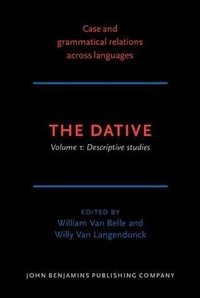
The Dative
Volume 1: Descriptive studies
1st Edition
Published on 20. March 1996
XVIII, 455 pages
978-90-272-8474-7 (ISBN)
Description

Since antiquity, scholars have been fascinated by the phenomena of case. The explanation for this fascination is, as Hjelmslev already pointed out over fifty years ago, the fact that he who can unravel the meaning of case-relations, has the key to language structure as a whole.
For over three years, a team of twenty scholars affiliated with the Linguistics Department of Leuven University in Belgium has concentrated on case phenomena in different languages, both Indo- and non-Indo-European. It is the first time that such a large scale investigation into case has been undertaken. Noteworthy is also its reliance on computer-stored corpora of authentic material.
The results are published as a series (Case and Grammatical Relations across Languages) of which the first volume, a bibliography, appeared in 1994.
The first volume on the dative case contains 13 articles, each of which gives a detailed syntactic-semantic description of the dative or its counterparts in a particular language. In addition to the lexico-syntactic frames in which they occur, a number of textual and extra-linguistic factors are taken into account. Languages investigated are English (K. Davidse), German (L. Draye), Dutch (W. Van Belle & W. Van Langendonck), Afrikaans (L.G. de Stadler), Latin (W. Van Hoecke), French (L. Melis), Spanish (N. Delbecque & B. Lamiroy), Portuguese (R. de Andrade), Polish (B. Rudzka-Ostyn), Hungarian (G. Tóth), Pashto (W. Skalmowski), Hebrew (P. Swiggers) and Orizaba Nahuatl (D. Tuggy).
For over three years, a team of twenty scholars affiliated with the Linguistics Department of Leuven University in Belgium has concentrated on case phenomena in different languages, both Indo- and non-Indo-European. It is the first time that such a large scale investigation into case has been undertaken. Noteworthy is also its reliance on computer-stored corpora of authentic material.
The results are published as a series (Case and Grammatical Relations across Languages) of which the first volume, a bibliography, appeared in 1994.
The first volume on the dative case contains 13 articles, each of which gives a detailed syntactic-semantic description of the dative or its counterparts in a particular language. In addition to the lexico-syntactic frames in which they occur, a number of textual and extra-linguistic factors are taken into account. Languages investigated are English (K. Davidse), German (L. Draye), Dutch (W. Van Belle & W. Van Langendonck), Afrikaans (L.G. de Stadler), Latin (W. Van Hoecke), French (L. Melis), Spanish (N. Delbecque & B. Lamiroy), Portuguese (R. de Andrade), Polish (B. Rudzka-Ostyn), Hungarian (G. Tóth), Pashto (W. Skalmowski), Hebrew (P. Swiggers) and Orizaba Nahuatl (D. Tuggy).
More details
Other editions
Additional editions
Book
03/1996
John Benjamins Publishing Co
€159.00
Shipment within 10-15 days
Persons
Content
- THE DATIVE
- Editorial page
- Title page
- Copyright page
- Table of contents
- List of abbreviations
- Introduction
- Part I: Romance languages
- Part II: Germanic languages
- Part III: Unrelated languages
- Conclusion
- REFERENCES
- PART I: ROMANCE LANGUAGES
- The Latin dative
- 1. Formal aspects
- 2. Traditional descriptions of the uses of the dative
- 3. Constructions competing with the dative
- 4. Conclusions
- NOTES
- REFERENCES
- The dative in Modern French
- 1. Three-term constructions
- 2. Two-term constructions
- 3. Extensions of the attributive datives
- 4. An interpretation of the dative clitic
- 5. From dative clitics to nominal datives
- NOTES
- REFERENCES
- Towards a typology of the Spanish dative
- 1. Introduction
- 2. a NP: prepositional accusative vs dative
- 3. Clitics
- 4. Typology
- NOTES
- REFERENCES
- The Portuguese dative
- 1. Introduction
- 2. The form of the dative NP
- 3. Typology
- 4. Conclusion: a tentative hierarchy
- NOTES
- REFERENCES
- PART II: GERMANIC LANGUAGES
- The German dative
- 1. Morphological aspects
- 2. Syntactic aspects
- 3. Semantic aspects
- REFERENCES
- The indirect object in Dutch
- 1. Introduction
- 2. Syntactic definition of the IO
- 3. Semantic analysis and typology
- 4. Conclusion
- NOTES
- REFERENCES
- The indirect object in Afrikaans
- 1. Introduction
- 2. The IO in Afrikaans: syntactic-semantic description
- 3. Predicate types and the polysemic network of the IO
- 4. Conclusion
- Acknowledgement
- REFERENCES
- Functional dimensions of the dative in English
- Introduction
- 1. The 'identifying' dimension
- 2. The implicative dimension
- Conclusion
- Appendix: Exemplificatory application of the description tocorpus data
- Data Sources
- NOTES
- REFERENCES
- PART III: UNRELATED LANGUAGES
- The Polish dative
- 1. Introduction
- 2. Basic concepts and assumptions
- 3. The Polish dative: form, distribution, meaning
- 4. Conclusions and prospects
- NOTES
- REFERENCES
- Dative counterparts in Pashto
- 1. Basic information on Pashto
- 2. Case
- 3. The ergative construction
- 4. Directional postpositions
- 5. Directional Pronouns
- 6. Dative-like constructions: structural patterns
- 7. Conclusion
- REFERENCES
- Dative-like constructions in Orizaba Nahuatl
- 0. Introduction
- 1. Verbal and clausal arguments
- 2. Subjects and objects
- 3. Verb-stem changing constructions
- 4. Adpositional objects
- 5. Miscellaneous and unusual "dative" structures
- 6. Summary
- NOTES
- REFERENCES
- Subject index
