

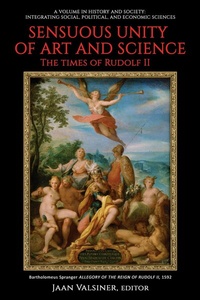
Sensuous Unity of Art and Science
The Times of Rudolf II
1st Edition
Published on 1. February 2023
195 pages
979-8-88730-162-4 (ISBN)
Description

The goal of this book is to locate the birth pangs of psychology-the study of the psyche-in in the Renaissance unity of art and science. The historical period 1583-1611 in Prague was a particularly productive for all Europe in its intellectual advancements in art and science. It was facilitated by the special personality of the Holy Roman Emperor Rudolf II who during his reign made Prague the capital of the Empire where the major artists, scientists, architects and alchemists came together in the service of the Emperor and formed a unique context of interdisciplinary synthesis of ideas that enhanced European philosophies, sciences, and arts in the following centuries. While the history of art in and astronomy in the Rudolfine era has been amply covered, the impacts of the intellectual atmosphere of the era on psychology, philosophy, social ideologies, and aesthetics has remained scarcely investigated. The volume includes analyses of history of ideas in psychology, sociology and other social sciences that received the impetus of the political situation of Rudolfine Prague with religious tolerance and decline of the political power of the Holy Roman Empire.
More details
Other editions
Additional editions
Book
02/2023
Information Age Publishing
€62.50
Shipment within 10-20 days
Content
- Cover
- Sensuous Unity of Art and Science: The Times of Rudolf II
- Series
- Sensuous Unity of Art and Science: The Times of Rudolf II
- Copyright
- Contents
- Series Editors Preface
- Introduction: Sensuality of Generalized Knowledge
- NOTE
- I. THE HISTORICAL BACKGROUND: RUDOLFINE PRAGUE AS AN OASIS OF ART AND SCIENCE
- 1. The Political Cradle for Rudolf II: Tensions in the Holy Roman Empire
- EUROPE IN THE SECOND HALF OF THE 16th CENTURY
- The Social Structure of the Governance
- The Augsburg Settlement: Leading to Decades of Uneasy Truce
- The Long Turkish War: Success by Avoidance
- The Beginning of the End: Habsburgs's Power Struggle Inside the Family Clan
- CONCLUSION: OPENING AND CLOSING OF THE POLITICAL LANDSCAPE AS A CHANCE FOR ARTS AND SCIENCES
- REFERENCES
- NOTES
- 2. The Union of the Opposites: Rabbi Loew, The Maharal of Prague
- A GOLDEN AGE
- THE MAHARAL OF PRAGUE
- THINKING WITH THE MAHARAL
- A Dynamic View: Process, Creativity, and History
- The Union of the Opposites
- Horizontal Axis: Ethics and Plurality
- Vertical Axis-Knowledge as Process
- The Diagonal-Being Engaged in Dialogue
- THE GOLEM
- THE GENERATIVITY OF THE MAHARAL'S IDEAS
- ACKNOWLEDGMENT
- REFERENCES
- NOTES
- II. THE LIMINAL ZONE: ART, ALCHEMY, AND SCIENCE INTERTWINED
- 3. Art and Political Power in Dialogue: The Emperor's Choice
- How Could Rudolf II Emerge?
- Back to Vienna: Quick Upward Mobility
- The Last Decades of the 16th Century: Golden Era for Arts and Sciences
- The Basic Ambivalence: Fear of the Other Gender
- THE FUNCTION OF ALLEGORIES: MAKING OF THE HYPER-GENERALIZED ATMOSPHERES
- UNIFYING OPPOSITES: BLENDING HERMES AND ATHENA
- THE EXTENDED EYES OF THE EMPEROR: COURT ARTISTS AS INFORMANTS
- Emperor's Endgame
- CONCLUSION: CREATIVITY IN ARTS AND SCIENCE AS RESULTING FROM HYPER-GENERALIZED AMBIVALENCES
- REFERENCES
- NOTES
- 4. Harmony of the World and the Ambivalence of the Other
- HARMONY AND NON-HARMONY UNITED: AMBIVALENCE OF LIVING
- THE POWER OF WOMEN: REMINDERS OF ROLE REVERSALS
- CONCLUSIONS: THE EROTIC HARMONY OF THE WORLD THAT DID NOT STAY
- REFERENCES
- NOTES
- 5. The Development of Psychological Polyphony in the Liminal Area of the Rudolfine Court: The Case of Kepler's Music of the Spheres and Maier's Atalanta Fugiens
- The Cultural Context at the Court of Emperor Rudolf II and the Prominence of Ancient Esoteric Traditions
- The Music of the Spheres of Pythagoras and the Innovative Contribution of Johannes Kepler
- Primacy of Geometry
- The Symbolic and Polyphonic Composition of Michael Maier's Atalanta Fugiens
- Final Discussions and Semiotic Considerations
- REFERENCES
- NOTES
- 6. Creating Glory Out of Miseries: Anatomy of the Making of Visual Allegories
- BUILDING THE GLORY: ALLEGORIES OF DIVINE SUPPORT
- Depicting the Declaration of the Long War: The Constantinople Encounter
- The Battle of Mezokeresztes: From Confusion to Glory
- The Battle of Goroszló (Guruslau in Romanian)
- SEMIOTIC CONSTRUCTION OF ALLEGORICAL HYPER-GENERALIZATION
- REFERENCES
- NOTES
- IV. GROWTH OF IDEAS
- 7. The Emerging Science: Art and Astronomy in the Making of a Gendered "Knowledge Society"
- Tensions For Sciences: Innovations Within Harmony
- Observing the World, Assuming Creation
- The Male Astronomers and the Femininity of the Celestial Goddesses
- IMAGINATIVE INVESTIGATION INTO NATURE
- Intuitive Realism: Rudolfian Solution for Unity of Art and Science
- CONCLUSION: POESIS OF EINFÜHLUNG AS A KEY TO SCIENCE
- REFERENCES
- NOTES
- 8. Let a Hundred Flowers Blossom: The Intellectual Atmosphere Around the Rise of Psychology in the 16th Century
- The First Use of the Term Psychology
- Not Aristotle, but Plato
- The Activities at the Court of Rudolph II
- Tycho Brahe and Johannes Kepler
- Kepler's Discoveries and Psychological Factors
- Johann Crato von Kraftheim
- Traces of Psychology at the Court of Rudolph II
- Conclusions
- REFERENCES
- NOTE
- 9. Between Art and Infinity: Principles of Geometric Generalization
- GENERALIZATION: THE IMPORTANCE OF ABSTRACTIVE LOSS
- Qualitative Generalization on a Geometric Basis
- Learning From the Frame: Extending the Whole
- Principles of Geometric Generalization: Bounded Extension of Contexts
- GENERAL CONCLUSION: TO UNDERSTAND IS TO GENERALIZE
- REFERENCES
- NOTES
- General Conclusion: The Decline of the Empire and Freedom Through Art
- The Ascent and Decline of the Social Order: Where Intellectual Oases Are Made
- Continuity and Break of Principles
- Art as Freedom
- Freedom as Art
- REFERENCES
- NOTES
- About the Authors
- EDITOR
- AUTHORS
