

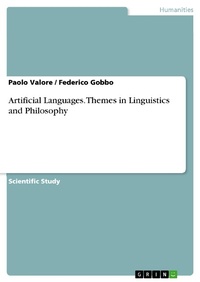
Artificial Languages
Themes in Linguistics and Philosophy
1st Edition
Published on 21. June 2010
146 pages
978-3-640-64599-2 (ISBN)
Description

Scientific Study from the year 2010 in the subject Philosophy - Theoretical (Realisation, Science, Logic, Language), Università degli Studi di Milano (Dipartimento di Filosofia), course: philosophy of language, language: Italian, abstract: The collection aims at proposing a contribution to the academic discussion of themes related to planned and artificial languages, including both logical-linguistical analyses of morphosyntactical structures and lexicon generation, as well as from a thought-historical perspective, focusing on their underlying epistemological and ontological assumptions.
The collection is opened by the mainly philosophical contribution by Paolo Valore. It's a known fact that planning an artificial language means that, also and mainly, in a laboratory for abstract research. In its "pseudo-manifesto", Paolo Valore starts from another perspective, completely personal, arguing that abstract research, when it's not only descriptive, consists, also and mainly, in the creation of artificial languages. Valore briefly explains his argument through the example of translating the ordinary language in an artificial logic language fit for ontological research.
Wim Jansen gives a slightly update version of his invited talk, which he had the 4th of September 2009 while he became
special professor of Interlinguistics and Esperanto Studies at the University of Amsterdam, clarifying the Esperanto project, its spontaneous evolution as a sign of liveness and the meaning of "artificiality" of this language.
Federico Gobbo treats interlinguistics as a science which can be related to the philosophical and scientific research of Leibniz. Gobbo shows how the research direction in mathematization of the linguistic knowledge has an important cognitive value which became explicit through the formalism of adpositional grammars.
Following Alan Reed Libert, it is possible to classify artificial and natural languages under three types, depending on the form of comparative adjectives. Artificial languages can form comparatives using only synthetic forms, only analytic forms, or both depending on cases. Artificial languages which use only synthetic strategies can be further classified by the rules for choosing one or the other strategy. There is some evidence of the fact that mostly artificial languages have both analytic and synthetic comparatives, as some natural languages. The formation of comparatives is an interesting area of morphology, in which it is possible to choose, even in the case of artificial languages.
More details
Other editions
Additional editions
Paolo Valore | Federico Gobbo
Artificial Languages. Themes in Linguistics and Philosophy
Book
06/2010
4th Edition
Grin Verlag
€47.95
Shipment within 7-9 days
