

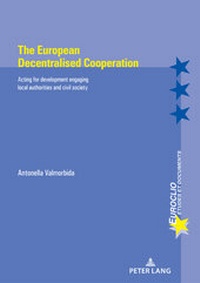
The European Decentralised Cooperation
Description

The local dimension is not considered any longer the final part of a top down long chain of processes bringing democracy and wealth but rather an essential and founding part of it. This publication gives a significant and unique overview on the processes of decentralised cooperation and the ways in which it impacts and engages communities in the European Union and the rest of the world. The publication is mainly focusing on the neighbouring countries of Europe as well those engaged in process of accession to the EU. Decentralised cooperation is an instrument with an important and evidenced added value to be further strengthened and empowered.
The compelling narrative develops a comprehensive perspective on the processes of Decentralisation and development through cooperation between local authorities and civil society based on thorough research on legislative, extensive work in the field as well as good practices from relevant countries in Europe and its Neighbourhood.
More details
Other editions
Additional editions
Person
Antonella Valmorbida is a senior expert on local governance and participative democracy at the local level. She developed and leads ALDA, the European Association for Local Democracy, since its creation in 1999. She is among the key experts in Europe that promote and implement programmes of participative democracy, local democracy and development. She has been engaged in South Eastern Europe and Eastern Europe since 1996. She manages a team of over 30 people and more, consultants and a network of 14 Local Democracy Agencies.
She is the Secretary General of ALDA, the European Association for Local Democracy, President of EPD (European Partnership for Democracy), coordinator of the Subgroup on Local Government and Public Administration Reform of the Civil Society Forum for the Eastern Partnership. She is also involved in Concord, the European NGO Confederation for Relief and Development.
Content
- Cover
- Author's Notes
- Table of Contents
- Chapter 1. The objectives of the book
- Chapter 2. Recommendations to unlock the potential of decentralised cooperation
- Chapter 3. Today's difficulties & opportunities of decentralised cooperation in Europe
- Chapter 4. System of European Decentralised cooperation: introduction and frame - comparative approach and objectives
- a. What is decentralised cooperation and why it is important for the enhancement of development policies
- b. Features of decentralised cooperation
- c. Actors of decentralised cooperation
- d. Key terms for understanding decentralised cooperation
- e. Role of EU policies to support decentralised cooperation
- Chapter 5. The actors of decentralised cooperation
- a) Actors for democracy: civil society versus local authorities
- b) Civil Society Organisations
- c) Local (municipal or regional) authorities
- Chapter 6. The role of Local Authorities in DEAR - Development Education and Awareness Raising
- Chapter 7. A Comparative analysis of decentralised cooperation by countries
- 7.1. The French experience: a leading role
- a) A centralised administration, a strong role of municipalities
- b) Decentralised cooperation: a branch of French Foreign Policy
- 7.2. The Spanish experience: a case of decentralisation focusing on the Mediterranean area and South America
- a) Development
- b) More details and elements on the legal basis
- C) Autonomous Community Development Cooperation Agencies
- d) Regional Development Cooperation Funds
- e) Development Cooperation Councils
- f) Challenges and limits of Decentralised Development Cooperation
- 7.3. Italy - regional leadership & community approach
- a) Decentralised cooperation in Italy - practices
- b) Examples and practices of Decentralised Cooperation
- 7.4. Germany, a key European stakeholder
- a) Promotion of the decentralisation process and general goals
- b) Actors involved in German decentralised cooperation
- c) German strategy on government-civil society cooperation in post-2015 development policy
- 7.5. Belgium - two ways of approaching cooperation
- a) Decentralisation in Belgium
- b) General goals of Belgian cooperation, partner countries and the promotion of decentralised cooperation
- c) Relation between Federal government level and regional level concerning decentralised cooperation policies
- d) Actors involved in Belgian decentralised cooperation
- 7.6. The Netherlands
- a) Decentralised Cooperation in the Netherlands
- b) Promotion of the decentralisation process and general goals
- c) Actors involved in the Netherlands' decentralised cooperation
- d) Global Goals Municipality Campaign
- 7.7. The Scandinavian countries and Finland
- Norway
- Denmark
- Finland
- Sweden
- 7.8. The Baltic countries
- Lithuania
- Latvia
- Estonia
- 7.9. Switzerland
- 7.10. The Visegrad group countries
- Poland
- Slovakia
- Czech Republic
- Hungary
- 7.11. United Kingdom and Ireland
- United Kingdom
- Ireland
- 7.12. South East Europe - Bulgaria, Romania, Croatia and Slovenia
- Bulgaria
- Romania
- Croatia
- Slovenia
- Strengthening of the international cooperation of local and regional authorities
- 7.13. Greece, Malta and Cyprus
- Greece
- Malta
- Cyprus
- 7.14. Turkey
- 7.15. Decentralised cooperation: an added value for Eastern Partnership Countries
- 7.16. The potentiality of decentralised cooperation in the Mediterranean area
- Chapter 8. Organisations supporting decentralisation cooperation and global trends
- 8.1. City Diplomacy
- 8.2. The Council of Europe and its Congress of Local and Regional Authorities
- 8.3. Networks of local authorities promoting decentralised cooperation and the international work
- 8.4. Civil Society Networks supporting decentralised cooperation and local governance at the European and global level
- 8.5. The role of decentralised cooperation and local governments' involvement in the implementation of the Sustainable Development Goals
- Role in localising the SDGs - from the tool kits of the UN website
- Chapter 9. Annexes
- 1. P4G - Partnership for Good - interregional cooperation, lead by Lower Silesia, Poland
- 2. "BAKHITA: SCHIO (Italy) - SUDAN"
- 3. New People's relations in the Mediterranean, lead by Region Apulia (Italy)
- 4. Euroregion Neisse - Nisa - Nysa as an example of cross-border cooperation within the European Union
- 5. BioTowns
- 6. Almelo (the Netherlands) - Denizli (Turkey)
- 7. Project FOSEL, Region Puglia
- 8. Teleorman Water Project, Flood Risk Management Pilot Project - Dutch - Romanian project
- Bibliography
