

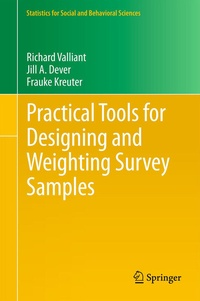
Practical Tools for Designing and Weighting Survey Samples
Description

Survey sampling is fundamentally an applied field. The goal in this book is to put an array of tools at the fingertips of practitioners by explaining approaches long used by survey statisticians, illustrating how existing software can be used to solve survey problems, and developing some specialized software where needed. This book serves at least three audiences: (1) Students seeking a more in-depth understanding of applied sampling either through a second semester-long course or by way of a supplementary reference; (2) Survey statisticians searching for practical guidance on how to apply concepts learned in theoretical or applied sampling courses; and (3) Social scientists and other survey practitioners who desire insight into the statistical thinking and steps taken to design, select, and weight random survey samples.
Several survey data sets are used to illustrate how to design samples, to make estimates from complex surveys for use in optimizing the sample allocation, and to calculate weights. Realistic survey projects are used to demonstrate the challenges and provide a context for the solutions. The book covers several topics that either are not included or are dealt with in a limited way in other texts. These areas include: sample size computations for multistage designs; power calculations related to surveys; mathematical programming for sample allocation in a multi-criteria optimization setting; nuts and bolts of area probability sampling; multiphase designs; quality control of survey operations; and statistical software for survey sampling and estimation. An associated R package, PracTools, contains a number of specialized functions for sample size and other calculations. The data sets used in the book are also available in PracTools, so that the reader may replicate the examples or perform further analyses.
Reviews / Votes
"The monograph gives an all-steps guidance on practical survey sampling implementation. . All described techniques are accompanied by R, SAS, and other code examples throughout the whole book, so they can be easily implemented by readers in their research. The R codes and datasets are also given in the R package PracTools available online." (Stan Lipovetsky, Technometrics, Vol. 59 (1), February, 2017)
"The book is very helpful for researchers, practitioners and all people designing a survey in practice . . The parts at the planning stage of a survey and the important quality control steps are often not mentioned in other textbooks. The abundance of examples helps the reader to understand the whole process. Thus, I can highly recommend this book." (Siegfried Gabler, Mda Methods, data, analyses, Vol. 9 (1), 2015)
"This is an invaluable reference to the design, implementation, data processing (including weight adjustments), and analysis of population surveys, and quality control and documentation of these processes. The book has a distinctly practical orientation, combining theory and textbook-like material with examples from . population surveys and advice and insight that usually cannot be found in the literature. It extensively uses R packages, SAS macros, and other software. Most chapters are concluded with exercises." (Nicholas T. Longford, Mathematical Reviews, April, 2014)
"The book is aimed at providing practical aspects of applying sampling and weighting approaches in surveys. It addresses to students as well as to survey and social scientists with basic knowledge of sampling methods. . supportive exercises are provided in each chapter with solutions given in the appendix." (Iris Burkholder, zbMATH, Vol. 1282, 2014)
More details
Other editions
Additional editions
Persons
Richard Valliant is a Research Professor at the Institute for Social Research of the University of Michigan and at the Joint Program in Survey Methodology at the University of Maryland. He is a Fellow of the American Statistical Association, an elected member of the International Statistical Institute, and has been an associate editor of the Journal of the American Statistical Association, Journal of Official Statistics, and Survey Methodology.
Jill A. Dever is a Senior Research Statistician at RTI International in Washington, D.C. where she works on a variety of surveys related to health care and education. Her current research interests include software for optimizing complex sample designs, variance estimation using calibrated analysis weights, and methods to evaluate the utility of non-probability sampling.
Frauke Kreuter is an Associate Professor in the Joint Program in Survey Methodology at the University of Maryland, USA; Professor of Statistics at Ludwig-Maximilians-Universität in Munich, Germany; and head of the Statistical Methods Research Department at the Institute for Employment Research (IAB) in Nürnberg, Germany. Currently she is associate editor of the Journal of the Royal Statistical Society, Journal of Official Statistics, Sociological Methods and Research, Survey Research Methods, and the Stata Journal.
