

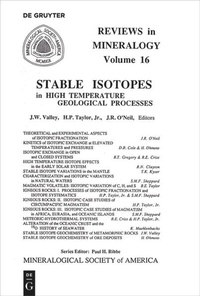
Stable Isotopes in High Temperature Geological Processes
Description

Volume 16 of Reviews in Mineralogy inroduces to high-temperature stable isotope geochemistry and should provide an entry into the pertinent literature, as well as some understanding of the basic concepts and potential applications.
The first three chapters focus on the theory and experimental data base for equilibrium, disequilibrium, and kinetics of stable isotope exchange reactions among geologically important minerals and fluids. The fourth chapter discusses the primordial oxygen isotope variations in the solar system prior to formation of the Earth, along with a discussion of isotopic anomalies in meteorites. The fifth chapter discusses isotopic variations in the Earth's mantle and the sixth chapter reviews the variations in the isotopic compositions of natural waters on our planet. In Chapters 7, 8, 9 and 10, these isotopic constraints and concepts are applied to various facets of the origin and evolution of igneous rocks, bringing in much material on radiogenic isotopes as well, because these problems require a multi-dimensional attack for their solution. In Chapters 11 and 12, the problems of hydrothermal alteration by meteoric waters and ocean water are considered, together with discussions of the physics and chemistry of hydrothermal systems and the 18O/16O history of ocean water. Finally, in Chapters 13 and 14, these concepts are applied to problems of metamorphic petrology and ore deposits, particularly with respect to the origins of the fluids involved in those processes.
More details
Other editions
Additional editions
Persons
John W. Valley , Univ. of Wisconsin; Hugh P. Taylor, Jr. , California Institute of Technology and James R. O'Neil , USGS, California, USA.
Content
- Intro
- COPYRIGHT
- ADDITIONAL COPES
- FOREWORD
- DEDICATION
- PREFACE
- TABLE of CONTENTS
- Chapter 1. THEORETICAL and EXPERIMENTAL ASPECTS of ISOTOPIC FRACTIONATION
- Chapter 2. KINETICS of ISOTOPIC EXCHANGE at ELEVATED TEMPERATURES and PRESSURES
- Chapter 3. ISOTOPIC EXCHANGE in OPEN and CLOSED SYSTEMS
- Chapter 4. HIGH TEMPERATURE ISOTOPE EFFECTS in the EARLY SOLAR SYSTEM
- Chapter 5. STABLE ISOTOPE VARIATIONS in the MANTLE
- Chapter 6. CHARACTERIZATION and ISOTOPIC VARIATIONS in NATURAL WATERS
- Chapter 7. MAGMATIC VOLATILES: ISOTOPIC VARIATION of C, H, and S
- Chapter 8. IGNEOUS ROCKS: I. PROCESSES of ISOTOPIC FRACTIONATION and ISOTOPE SYSTEMATICS
- Chapter 9. IGNEOUS ROCKS: II. ISOTOPIC CASE STUDIES of CIRCUMPACIFIC MAGMATISM
- Chapter 10. IGNEOUS ROCKS: III. ISOTOPIC CASE STUDIES of MAGMATISM in AFRICA, EURASIA and OCEANIC ISLANDS
- Chapter 11. METEORIC -HYDROTHERMAL SYSTEMS
- Chapter 12. ALTERATION of the OCEANIC CRUST and the ⊃&18&/sup&O HISTORY of SEAWATER
- Chapter 13. STABLE ISOTOPE GEOCHEMISTRY of METAMORPHIC ROCKS
- Chapter 14. STABLE ISOTOPE GEOCHEMISTRY of ORE DEPOSITS
- Appendix: TERMINOLOGY and STANDARDS
