

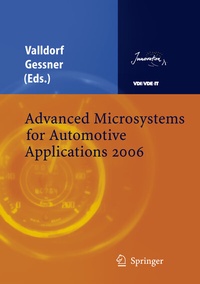
Advanced Microsystems for Automotive Applications 2006
Description

Looking back 10 years when the International Forum on Advanced Microsystems for Automotive Application (AMAA) started, enormous progress has been made in reducing casualties, emissions and in increasing comfort and performance. Microsystems in many cases provided the key functions for this progress. Although the issues the event concentrated on didn't change significantly (safety, powertrain, comfort, etc.), considerable shifts of technological paradigms and approaches can be stated.
The future of microsystems will consist of integrated smart systems which are able to diagnose a situation, to describe and to qualify it. They will be able to identify and mutually address each other. They will be predictive and therefore they will be able to decide and help to decide. Smart systems will enable the automobile to interact with the environment, they will perform multiple tasks and assist a variety of activities. Smart systems will be highly reliable, often networked and energy autonomous.
There is a coincidence of the AMAA objectives and those of EPoSS, the European Technology Platform on Smart Systems Integration, contributing intensively to the development of automotive-specific smart systems. You will find a series of the EPoSS items in the programme of the 10th AMAA, which continues to be a unique exchange forum for companies in the automotive value chain.
The publication in hand also reflects these issues. It is a cut-out of new technological priorities in the area of microsystems-based smart devices and opens up a mid-term perspective of future smart systems applications in automobiles.
Additional information is available on www.amaa.de
More details
Other editions
Additional editions
Content
3 Review of Mid-Term Results (p. 383-384)
After about 2 years of work, the project is in the middle of its most intense development and experimental phase. The present chapter provides an overview of the results achieved to date. Naturally, due to the limited space, only general descriptions can be provided here. However, references are provided to sources where more detailed information can be obtained, in particular the AIDE deliverables most of which are available on www.aide-eu.org (where also summaries of the confidential deliverables can be found).
3.1 Sub Project 1: Behavioural Effects of Driving Support Systems and Driver- Vehicle-Environment Modelling
The main goal of SP1 is to develop a detailed understanding about the mechanisms that govern the interaction between the driver, the vehicle (in particular with IVIS and ADAS) and the environment, to be embodied in testable models as well as a computer simulations. The model development is supported by empirical studies on behavioural effects of different types of support systems. Below, the main results to achieved so far are reviewed.
3.1.1 Driver-Vehicle-Environment Modeling and Simulation
The main expected result from this activity is a testable model of the DVE, implemented in a computer simulation, which can be used to investigate potential behavioural effects early in the design process. The results of this work is also an important input to the DVE monitoring module development in SP3 (see section 3.3.6). The development of the AIDE DVE model is an iterative, incremental procedure which is based on data collected in the AIDE empirical studies on behavioural effects of driver support systems (see next section) as well existing results in the literature. The basic requirements on the model and a preliminary model structure were outlined in Cacciabue et al., [3].
The modelling is based on the general SHELL architecture [4], which is a suitable framework for representing interactions between humans and other elements in the working environment such as support systems and other humans. A major focus so far has been on the identification of the key parameters of the model. At the current stage of development, the following parameters have been identified: (1) Attitudes/personality, (2) experience/competence, (3) task demand, (4) driver state, (5) situation awareness and (6) driver intention/goals. For each parameter, the correlation to measurable variables and other parameters are investigated. The results are documented in Cacciabue et al. [5]. (It could be noted that these parameters correspond roughly to the output vector of the DVE monitoring modules developed in SP3 – see below)
Moreover, a first high-level specification of the simulation software architecture has been developed. The DVE simulation architecture is intended as a generic tool where different types of driver, environment and vehicle models could be implemented and tested. For a further description of the initial DVE simulation specification, see Carusi [6].
